Ovis aries musimon (Pallas, 1811)

English Mouflon Status LU: established. 1st record: 1905.
Lëtzebuergesch Mouflon[ref name=”DFL”]Derrmann-Loutsch, L., 2006. Dictionnaire Français-luxembourgeois. Luxembourg: Éd. Saint-Paul. 606 S. ISBN 978-2-87963-634-4[/ref], Muffel(-schof) Status Eur.: established.
Français Mouflon RA: ISEIA: C2. Harmonia+: n/a.
Deutsch Mufflon Wikipedia: Wikipedia - English - Mouflon Wikipedia - Français - Mouflon Wikipedia - Deutsch - Mufflon Wikipedia - Nederlands - Moeflon | Wikispecies: Wikispecies - Ovis aries | CABI
Nederlands Moeflon Back to the list of vertebrates

Notes on taxonomy and nomenclature

On February 4, 2020, we changed the title of this page from Ovis ammon (Linnaeus, 1758) to Ovis aries musimon (Pallas, 1811) according to the CABI fact sheet: “Given that it is generally assumed that European mouflons are feral populations of ancient domestic stocks, it is advisable to denominate them taxonomically as Ovis aries (…), subspecies musimon, which is the name used in this datasheet, following ITIS (2016)” (CABI 2016). For more details read the detailed “Notes on Taxonomy and Nomenclature” in the CABI fact sheet (CABI 2016).

The distribution of the species at GBIF is split due to the use of several synonyms, e.g. Ovis ammon (Linnaeus, 1758) (GBIF 2020a) and Ovis aries musimon (Pallas, 1811) (GBIF 2020b).

Other scientific names in use in Luxembourg

  • Ovis ammon (Linnaeus, 1758) [used in: Ries et al. 2014; Schley & Herr 2019]
  • Ovis ammon musimon (Pallas, 1811) [used in: Massard & Kintziger 1994]

Brief description

Eifelpark Gondorf Mufflons

Mouflons in a wildlife park in the Eifel (Rhineland-Palatinate, Germany) in August 2008

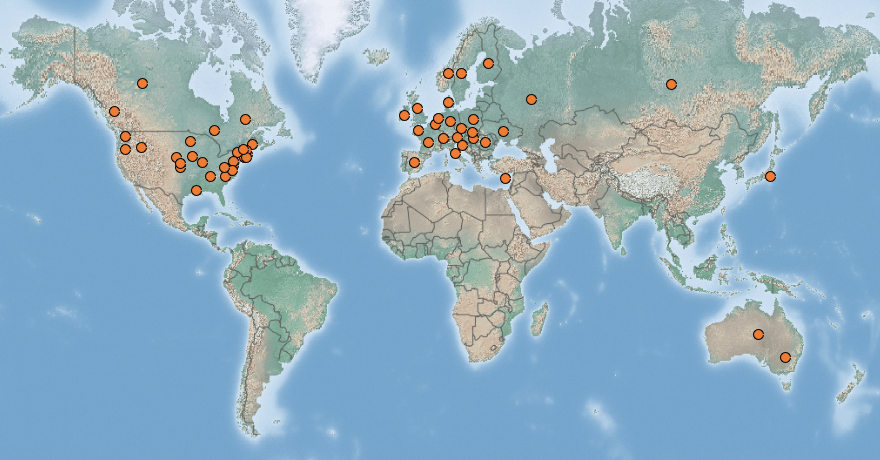
The European mouflon is the westernmost and smallest sub-species of mouflon. It was originally found only on the Mediterranean islands of Corsica and Sardinia, but has since been introduced into many other regions of Europe (Wikipedia contributors 2020).

The European mouflon is a small sheep, particularly compared to its Asian relatives and to some domestic breeds. Sexual dimorphism is present, with males weighing about 30% more than females. Both sexes can exhibit horns, although not all females (and none in the Sardinian population) do. The horns of males can be up to 60 cm long and are curved into a circle. The coat colour is reddish-brown; darker in winter, when males have a black mane with whitish tones on the snout, the ventral area and the distal part of the legs (Asian mouflon from Asia Minor and Iran have more distinct colours). The whitish tones of the face increase with age. The anal white coat is well marked. The tail is black and short. Mouflons have thick skin and wool; the dense winter coat is shed in spring. Males are more robust than females and possess long hair on the neck, chest and front of the forelegs; they also show a characteristic side spot, the “saddle”, of whitish tones, which is much less marked in females (CABI 2019).

The European mouflon is a wild sheep that originates from the Mediterranean islands of Corsica and Sardinia; it is thought to be descended from semidomesticated wild sheep from the Near East brought to Sardinia around 8000 years ago. It has been introduced to many countries in Europe and some elsewhere, mostly as a quarry species for hunting; the extent to which populations have become established or increased varies from country to country. In most countries there is little evidence of serious adverse effects (although there has been little research on the subject), but the mouflon is considered invasive in Hawaii and the Canary Islands, where it has had serious adverse effects on native vegetation (CABI 2019).

As early as the 18th century mouflons were introduced in various regions of Europe (Niethammer 1963 cit. in: Massard & Kintziger 1994: 187).

Health issues of mouflons outside their home range

Mouflon are a longstanding matter of concern in most regions outside their home range. Not well adapted to most of the habitats where they have been released, many animals are suffering from problems with their hooves (foot rot, hoof overgrowth; Piegert & Uloth 2000) (Apollonio et al. 2010).

In the case of the mouflon, NABU North Rhine-Westphalia demands that this non-native species be completely shot down for reasons of nature conservation and animal protection, because the individuals, optimally adapted to life on rocky islands, develop hoof problems as a result of the soft soils prevailing here. Their hooves often grow extremely long and cause considerable pain. They also increase the pressure on the natural growth in the forest. Furthermore, mouflons damage rare biotopes such as rocky heads (NABU, 2020).

Examples from 2 regions:

  • Bavaria: The mouflon is not very well adapted to the living conditions prevailing in Bavaria. Thus, the animals often suffer from serious claw diseases on the softer soils in our country (Wildtierportal Bayern 2020).
  • Switzerland: The free mouflon lives in forested areas, from the lowlands to the mountains. It needs hard and stony soils to grind down its fast growing hooves. In the wildlife park this is made possible by stone fields, as otherwise deformities and infections can develop (Wildpark Mühletäli 2020).

Status and distribution in Luxembourg

Records of Ovis ammon Linnaeus, 1758 in Luxembourg. Data source: Recorder-Lux, iNaturalist & GBIF, 2026-09-21.

Currently, mouflons are present in three areas of Luxembourg: the Our valley, the northern Upper Sûre area and around Heffingen/Echternach (Massard & Kintziger 1994; Schley & Herr 2019: 34).

A former population in the Meysembourg area is extinct (Lux 2005). The grand ducal compound (“Gatter”) at Grünewald near Imbringen was opened to the public in 2009 (SPC 2020).

A male mouflon was run over near the animal park “Escher Déierepark” at Gaalgebierg in Esch-sur-Alzette in 2012 (MNHNL 2000-), it can be assumed it was an escaped animal.

The mouflon in the regions of Luxembourg

Grand ducal compound at Grünewald (1905-2009)

Since 1905 mouflons were kept in the grand ducal compound in Grünewald near Imbringen, municipality of Junglinster (Massard & Kintziger 1994). Several animals have been introduced in 1905 from a game park near Wiesbaden, Germany (Massard & Kintziger 1994: 188; Lux 2005). According to Decker (1979), a second batch of mouflons entered Luxembourg in 1921: six animals from Het Loo (NL) (cit. in: Massard & Kintziger 1994: 188). In 1953, most of the grand ducal mouflons were sold (e.g. to Spain), but at the same time a few other mouflons were imported from the enclosure of the Duke of Bavaria (Decker 1979).

The cited sources don’t mention if this population still existed in the 1990ies. The grand ducal compound in Grünewald (nicknamed “Gatter”) was opened to the public on 9 April 2009, following the agreement of 16 January 2009 between the Luxembourg State and the grand ducal administration (SPC 2009).

Upper Sauer region (1970-)

In 1968, on the proposal of the High Council for Hunting, the Minister of the Interior instructed the Water and Forestry Administration to prepare the introduction of mouflons into the Luxembourg natural environment in the Kaundorf region. In 1970, 14 animals were released into the natural environment near Kaundorf. Since then, and until the beginning of the 1990s, the population has been steadily increasing due to the rather restricted shooting plan: the population numbers about 200 animals and has proliferated over an area of about 9,000 ha. In 1994, in view of the poor health situation of the herd and the numerous damages caused to the forest, the mouflon hunt was widely opened and the shooting plan was abolished. In the 2000s, the population stabilizes at about 60 individuals (spring counting) (Lux 2005).

In 1992, the population was estimated at 100-120 animals living in the area around the barrier lake of the Upper Sauer (Massard & Kintziger 1994).

Our valley near Hosingen (1970-)

The mouflon population around Hosingen originates from the former wildlife park “Wildpark Hosingen”, which existed between 1970 and 1984 and where deer, wild boars, fallow deer, mouflons, mountain goats and indigenous bird species were introduced to visitors in enclosures on an area of around 150 hectares (SISPOLO 2015).

The park had financial problems from 1983 (Lux 2005) and shut down in 1984. This was followed by the escape of some of the animals (fallow deer and mouflons). In the 2000s, the mouflon population numbers about 30 individuals (spring counting) (Lux 2005).

Meysembourg aera (1972-1993)

A mouflon enclosure was established in Meysembourg in 1972. Shortly afterwards, several animals fled and settled in the Christnach/Heffingen region. In the 1980s, the population numbered about 100 animals. In 1984, severe barking damage was noted, followed by a wide opening for hunting from 1985 onwards. In 1993 the population became extinct (Lux 2005).

Echternach aera (1995-)

As far as the Echternach region is concerned, there is a strong presumption of illegal releases (Lux 2005):

  • In October 1995, first appearance of moufflons in the “Haardt” forest near the lake of Echternach, their origin being unknown (120 animals). In winter 2003/04, the Haard population amounts to ± 160 animals.
  • In October 1996, first appearance of moufflons near the Mélickshaff and in Kalkesbaach near Consdorf, their origin also unknown (20 animals). February 2005: 16 animals.
  • In December 1996, first appearance of moufflons at Seiterhof near Berdorf, also unknown provenance (20 animals). February 2005: 70 animals.

At the end of February 2005, a new population count by the Water and Forestry Administration (before the calving) indicates that the mouflon population in the region before the calving in March 2005 was 264 head. The female sex predominates in the composition of the herds in the Echternach region. Based on observations in recent years, it can be said that the population always increases by one third after giving birth. The population in the Echternach region should therefore have reached the current level of ± 350 animals (Lux 2005).

Schley & Herr (2019: 34) confirm that the mouflon population in the area around Heffingen/Echternach originates from an illegal release. In 2020, there is estimated to be between about 100 (Anonyme 2020) and 200 (Magar 2020, ota 2020) mouflons in that region.

Estimated damages caused by mouflon

The mouflons cause different kinds of damage. For example, the following damage can currently be seen in the Echternach region (Lux 2005):

  • debarking of trees, especially spruce trees;
  • spike grazing in leaf plantations and natural regeneration;
  • damage to agricultural crops;
  • disturbance of native deer by non-native mouflons.

In the summer of 2003, an inventory was carried out in the canton’s forests of Echternach, to determine the debarking damage caused by the mouflons, resulting in a damaged area of 18,79 ha. The damaged species are mainly spruce and Douglas fir, the hardwood species are less affected by debarking. Recently it has also been observed that natural regeneration of beech has been damaged by mouflons (bud browsing) (Lux 2005).

In 2020, in the press, various statements are made about the damage caused by muffled animals:

  • lessentiel.lu: There is estimated to be about 100 mouflons in that region and the damage they cause is estimated at 31.814,77 euros, as well as the prevention of forest regeneration (Anonyme 2020).
  • wort.lu: Yves Wengler (CSV), mayor of Echternach, estimates that the 200 or so mouflons living in the woods of his commune caused damage of 100.000 euros (ota 2020).

Management

Mouflon hunt in Luxembourg

The addition of the administrative hunt to the law on hunting

Note: this chapter is an excerpt of the answer of Lucien Lux (2005) to parliamentary question n°377.

Since the first appearance of mouflons in the region of Echternach in 1995, the administration of Water and Forests has been very concerned about this presence. Since the mouflon is not a native species and there are no other populations of this species in the region, it soon became clear that the population could only be the result of clandestine or even illegal releases, without it having been possible so far to establish who was responsible.

As the sheep population continued to grow, on the initiative of the Minister of the Environment two meetings were held in autumn 2003 with tenants and representatives of the hunting unions in the Echternach region to find a solution to the worrying situation. At these meetings, the final goal was clearly formulated, namely to achieve a “zero” mouflon population within a reasonable period of time (5 years) by means of hunting. To this end, the Water and Forestry Administration had developed various models for reducing the population. The following recommendations were made to hunting tenants: priority should be given to shooting female animals and an attempt should be made to reduce the population by more than half in the first hunting year. This proposal was accepted by the representatives of the unions and the hunters, and voluntary commitments were signed by all hunting tenants.

At the end of winter 2004/05 (March 2005), the Water and Forestry Administration analysed the current situation and drew up an interim assessment of the commitments made by the hunting tenants. It turned out that the situation has not improved at all, but on the contrary has worsened. Although some hunting tenants have made an effort to shoot as many animals as possible, this does not seem to be the case for others. Indeed, recent counts carried out by the Water and Forestry Administration at the end of February 2005 show that the combined effort of all hunting tenants has been absolutely insufficient.

The current hunting legislation does not confer any right of direct intervention by either the Ministry of the Environment or the Water and Forests Administration to reduce a game species once the animals are in a state of natural freedom. The Government is therefore relatively powerless in the face of this situation and must confine itself to recommendations.

This is why the Minister of the Environment recently tabled a bill amending the hunting legislation and including the following point: introduction of the right of initiative for the State with a view to organizing administrative hunting under certain well-defined conditions, alongside the right of initiative of the hunting syndicate, which is to be maintained. The conditions which must be met before the administrative hunting procedure can be initiated are as follows:

  • high concentrations of game, as evidenced by the presence of crop damage;
  • unauthorised releases of animal species, whether or not they are classified as game;
  • control of epizootic diseases.

Legal aspects

The law of 25 May 2011 on hunting (Mémorial 2011) stipulates:

  • Art. 10. Shooting with a bullet is obligatory for the hunting of deer, roe deer, wild boar, mouflon and fallow deer (Mémorial 2011: 1729).
  • Art. 13. The hunting of deer, wild boar, roe deer, fallow deer and mouflon may be subject to a shooting plan. This plan determines the number of animals, distributed according to their species, type, age or sex, which must or may be shot on a given territory during a given period. / A Grand Ducal regulation determines the procedures for drawing up the shooting plan, the species of game covered by it, the duration of the plan and the related control measures (Mémorial 2011: 1729).
  • In the annex to the Act, the ‘mouflon (Ovis musimon)’ is considered to be a species belonging to the wild fauna and classified as ‘large game’ alongside deer (Cervus elaphus), roe deer (Capreolus capreolus), wild boar (Sus scrofa) and fallow deer (Dama dama) (Mémorial 2011: 1741).

Hunting statistics
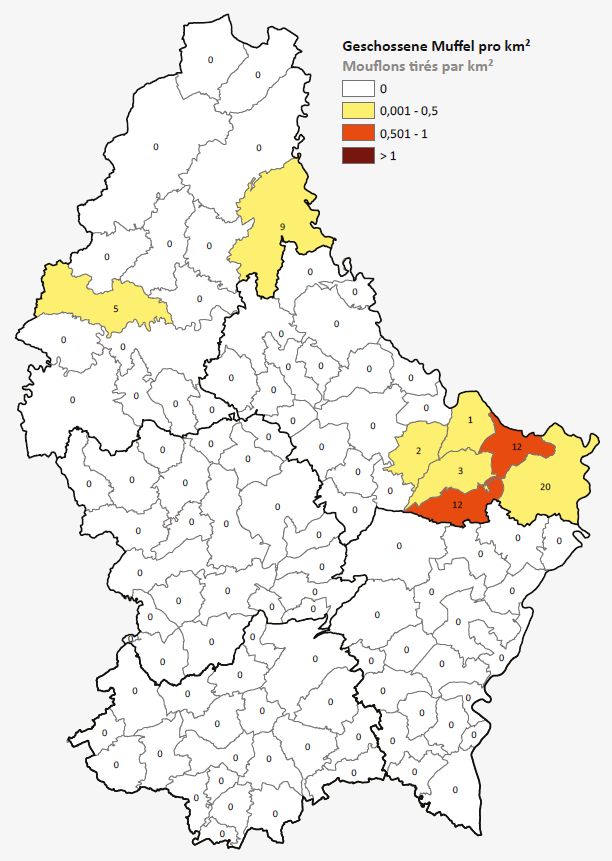
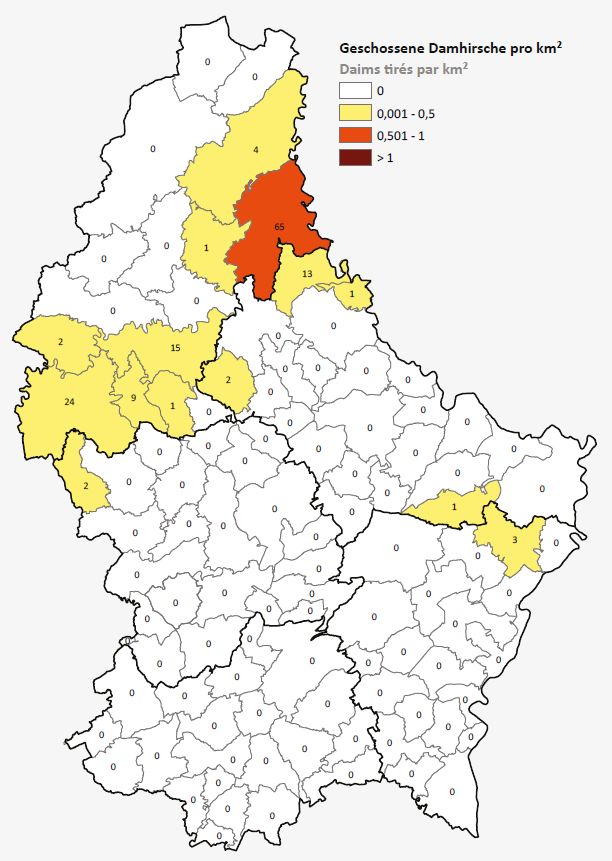
Mouflons shot per km² in the hunting season 2017-2018 (Schley & Celllina 2018: 25)

Hunting statistics show that the number of hunted mouflons has been increasing from around 20 in the late 1980s to over 150 since 2000, with a peak of 250 during the hunting season 2009/2010 (Naturverwaltung 2012). Since then, the number of shot animals decreased to about 75 in 2013/2014 (Naturverwaltung 2014) and stayed at a similar level in the hunting season 2017-2018 (Schley & Celllina 2018: 9). Schley & Herr (2019: 35) state that about 100-150 mouflons are shot in Luxembourg every year.

The geographical distribution of shot mouflons for the hunting year 2017/18 (see map on the right) is in line with the mouflon distribution (see above) based on data from Recorder-Lux, GBIF and iNaturalist (MNHNL, iNaturalist & GBIF 2020).

Administrative hunt in 2020

In February 2020, the Ministry of the Environment planed an administrative hunt for mouflons in the Echternach region which was not carried out yet (2020-03-12)1. End of 2019, the Higher Council for Hunting (Conseil supérieur de la chasse) had given the go-ahead for this hunt (Magar 2020).

The public debate on mouflon in Luxembourg

Parliamentary questions

  1. 2005-03-29: Question écrite n°377 [PDF]. Sujet: Mouflon. Auteur : Monsieur Jos Scheuer, Député. Auteur de la réponse: Monsieur Lucien Lux, Ministre de l’Environnement (Lux 2005) [PDF].
  2. 2006-06-20: Question écrite n°1124 [PDF]. Sujet: Présence du mouflon sur le territoire du Luxembourg. Auteurs: Monsieur Marco Schank, Député; Monsieur Marcel Oberweis, Député; Madame Françoise Hetto-Gaasch, Députée (Hetto-Gaasch et al. 2006). Auteur de la réponse: Monsieur Lucien Lux, Ministre de l’Environnement (Lux 2006) [PDF].
  3. 2019-10-28: Question écrite n°1402 [PDF]. Sujet: Colonies de mouflons. Auteur: Monsieur Marc Goergen, Député (Goergen 2019a). Auteur de la réponse: Madame Carole Dieschbourg, Ministre de l’Environnement, du Climat et du Développement durable (Dieschbourg 2019) [PDF].
  4. 2019-12-18: Question écrite n°1623 [PDF]. Sujet: Colonies de mouflons. Auteur: Monsieur Marc Goergen, Député (Goergen 2019b). Auteur de la réponse: Madame Carole Dieschbourg, Ministre de l’Environnement, du Climat et du Développement durable (Dieschbourg 2020a) [PDF].
  5. 2020-01-22: Question urgente n°1746 [PDF]. Sujet: Chasse au mouflon. Auteur: Monsieur Marc Goergen, Député (Goergen 2020a). Auteur de la réponse: Madame Carole Dieschbourg, Ministre de l’Environnement, du Climat et du Développement durable (Dieschbourg 2020b) [PDF].
  6. 2020-03-02: Question urgente n°1961 [PDF]. Sujet: Chasse aux mouflon. Auteur: Monsieur Marc Goergen, Député (Goergen 2020b). Destinataire: Madame Carole Dieschbourg, Ministre de l’Environnement, du Climat et du Développement durable.

Social media

From the end of February 2020 onwards, the debate surrounding the mouflon hunt was the subject of controversy, hateful debates and excesses on social networks in Luxembourg.

On February 28 2020, the political party “Piratepartei Lëtzebuerg” posted a video on its Facebook account criticising the Minister of the Environment, Climate and Sustainable Development Carole Dieschbourg for her position in the hunt for mouflons (Piratepartei Lëtzebuerg 2020; Pautsch 2020).

Following a series of hateful and threatening comments against her, Carole Dieschbourg announced on 4 March 2020 via her Facebook account to take legal action (Dieschbourg 2020c; Frati 2020).

Risk assessment

ISEIA protocol
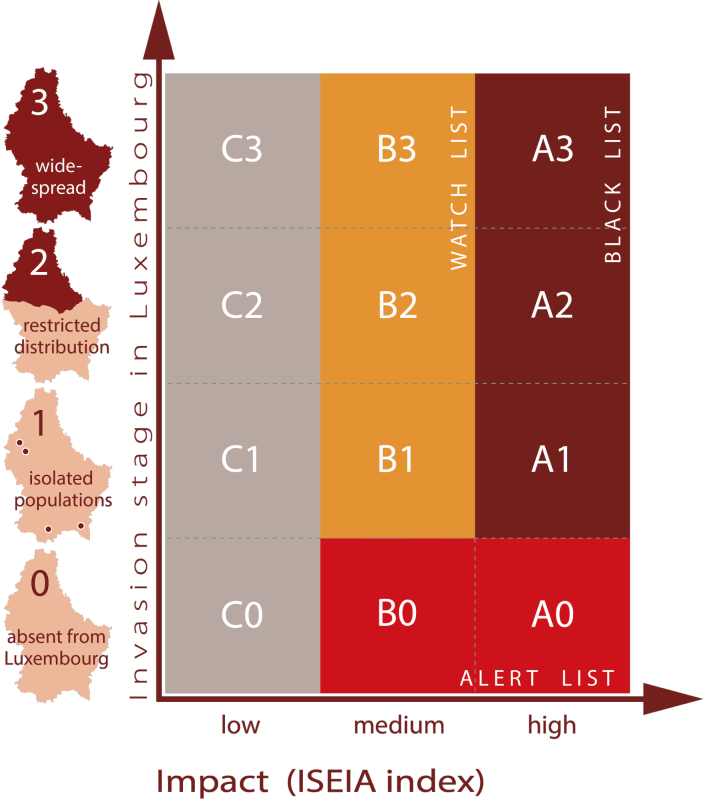
C2 (3+2+1+1) (Ries et al. 2014: 199).

Harmonia+ protocol

Not assessed yet.

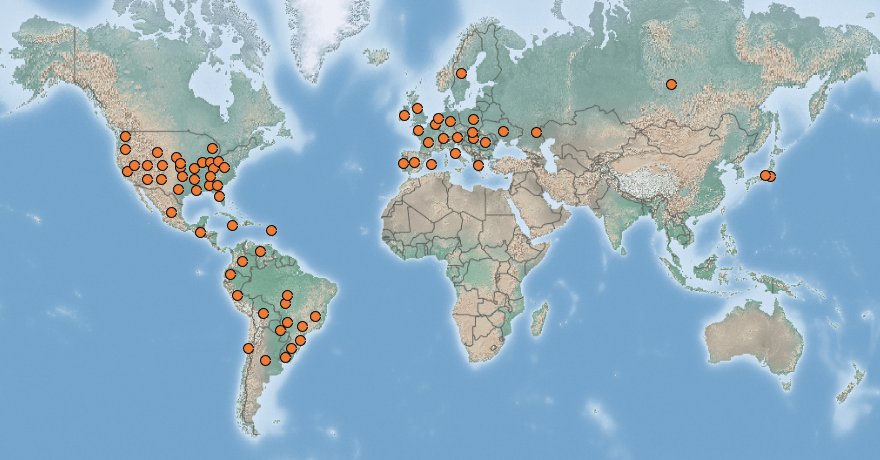
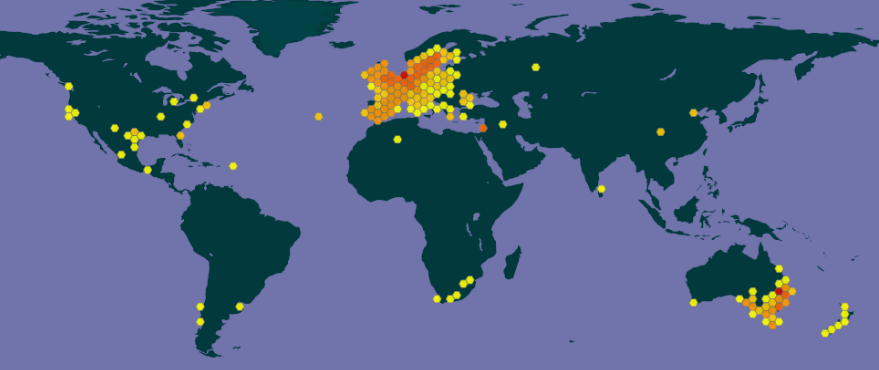
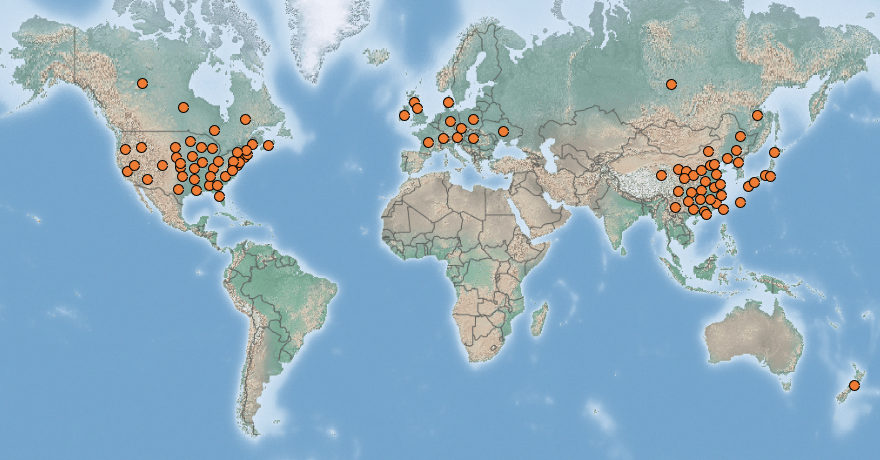
Worldwide distribution

Bibliography

  • Anonyme, 2020. Le Luxembourg veut chasser les mouflons. L’Essentiel, 17 décembre 2019. http://www.lessentiel.lu/fr/luxembourg/story/le-luxembourg-veut-chasser-les-mouflons-18262683
  • Apollonio, M., R. Andersen & R. Putman, 2010. European ungulates and their management in the 21st century. Cambridge University Press, Cambridge, UK ; New York. 604 p.
  • Bingenheimer V., 2018. Eine unangenehme Wahrheit – Trotz massiver Abschüsse vermehren sich die Mufflons im Wald bei Echternach ungebremst. Luxemburger Wort 3. April 2018: 18-19. [PDF 4.3 MB]
  • CABI, 2019. Ovis aries musimon Pallas, 1811 [original text by Jorge Cassinello]. In: Invasive Species Compendium. Wallingford, UK: CAB International. URL: www.cabi.org/isc [accessed 2019-11-22]
  • Decker, P. 1979. Die Einbürgerung von Mufflons in Luxemburg. Direction des eaux et forêts, Rapport non publié, 8 p.
  • Dieschbourg, C., 2019a. Réponse de la Ministre de l’Environnement, du Climat et du Développement durable à question N°1402 de Monsieur Marc Goergen concernant Colonies de mouflons. Q-2019-O-E-1402-02. [chd.lu]
  • Dieschbourg, C., 2020a. Réponse de la Ministre de l’Environnement, du Climat et du Développement durable à question N°1623 de Monsieur Marc Goergen concernant Colonies de mouflons. Q-2019-O-E-1623-02 [chd.lu]
  • Dieschbourg, C., 2020b. Réponse de la Ministre de l’Environnement, du Climat et du Développement durable à question N°1746 de Monsieur Marc Goergen concernant Chasse au mouflon. Q-2019-O-E-1746-02 [chd.lu]
  • Dieschbourg, C., 2020c. Post on Facebook, 2020-03-04, 09:38. URL: https://www.facebook.com/DieschbourgCarole/ [accessed 2020-03-12]
  • Frati, C., 2020. La justice saisie / Carole Dieschbourg ciblée par des messages haineux. paperjam online 2020-03-04. URL: https://paperjam.lu/article/dieschbourg-prend-mouflon-par- [accessed 2020-03-12]
  • GBIF, 2020a. Ovis ammon (Linnaeus, 1758) in GBIF Secretariat (2019). GBIF Backbone Taxonomy. Checklist dataset https://www.gbif.org/species/2441122 [accessed 2020-02-04]
  • GBIF 2020b. Ovis aries subsp. musimon (Pallas, 1811) in GBIF Secretariat (2019). GBIF Backbone Taxonomy. Checklist dataset https://www.gbif.org/species/6165157 [accessed 2020-02-04]
  • Goergen, M., 2019a. Question N°1402 de Monsieur Marc Goergen concernant Colonies de mouflons. Q-2019-O-E-1402-01 [chd.lu]
  • Goergen, M., 2019b. Question N°1623 de Monsieur Marc Goergen concernant Colonies de mouflons. Q-2019-O-E-1623-01 [chd.lu]
  • Goergen, M., 2020a. Question N°1746 de Monsieur Marc Goergen concernant Chasse au mouflon. Q-2019-O-E-1746-01 [chd.lu]
  • Goergen, M., 2020b. Question N°1961 de Monsieur Marc Goergen concernant Chasse aux mouflon. Q-2019-O-E-1961-01 [chd.lu]
  • Hetto-Gaasch, F., M. Oberweis & M. Schank, 2006. Question N° 1124 de Mme Françoise Hetto-Gaasch et M. Marcel Oberweis et M. Marco Schank concernant Présence du mouflon sur le territoire du Luxembourg. Q-2005-O-E-1124-01 [chd.lu]
  • ITIS, 2016. Integrated Taxonomic Information System online database. http://www.itis.gov
  • Lux, L., 2005. Réponse du Ministre de l’Environnement à la question parlementaire no. 377 de Monsieur le député Jos Scheuer. 2005-04-18.
  • Lux, L., 2006. Réponse du Ministre de l’Environnement à la question N° 1124 de Mme Françoise Hetto-Gaasch et M. Marcel Oberweis et M. Marco Schank concernant Présence du mouflon sur le territoire du Luxembourg. Q-2005-O-E-1124-02 [chd.lu]
  • Magar, M., 2020. Une première chasse au mouflon au Luxembourg. L’essentiel 10 janvier 2020. URL http://www.lessentiel.lu/fr/luxembourg/story/une-premiere-chasse-au-mouflon-au-luxembourg-31427844 [accessed 2020-03-06]
  • Massard, J.A. & P. Kintziger, 1994. Le Mouflon (Ovis ammon musimon) au Luxembourg: notes historiques sur son introduction et analyse de la population des mouflons de la région de la Haute-Sûre. Bull. Soc. Nat. luxemb. 95: 187-208. [PDF 1058 KB]
  • Mémorial 2011. Loi du 25 mai 2011 relative à la chasse. Mémorial A, 111: 1727-1741.
  • MNHNL, 2000-. Ovis ammon in Recorder-Lux, database on the natural heritage of the Grand Duchy of Luxembourg. Musée national d’histoire naturelle, Luxembourg. URL: https://mdata.mnhn.lu [Accessed 2020-02-04]
  • MNHNL, iNaturalist & GBIF, 2020. MNHNL-mdata, online portal combining species observation from Recorder-Lux, iNaturalist and GBIF. National Museum of Natural History, Luxembourg. URL: https://mdata.mnhn.lu [Accessed 2020-02-04]
  • NABU, 2020. Das Mufflon. NABU Nordrhein-Westfalen. URL: https://nrw.nabu.de/natur-und-landschaft/landnutzung/jagd/jagdbare-arten/weitere-saeugetiere/06783.html [accessed 2020-03-09]
  • Naturverwaltung (ed.), 2012. Technischer Bericht der Naturverwaltung betreffend Wildtiermanagement und Jagd, Nummer 2 (2012), 68 pp.
  • Naturverwaltung (ed.), 2013. Jagbare Wildtierarten Luxemburgs. 96 pp.
  • Naturverwaltung, 2014. Bulletin technique de l’Administration de la nature et des forêts en matière de gestion de la faune sauvage et de chasse, numéro 3 (2014), 72 pp.
  • Niethammer, G., 1963. Die Einbürgerung von Säugetieren und Vöglen in Europa. Ergebnisse und Aussichten. Hamburg, P. Parey, 319 p.
  • ota, 2020. Carole Dieschbourg menacée de mort. Online article on wort.lu. URL: https://www.wort.lu/fr/luxembourg/carole-dieschbourg-menacee-de-mort-5e60d048da2cc1784e3579c9 [accessed 2020-03-06]
  • Pautsch, M. 2020. Facebook / Carole Dieschbourg schaltet wegen Kommentaren mit Morddrohungen Autoritäten ein. Tageblatt online, 2020-03-05. URL: https://www.tageblatt.lu/headlines/carole-dieschbourg-schaltet-wegen-kommentaren-mit-morddrohungen-justiz-ein/?fbclid=IwAR0L6ONV1fONfskNmxVMZ23VsB9wp-sIpvbXtAEQQi59HegKnS7s5kfy5V8 [accessed 2020-03-12]
  • Piegert, H. & W. Uloth, 2000. Der Europäische Mufflon. Hamburg. 280 p.
  • Pir, J.B. & L. Schley, 2015. Développement des connaissances sur la répartition et l’écologie des mammifères au Luxembourg entre 1990 et 2015. Bull. Soc. Nat. luxemb. 116: 437-455.
  • Piratepartei Lëtzebuerg, 2020. Video on Facebook, 2020-02-28, 22:02. URL: https://www.facebook.com/Piratepartei/videos/2508661829350143/ [accessed 2020-03-12]
  • Ries, C., M. Pfeiffenschneider, Engel, E., J.-C. Heidt & M. Lauff, 2014. Environmental impact assessment and black, watch and alert list classification after the ISEIA Protocol of vertebrates in Luxembourg. Bull. Soc. Nat. luxemb. 115: 195-201. [PDF 247 KB]
  • Scheuer, J., 2005. Question N° 0377 de M. Jos Scheuer concernant Mouflon. Q-2004-O-E-0377-01 [chd.lu]
  • Schley, L. & J. Herr, 2019. Säugetiere Luxemburgs. Hrsg.: natur&ëmwelt a.s.b.l., Ministère du développement durable et des infrastructures, Administration de la nature et des forêts. 219 S. ISBN 978-2-9199511-0-9 [French edition: Les mammifères du Luxembourg, ISBN 978-2-9199511-2-3]
  • Schley, L. & S. Cellina, 2018. Technischer Bericht der Naturverwaltung betreffend Wildtiermanagement und Jagd, Nr. 7, 52 S. Administration de la nature et des forêts, Diekirch. [PDF 13 MB]
  • SISPOLO, 2015. Historischer Überblick der Aktivitäten und der Entstehung des SISPOLO-Syndikats. URL: https://www.sispolo.lu/geschichte-1.html [accessed 2020-03-06]
  • SPC, 2009. Ouverture au public de la forêt du Grünewald. 09-04-2009. Service Presse et Communication. URL: http://www.monarchie.lu/fr/actualites/evenements/2009/04/Grunewald/index.html?highlight=Gr%C3%BCnewald [accessed 2020-03-12]
  • Wildpark Mühletäli, 2020. Mufflon / Europäisches Wildschaf. URL: http://www.wildpark-muehletaeli.ch/tiere-im-park/mufflon/ [accessed 2020-03-09]
  • Wildtierportal Bayern, 2020. Muffelwild. URL: http://www.wildtierportal.bayern.de/wildtiere_bayern/096779/index.php [accessed 2020-03-09]
  • Wikipedia contributors, 2020. ‘European mouflon’, Wikipedia, The Free Encyclopedia, 18 January 2020, 21:49 UTC, <https://en.wikipedia.org/wiki/European_mouflon> [accessed 2020-02-04]

 Page content last updated on 2025-10-22. Last proofread by Caroline Grounds on 2020-02-05.

  1. On 29 February 2020 a private hunt on mouflon took place in the Echternach region.[]

Lemna minuta Humb., Bonpl. et Kunth

English Least duckweed Status LU: casual. 1st record: LU & ITW 2002.
Lëtzebuergesch Klinzeg Intelëns Status Eur.: established. 1st record: FR 1965.1
Français Lentille d’eau minuscule RA: ISEIA: B1, Watch List. Harmonia+: 0,24.
Deutsch Winzige Wasserlinse Wikipedia: Wikipedia - English - Least duckweed Wikipedia - Nederlands - Dwergkroos Deutsch | Wikispecies: Wikispecies - Lemna minuta | CABI
Nederlands Dwergkroos Back to the list of neophytes

Brief description

Lemna minor & minuta PG

Pascale Guinchard, CC BY-SA 4.0, via Wikimedia Commons

Lemna minuta Humb., Bonpl. et Kunth is an aquatic plant that settles in shallow standing or slow-flowing waters, often in shaded conditions. Outbreaks of the species cause dense floating mats at the water surface that reduce light penetration and gas exchanges, causing the predominance of respiratory activities and the reduction in dissolved oxygen in water beneath the mats. As for native duckweed species, outbreaks are usually limited in time and space and are favoured by increased levels of water eutrophication that often cause the disappearance of submerged macrophytes. Waterfowl and Cyprinid fish are known to eat duckweeds to supplement their diet which may help to reduce outbreaks (Branquart et al. 2010).

Status and distribution in Luxembourg

Records of Lemna minuta Humb., Bonpl. et Kunth in Luxembourg. Data source: Recorder-Lux, iNaturalist & GBIF, 2026-09-21.

Lemna minuta Humb., Bonpl. et Kunth was first documented in Mecheren near Remerschen (Municipality of Schengen) close to the bird watch station on 21 June 2015 by Guy Colling and on 29 June 2015 by A. Mesterházy (Krippel & Colling 2016: 39; MNHNL 2000-). It should be noted that the tiny water lens had already been reported for the Remerschen ponds in 2002 by Gérard Schmidt (in litt.), but no herbarium specimens had been taken at that time (Krippel & Colling 2016: 39).
This American aquatic monocotyledon, the smallest species of its kind (Synonym: Lemna minuscula Herter), was discovered in the wild here in 1983 (Lambinon & Verloove 2012: 976). Given its pervasive potential, it was listed on the alert list (Ries et al. 2013).

Risk assessment

ISEIA protocol

B1 (2+3+2+3) = Watch List. Reassessed 16 February 2017 by Yves Krippel and Christian Ries. Assessment before the appearance of the species in Luxembourg: B0 (2+3+2+3) = Alert List (Ries et al. 2013).

Harmonia+ protocol

Overall risk score 0,24 = (Overall Invasion score 0,67 x Overall Impact score 0,35) (Ries et al. 2020).

0,67Invasion
0,35Impact
0,24Risk

Worldwide distribution

Bibliography

  • Branquart, E., I. Stiers, L. Triest, S. Vanderhoeven, W. Van Landuyt, F. Van Rossum & F. Verloove, 2010. Harmonia database: Lemna minuta Humb., Bonpl. et Kunth. Harmonia version 1.2, Belgian Forum on Invasive Species. URL: http://ias.biodiversity.be [accessed on 2019-10-11]
  • CABI, 2021. Lemna minuta. In: Invasive Species Compendium. Wallingford, UK: CAB International. URL: www.cabi.org/isc [accessed 2021-03-04]
  • Krippel, Y. & G. Colling, 2016. Notes floristiques. Observations faites au Luxembourg (2014-2015). Bull. Soc. Nat. luxemb. 118: 27-51. [PDF 1,33 MB]
  • Lambinon J. & F. Verloove, 2012. Nouvelle flore de la Belgique, du grand-duché de Luxembourg, du Nord de la France et des régions voisines. Sixième édition. Avec la collaboration de L. Delvosalle, B. Toussaint, D. Geerinck, I. Hoste, F. Van Rossum, B. Cornier, R. Schumacker, A. Vanderpoorten et H. Vannerom. Jardin botanique national de Belgique, Meise. CXXXIX + 1195 pp. ISBN : 9789072619884.
  • MNHNL, 2000-. Lemna minuta Humb., Bonpl. et Kunth in Recorder-Lux, database on the natural heritage of the Grand Duchy of Luxembourg. Musée national d’histoire naturelle, Luxembourg. URL: https://mdata.mnhn.lu [Accessed 2019-10-11]
  • MNHNL, iNaturalist & GBIF, 2019. Lemna minuta Humb., Bonpl. et Kunth in MNHNL-mdata, online portal combining species observation from Recorder-Lux, iNaturalist and GBIF. National Museum of Natural History, Luxembourg. URL: https://mdata.mnhn.lu [Accessed 2019-10-11]
  • Oly, M., 2022. Kartierung invasiver gebietsfremder Wasserpflanzen im Großherzotum Luxemburg, Untersuchungen zur Verbreitung von invasiven gebietsfremden Wasserpflanzen in einer beispielhaften Auswahl an Stillgewässern, Musée national d’histoire naturelle, Luxembourg. 117 pp. 
  • Ries, C. & Y. Krippel, 2021. First records of 56 invasive alien vascular plants in Luxembourg. Bulletin de la Société des naturalistes luxembourgeois 123: 115-127. [PDF 241 KB]
  • Ries, C., Y. Krippel & M. Pfeiffenschneider, 2020. Risk assessment after the Harmonia+ protocol of invasive alien vascular plant species in Luxembourg. Bull. Soc. Nat. luxemb. 122: 197-205. [PDF 132 KB]
  • Ries, C., Y. Krippel, M. Pfeiffenschneider & S. Schneider, 2013. Environmental impact assessment and black, watch and alert list classification after the ISEIA Protocol of non-native vascular plant species in Luxembourg. Bull. Soc. Nat. luxemb. 114: 15-21. [PDF 652 KB]

 Page content last updated on 2026-09-19. Last proofread by Caroline Grounds on 2019-11-19.

  1. Cf. CABI 2021.[]

Dama dama (Linnaeus, 1758)

English Fallow deer Status LU: established. 1st record: 1977.
Lëtzebuergesch Damhirsch Status Eur.: established.
Français Daim européen RA: ISEIA: B2, Watch List. Harmonia+: n/a.
Deutsch Damhirsch Wikipedia: Wikipedia - English - Fallow deer Wikipedia - Français - Daim européen Wikipedia - Deutsch - Damhirsch Wikipedia - Nederlands - Damhert | Wikispecies: Wikispecies - Dama dama
Nederlands Damhert Back to the list of vertebrates

Brief description

Damhirsch Wildpark

Fallow deers at wildlife park Klotten, Eifel, Germany, August 2011

Dama dama (Linnaeus, 1758) prefers open, deciduous woodlands and conifer plantations with open areas. Fallow deers are very adaptable to almost all ecological conditions. The species can cause considerable damage to woodlands when populations are not managed. At high densities, they can alter the structure of vegetation communities and cause biodiversity loss, although moderate deer densities tend to promote higher biodiversity. Above some density threshold, fallow deer can also cause the decline of roe deer populations (Branquart et al. 2009).

The species originates from the Near East (Turkey, Iran, etc.) (Schley & Herr 2019:32).

Status and distribution in Luxembourg

Records of Dama dama Linnaeus, 1758 in Luxembourg. Data source: Recorder-Lux, iNaturalist & GBIF, 2026-09-21.

In Luxembourg, Dama dama (Linnaeus, 1758) is thought to have been introduced accidentally into the wild when some individuals escaped from the animal park in Hosingen in 1977.

Hunting statistics show that the population of fallow deer is concentrated in the southern part of the Upper Sauer region and in the Our valley (Naturverwaltung 2012, Naturverwaltung 2014, Schley & Herr 2019: 32; Schley & Celllina 2018: 27).

Records in the Recorder-Lux database show that fallow deers also live in the Mullerthal region (MNHNL 2000-).

Fallow deer hunt in Luxembourg

Fallow deers shot per km² in the hunting season 2017-2018 (Schley & Celllina 2018: 27)

The first fallow deer were shot in 1979 and numbers shot reached 54 in 1995 (Schley et al. 1998). In the 1990s, the number of shot deer per year amounted to over 50 and increased to approximately 125-150 animals since 2007.

The geographical distribution of shot fallow deers for the hunting year 2017/18 (see map on the right) is in line with the fallow deer distribution (see above) based on data from Recorder-Lux, GBIF and iNaturalist (MNHNL, iNaturalist & GBIF 2020).

Risk assessment

ISEIA protocol

B2 (3+3+2+1) = Watch List (Ries et al. 2014: 199).

Harmonia+ protocol

Not assessed yet.

Worldwide distribution

Bibliography

  • Branquart, E., M. D’aes, A. Licoppe, B. Manet, G. Motte, V. Schockert & J. Stuyck, 2009. Harmonia database: Dama dama (Linnaeus, 1758). Harmonia version 1.2, Belgian Forum on Invasive Species. URL: http://ias.biodiversity.be [accessed on 2019-10-28]
  • GBIF, 2019. Dama dama (Linnaeus, 1758) in GBIF Secretariat (2019). GBIF Backbone Taxonomy. Checklist dataset https://doi.org/10.15468/39omei [accessed 2020-04-22]
  • Klees, H., 1981. Luxemburger Tiernamen. Beiträge zur luxemburgischen Sprach- und Volkskunde XIV. Institut grand-ducal, Section de linguistique, de folklore et de toponymie. 2. Aufl. 131 S. Imprimerie Pierre Linden, Luxembourg.
  • MNHNL, 2000-. Dama dama (Linnaeus, 1758) in Recorder-Lux, database on the natural heritage of the Grand Duchy of Luxembourg. Musée national d’histoire naturelle, Luxembourg. URL: https://mdata.mnhn.lu [Accessed 2020-02-04]
  • MNHNL, iNaturalist & GBIF, 2019. Dama dama (Linnaeus, 1758) in MNHNL-mdata, online portal combining species observation from Recorder-Lux, iNaturalist and GBIF. National Museum of Natural History, Luxembourg. URL: https://mdata.mnhn.lu [Accessed 2020-02-04]
  • Naturverwaltung (ed.), 2012. Technischer Bericht der Naturverwaltung betreffend Wildtiermanagement und Jagd, Nummer 2 (2012), 68 pp.
  • Naturverwaltung (ed.), 2013. Jagbare Wildtierarten Luxemburgs. 96 pp.
  • Naturverwaltung, 2014. Bulletin technique de l’Administration de la nature et des forêts en matière de gestion de la faune sauvage et de chasse, numéro 3 (2014), 72 pp.
  • Pir, J.B. & L. Schley, 2015. Développement des connaissances sur la répartition et l’écologie des mammifères au Luxembourg entre 1990 et 2015. Bull. Soc. Nat. luxemb. 116: 437-455.
  • Ries, C., M. Pfeiffenschneider, Engel, E., J.-C. Heidt & M. Lauff, 2014. Environmental impact assessment and black, watch and alert list classification after the ISEIA Protocol of vertebrates in Luxembourg. Bull. Soc. Nat. luxemb. 115: 195-201. [PDF 247 KB]
  • Schley, L. & J. Herr, 2019. Säugetiere Luxemburgs. Hrsg.: natur&ëmwelt a.s.b.l., Ministère du développement durable et des infrastructures, Administration de la nature et des forêts. 219 S. ISBN 978-2-9199511-0-9 [French edition: Les mammifères du Luxembourg, ISBN 978-2-9199511-2-3]
  • Schley, L. & S. Cellina, 2018. Technischer Bericht der Naturverwaltung betreffend Wildtiermanagement und Jagd, Nr. 7, 52 S. Administration de la nature et des forêts, Diekirch. [PDF 13 MB]
  • Schley, L., A. Krier, A. Baghli & T.J. Roper, 1998. Hunting records of game species in Luxembourg during the period 1946 to 1995.. Bull. Soc. Nat. luxemb. 99: 69-75. [PDF 47KB]

 Page content last updated on 2020-04-22. Last proofread by Caroline Grounds on 2019-11-27.

Cervus nippon Temminck, 1838

English Sika deer Status LU: casual. 1st record: 2012.
Lëtzebuergesch Sikahirsch Status Eur.: established.
Français Cerf Sika RA: ISEIA: B1, Watch List. Harmonia+: n/a.
Deutsch Sikahirsch Wikipedia: Wikipedia - English - Sika deer Wikipedia - Français - Cerf Sika Wikipedia - Deutsch - Sikahirsch Wikipedia - Nederlands - Sikahert | Wikispecies: Wikispecies - Cervus nippon | CABI
Nederlands Sikahert Back to the list of vertebrates

Brief description

Männlicher und weiblicher Sikahirsch Wildpark Klein-Auheim Juni 2012

Sika deer on 26 June 2012 in the game park Alte Fasanerie in Klein-Auheim (Hesse, Germany)

Cervus nippon Temminck, 1838 is found in dense woodland and scrub, including the thicket stages of coniferous forests and adjacent open ground. The population of the species is increasing and expanding in several European countries. Sika can build up higher densities than red dear and can cause great environmental and economic damage to forests and wetlands. Hybrids with the native congeneric red deer are fertile, and further hybridisation or back-crossing to either parental type is rapidly threatening the genetic integrity of the native species. Sika are often reported to be better competitors than native deer species (e.g. roe deer) (Branquart et al. 2013).

The species can easily be confused with the fallow deer Dama dama (Linnaeus, 1758), which the Sika deer resembles in its greetings and colouring. However, the antlers of the sika deer do not develop shovels as they do with the fallow deer as the animal ages (Schley & Herr 2019: 31).

Status and distribution in Luxembourg

Records of Cervus nippon Temminck, 1838 in Luxembourg. Data source: Recorder-Lux, iNaturalist & GBIF, 2026-09-21.

The presence of Cervus nippon Temminck, 1838 in Luxembourg was first documented in December 2012 in the valley of the river Our near Stolzembourg, municipality of Putscheid (Cellina & Schley 2014; MNHNL 2000-). In 2013, three Sika deer were sighted near Bivels (Naturverwaltung 2014).

Supposedly the Sika deer migrated to north-eastern parts of the country after escaping from a deer park in Gemünd (Germany). In order to avoid hybridisation with red deer (Cervus elaphus), an eradication of the individuals found in Luxembourg is recommended.

An identification sheet of the species has been published by the MECDD in French and German.

Risk assessment

ISEIA protocol

B1 (3+2+3+1) = Watch List (Ries et al. 2014: 199).

Harmonia+ protocol

Overall risk score 0,27 = (Overall Invasion score 0,51 x Overall Impact score 0,56) (evaluated by Sandra Cellina, Jan Herr and Manou Pfeiffenschneider).

0,51Invasion
0,56Impact
0,27Risk

Worldwide distribution

Bibliography

  • Branquart, E., A. Licoppe, G. Motte, V. Schockert & J. Stuyck, 2013. Harmonia database: Cervus nippon Temminck, 1838. Harmonia version 1.2, Belgian Forum on Invasive Species. URL: http://ias.biodiversity.be [accessed on 2019-10-24]
  • CABI, 2009. Cervus nippon Temminck, 1838 [original text by Rory Putman]. In: Invasive Species Compendium. Wallingford, UK: CAB International. URL: www.cabi.org/isc [accessed 2020-02-05]
  • Cellina, S. & L. Schley, 2014. Premières observations du cerf sika (Cervus nippon) au Luxembourg. Bull. Soc. Nat. luxemb. 115: 193-194. [PDF 100 KB]
  • MNHNL, 2000-. Cervus nippon Temminck, 1838 in Recorder-Lux, database on the natural heritage of the Grand Duchy of Luxembourg. Musée national d’histoire naturelle, Luxembourg. URL: https://mdata.mnhn.lu [Accessed 2019-10-24]
  • MNHNL, iNaturalist & GBIF, 2019. Cervus nippon Temminck, 1838 in MNHNL-mdata, online portal combining species observation from Recorder-Lux, iNaturalist and GBIF. National Museum of Natural History, Luxembourg. URL: https://mdata.mnhn.lu [Accessed 2019-10-24]
  • Naturverwaltung , 2014. Bulletin technique de l’Administration de la nature et des forêts en matière de gestion de la faune sauvage et de chasse, numéro 3 (2014), 72 pp [http://www.environnement.public.lu/chasse/publications/bulletintechnique3/index.html].
  • Pir, J.B. & L. Schley, 2015. Développement des connaissances sur la répartition et l’écologie des mammifères au Luxembourg entre 1990 et 2015. Bull. Soc. Nat. luxemb. 116: 437-455.
  • Ries, C., M. Pfeiffenschneider, Engel, E., J.-C. Heidt & M. Lauff, 2014. Environmental impact assessment and black, watch and alert list classification after the ISEIA Protocol of vertebrates in Luxembourg. Bull. Soc. Nat. luxemb. 115: 195-201. [PDF 247 KB]
  • Schley, L. & J. Herr, 2019. Säugetiere Luxemburgs. Hrsg.: natur&ëmwelt a.s.b.l., Ministère du développement durable et des infrastructures, Administration de la nature et des forêts. 219 S. ISBN 978-2-9199511-0-9 [French edition: Les mammifères du Luxembourg, ISBN 978-2-9199511-2-3]

 Page content last updated on 2024-03-11. Last proofread by Caroline Grounds on 2019-11-27.

Branta canadensis (Linnaeus, 1758)

English Canada goose Status LU: established. 1st record: 1980.
Lëtzebuergesch Kanadagäns1 Status Eur.: established.
Français Bernache du Canada RA: ISEIA: B3, Watch List. Harmonia+: n/a.
Deutsch Kanadagans Wikipedia: Wikipedia - English - Canada goose Wikipedia - Français - Bernache du Canada Wikipedia - Deutsch - Kanadagans Wikipedia - Nederlands - Grote Canadese gans | Wikispecies: Wikispecies - Branta canadensis | CABI
Nederlands Grote Canadese gans Back to the list of vertebrates

Brief description

Canada goose on Seedskadee NWR (27826185489)Branta canadensis (Linnaeus, 1758) most often breed along small meso- to eutrophic ponds near open habitats with short grass. They are especially common in man-made habitats (parks, urban and agricultural areas) but are also known to colonise natural wetlands and coastal areas. The Canada goose is primarily a grazer and feeds mainly on grasses and aquatic plants. The species often exhibits direct aggression to other bird species through strong territorial behavior. High goose densities damage wetland habitats by overgrazing, fouling and trampling (Anselin et al. 2012).

Status and distribution in Luxembourg

Records of Branta canadensis L. in Luxembourg. Data source: Recorder-Lux, iNaturalist & GBIF, 2026-09-21.

Branta canadensis (Linnaeus, 1758) was first reported by Eugène Conrad on 19th April 1980 in the area of Stolzembourg, municipality of Putscheid (Konter et al. 2009). The first documented breeding in Luxembourg dates from 2002 from the nature conservation reserve Cornely’s Millen, near Troisvierges in the far north of the country (Bastian 2016: 6). The first successful breeding attempt was documented in 2002. Meanwhile the species breeds regularly in Luxembourg with some 10 to 15 breeding couples, especially on the Moselle river and in the Oesling area (Lorgé & Melchior 2015). Today the Canada goose is less widespread in Luxembourg than the Egyptian goose. A recent survey estimates the actual breeding population of the Canada goose to a total of 18 breeding couples (Bastian 2016: 13). Problems caused by Canada geese were reported in 2016 by several local authorities to the Department of Environment of MDDI, concerning several playgrounds, promenades and open air swimming pools in the Moselle area, and also from problems in a vineyard in the Schengen area.

An identification sheet of the species has been published by the MECDD in French and German.

Risk assessment

ISEIA protocol

B3 (3+3+2+2) = Watch List. Assessment update on 15 May 2018 by Patrick Lorgé, Christian Ries & Manou Pfeiffenscheider. First assessment: A1 (3+3+3+3) = Black List (Ries et al. 2014: 199). The adverse impacts on native species and ecosystem functions were overestimated by the first assessment.

Harmonia+ protocol

Not assessed yet.

Worldwide distribution

Fact sheet

PDF fact sheet of the Nature and Forestry Administration: FR | DE

Bibliography

  • Anders, C., 2017. Erfassung der Bestände von Kanadagans (Branta canadensis) und Nilgans (Alopochen aegyptiaca) im Jahr 2016 im Großherzogtum Luxemburg. Regulus Wissenschaftliche Berichte 32: 12-19.
  • Anselin, A., E. Branquart, K. Devos, J.-Y. Paquet, D. Strubbe, D. Vangeluwe & A. Weiserbs, 2012. Harmonia database: Branta canadensis (Linnaeus, 1758). Harmonia version 1.2, Belgian Forum on Invasive Species. URL: http://ias.biodiversity.be [accessed 2020-04-22]
  • Bastian, M., 2016. Kanadagans (Branta canadensis) und Nilgans (Alopochen aegyptiaca) in Luxemburg. Bericht zur Erfassung der Kanadagans und der Nilgans im Jahr 2016 zur Untersuchung der Verbreitung, der Bestände sowie der Bestandsentwicklung im Großherzogtum Luxemburg. Centrale ornithologique Luxembourg, natur&ëmwelt a.s.b.l., Kockelscheuer. 21 p.
  • CABI, 2019. Branta canadensis (Linnaeus, 1758). In: Invasive Species Compendium. Wallingford, UK: CAB International. URL: www.cabi.org/isc [accessed 2020-04-22]
  • Konter, A., 2015. Die weitere Entwicklung der Wasservogelwelt an der Sauer unterhalb von Steinheim in den Jahren 2012-2014. Regulus Wissenschaftliche Berichte 30: 1-34.
  • Konter, A., 2016. Die Kanadagans Branta canadensis auf der Sauer unterhalb von Steinheim: Aufkommen, aggressives Verhalten und Bruten nach der Renaturierung des Gebiets. Regulus Wissenschaftliche Berichte 31: 23-27.
  • Konter, A., 2021. Beobachtung einer Auseinandersetzung zwischen zwei Höckerschwänen Cygnus olor und einer Kanadagansfamilie Branta canadensis. Regulus Wissenschaftliche Berichte 36: 75-79.
  • Konter, A. & P. Lorgé, 2009. Vorkommen und Brut von Kanada- Branta canadensis (Linné 1758) und Nilgans Alopochen aegyptiacus (Linné 1766) in Luxemburg. Regulus wissenschaftliche Berichte 24: 49–54.
  • Lorgé, P. & E. Melchior, 2015. Vögel Luxemburgs, natur&emwelt, ISBN: 978-2-919920-01-3, 9. Ausgabe, 273 pp.
  • MNHNL, iNaturalist & GBIF, 2020. Branta canadensis (Linnaeus, 1758) in MNHNL-mdata, online portal combining species observation from Recorder-Lux, iNaturalist and GBIF. National Museum of Natural History, Luxembourg. URL: https://mdata.mnhn.lu [accessed 2020-04-22]
  • Ries, C., M. Pfeiffenschneider, Engel, E., J.-C. Heidt & M. Lauff, 2014. Environmental impact assessment and black, watch and alert list classification after the ISEIA Protocol of vertebrates in Luxembourg. Bull. Soc. Nat. luxemb. 115: 195-201. [PDF 247 KB]
  • Weiss, J., 2015. Liste der Luxemburger Vogelnamen. Regulus Wissenschaftliche Berichte 29 (2014): 69-79. [PDF 1.1 MB]

 Page content last updated on 2023-08-17. Last proofread by Caroline Grounds on 2019-11-27.

  1. Cf. Weiss 2015: 73.[]

Alopochen aegyptiaca (Linnaeus, 1766)

English Egyptian goose Status LU: established.
Lëtzebuergesch Nilgäns1 Status Eur.: established. IAS of EU concern (2017).
Français Ouette d’Égypte RA: ISEIA: B3, Watch List. Harmonia+: n/a.
Deutsch Nilgans Wikipedia: Wikipedia - English - Egyptian goose Wikipedia - Lëtzebuergesch - Nilgäns Wikipedia - Français - Ouette d'Égypte Wikipedia - Deutsch - Nilgans Wikipedia - Nederlands - Nijlgans | Wikispecies: Wikispecies - Alopochen aegyptiaca | CABI
Nederlands Nijlgans Back to the list of vertebrates

Brief description

Adult-and-egyptian-geese-chicksAlopochen aegyptiaca (Linnaeus, 1766) is found in a diversity of wetlands, usually supplied with a belt of trees or shrubs. The species seems to be in strong expansion, Belgium is one example. During the nesting period, it develops aggressive behaviour leading to nest usurpation and decrease of offspring number in several bird species (see also Konter 2015), namely herons and raptors. Post-breeding flocks are responsible for overgrazing and for the alteration of banks and quality of water bodies (Anselin et al. 2010).

IAS of Union concern

In 2017,  the Egyptian goose was added to the list of invasive alien species of Union concern (Anonymous 2017) which implies that member states shall take all necessary steps to prevent it’s unintentional introduction or spread.

Status and distribution in Luxembourg

Records of Alopochen aegyptiaca L. in Luxembourg. Data source: Recorder-Lux, iNaturalist & GBIF, 2026-09-21.

Alopochen aegyptiaca (Linnaeus, 1766) was first documented by R. Gloden in late December 1984 on the Moselle in Bech-Kleinmacher, municipality of Schengen (MNHNL, iNaturalist & GBIF 2020). The first successful breeding attempt took place in 2007 in the nature conservation area, Haff Réimech, near Remerschen (Bastian 2016: 7). Some 20 to 30 breeding couples can now be observed every year. Outside of the breeding season, the species can be seen in large numbers on rivers or stagnant waters (Lorgé & Melchior 2015).

Today the species is widespread in the country. 

An identification sheet of the species has been published by the MECDD in French and German.

Management

In an answer to a parliamentary question (Dieschbourg 2020), Environment Minister Carole Dieschbourg explained on 25 August 2020 how Luxembourg intends to tackle the birds. Instead of hunting, the eggs are to be sterilised so that the Egyptian geese can continue their breeding habits, but nothing hatches from the clutch. This is to be done by officials from the Nature and Forestry Administration, who have a lot of manpower – the eggs must be perforated or rubbed with paraffin.

Action plan

The Luxembourg management plan was published in the spring, was then open to public comment and will now be presented in autumn 2020. Hunting of the Nile geese will therefore not be allowed in Luxembourg (Adami 2020). In September 2020, Radio 100,7 reported about the management measures planed by the government (Hill 2020).

Finalised Action Plan for Alopochen aegyptiacus (De Sousa 2020)

The public debate on Egyptian goose in Luxembourg

Parliamentary questions

  • 2020-07-14: Question écrite n°2536 [PDF]. Sujet : Propagation de l’ouette d’Égypte. Auteur : Monsieur Gusty Graas, Député. Destinataire et auteur de la réponse : Madame Carole Dieschbourg, Ministre de l’Environnement, du Climat et du Développement durable [PDF].

Risk assessment

ISEIA protocol

B3 (3+3+2+1) = Watch List (Ries et al. 2014: 199). Confirmed by new assessment on 15 May 2018 by Patrick Lorgé, Christian Ries & Manou Pfeiffenscheider.

Harmonia+ protocol

Not assessed yet.

Worldwide distribution

Fact sheet

PDF fact sheet of the Nature and Forestry Administration: FR | DE

Bibliography

  • Adami, J., 2020. Invasive Wasservögel: Kampf gegen die Nilgänse. Woxx Nr. 1595: 3 (28/08/2020). Also published online.
  • Anders, C., 2017. Erfassung der Bestände von Kanadagans (Branta canadensis) und Nilgans (Alopochen aegyptiaca) im Jahr 2016 im Großherzogtum Luxemburg. Regulus Wissenschaftliche Berichte 32: 12-19.
  • Anonymous, 2017. Commission implementing regulation (EU) 2017/1263 of 12 July 2017 updating the list of invasive alien species of Union concern established by Implementing Regulation (EU) 2016/1141 pursuant to Regulation (EU) No 1143/2014 of the European Parliament and of the Council. Official Journal of the European Union L 182: 37-39 (13.7.2017).
  • Anselin, A., E. Branquart, K. Devos, J.-Y. Paquet, D. Strubbe, D. Vangeluwe & A. Weiserbs, 2010. Harmonia database: Alopochen aegyptiaca (Linnaeus, 1766). Harmonia version 1.2, Belgian Forum on Invasive Species. URL: http://ias.biodiversity.be [accessed 2020-04-22]
  • Bastian, M., 2016. Kanadagans (Branta canadensis) und Nilgans (Alopochen aegyptiaca) in Luxemburg. Bericht zur Erfassung der Kanadagans und der Nilgans im Jahr 2016 zur Untersuchung der Verbreitung, der Bestände sowie der Bestandsentwicklung im Großherzogtum Luxemburg. Centrale ornithologique Luxembourg, natur&ëmwelt a.s.b.l., Kockelscheuer. 21 p.
  • Biver, G., 2013. Waterbird count – recensement hivernal des oiseaux d’eau 2009-2012. Regulus Wissenschaftliche Berichte 28: 43-58.
  • CABI, 2019. Alopochen aegyptiaca (Linnaeus, 1766). In: Invasive Species Compendium. Wallingford, UK: CAB International. URL: www.cabi.org/isc [accessed 2020-04-22]
  • De Sousa, Tiago, 2020. Plan d’action pour espèces exotiques envahissantes au Grand-Duché de Luxembourg: l’Ouette d’Égypte, Alopochen aegyptiacus (Linnaeus, 1766). Version 2020-09-04. Administration de la nature et des forêts, Luxembourg. 23 pp.
  • Dieschbourg, C., 2020. Réponse de la Ministre de l’Environnement, du Climat et du Développement durable à question n°2536 de Monsieur Gusty Graas concernant la propagation de l’ouette d’Égypte. [chd.lu]
  • Graas, G., 2020. Question n°2536 de Monsieur Gusty Graas concernant la propagation de l’ouette d’Égypte. [chd.lu]
  • Hill, C., 2020. D’lëtzebuergesch Äntwert op den internationalen Nilgäns-Problem. Radio 100,7: 2020-09-22 – 07:20. URL: https://www.100komma7.lu/program/episode/316652/202009220720-202009220725
  • Konter, A., 2015. Die weitere Entwicklung der Wasservogelwelt an der Sauer unterhalb von Steinheim in den Jahren 2012-2014. Regulus Wissenschaftliche Berichte 30: 1-34.
  • Konter, A., 2021. Zum Brutgeschäft der Nilgänse Alopochen aegyptiaca in Luxemburg. Regulus Wissenschaftliche Berichte 36: 43-58.
  • Konter, A. & P. Lorgé, 2009. Vorkommen und Brut von Kanada- Branta canadensis (Linné 1758) und Nilgans Alopochen aegyptiacus (Linné 1766) in Luxemburg. Regulus wissenschaftliche Berichte 24: 49–54.
  • Lorgé, P. & E. Melchior, 2015. Vögel Luxemburgs, natur&emwelt, ISBN: 978-2-919920-01-3, 9. Ausgabe, 273 pp.
  • MNHNL, iNaturalist & GBIF, 2020. Alopochen aegyptiaca (Linnaeus, 1766) in MNHNL-mdata, online portal combining species observation from Recorder-Lux, iNaturalist and GBIF. National Museum of Natural History, Luxembourg. URL: https://mdata.mnhn.lu [accessed 2020-04-22]
  • Ries, C., M. Pfeiffenschneider, Engel, E., J.-C. Heidt & M. Lauff, 2014. Environmental impact assessment and black, watch and alert list classification after the ISEIA Protocol of vertebrates in Luxembourg. Bull. Soc. Nat. luxemb. 115: 195-201. [PDF 247 KB]
  • Weiss, J., 2015. Liste der Luxemburger Vogelnamen. Regulus Wissenschaftliche Berichte 29 (2014): 69-79. [PDF 1.1 MB]

 Page content last updated on 2023-08-17. Last proofread by Caroline Grounds on 2019-11-27.

  1. Cf. Weiss 2015: 73.[]

Ailanthus altissima (Mill.) Swingle

English Tree of heaven Status LU: established. 1st record: LU <1875, ITW <2013.
Lëtzebuergesch Himmelsbam Status Eur.: established. 1st record: HU 1740s.  IAS of EU concern (2019).
Français Ailante glanduleux RA: ISEIA: C1. Harmonia+: 0,42.
Deutsch Götterbaum Wikipedia: Wikipedia - English - Tree-of-heaven Wikipedia - Français - Ailante glanduleux Wikipedia - Deutsch - Götterbaum Wikipedia - Nederlands - Hemelboom Wikispecies: Wikispecies - Ailanthus altissima | CABI
Nederlands Hemelboom Back to the list of neophytes

Brief description

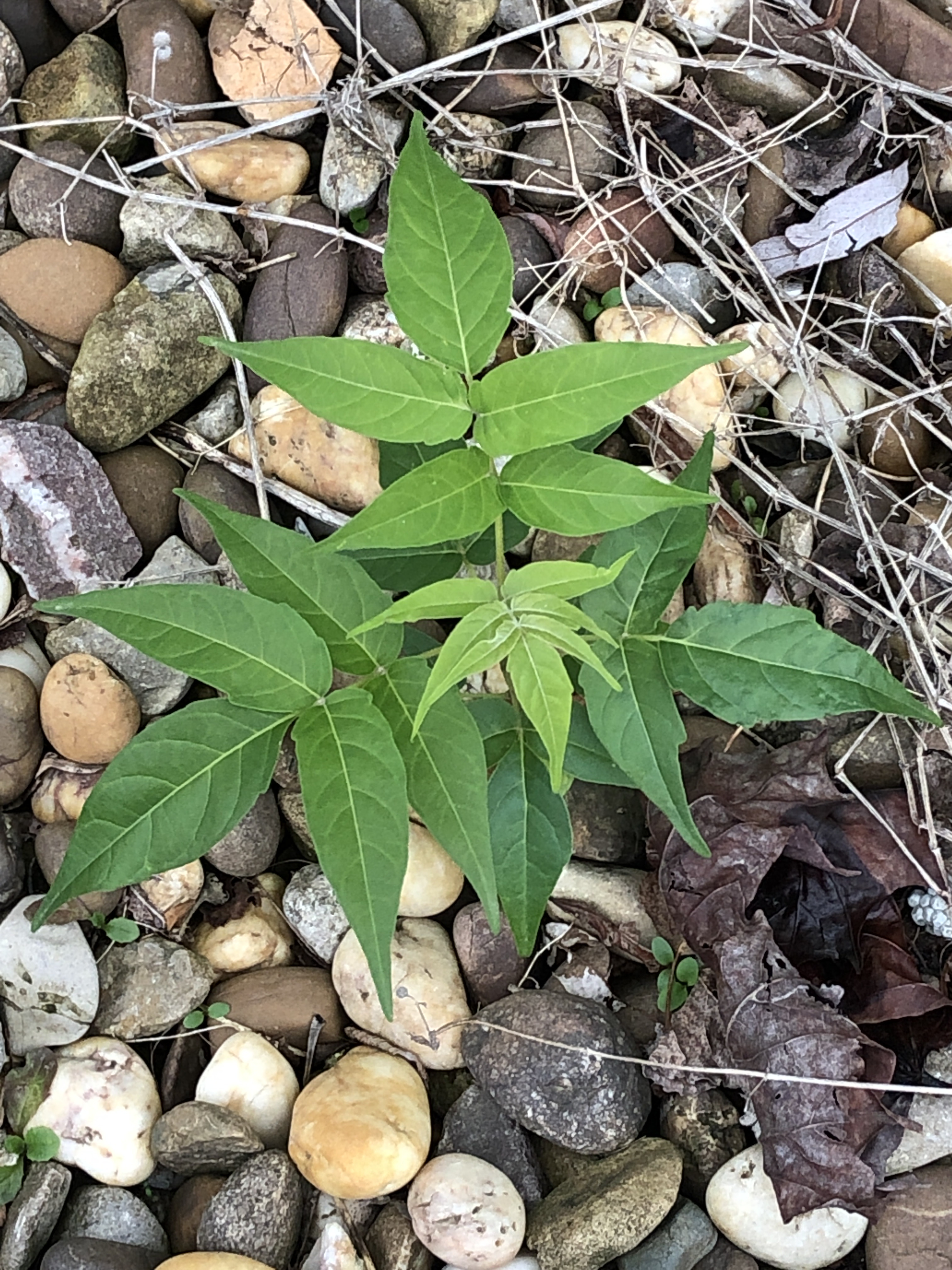
Ailanthus altissima (Mill.) Swingle is a fast-growing, light-demanding and thermophilic pioneer tree species. It grows best on nutrient-rich soils and is very tolerant to dryness and air pollution. It is mostly found in waste and disturbed areas, but can also invade different kinds of forest ecosystems, riparian areas, rock outcrops and semi-natural grasslands. Winged seeds are easily dispersed by wind and water over distances exceeding several hundreds of metres (Branquart et al. 2017).

Ailanthus altissima successfully displace native vegetation due to its rapid growth and root suckering. It produces allergenic toxins in bark and leaves. As these accumulate in the soil, they inhibit the growth of other plants (allelopathic interactions), favour the formation of monospecific stands and inhibit vegetation succession. Ailanthus also increases soil N content and pH. Ailanthus can reduce soil water availability in case of severe infestation. It may damage roads and other infrastructures due to strong and rapid root development (Branquart et al. 2017). The root system is aggressive enough to cause damage to sewers and foundations (GISD 2019).

Photo gallery

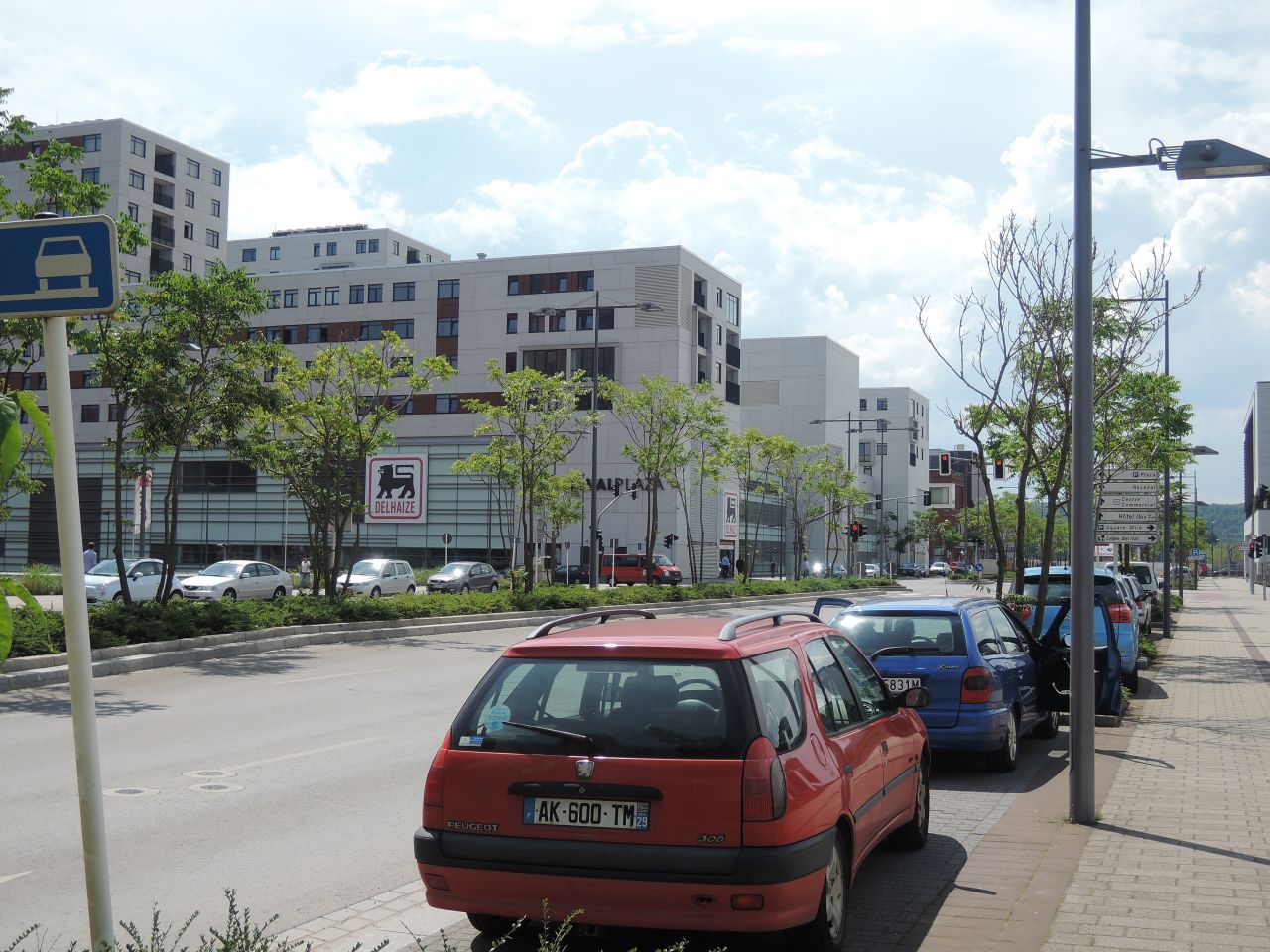
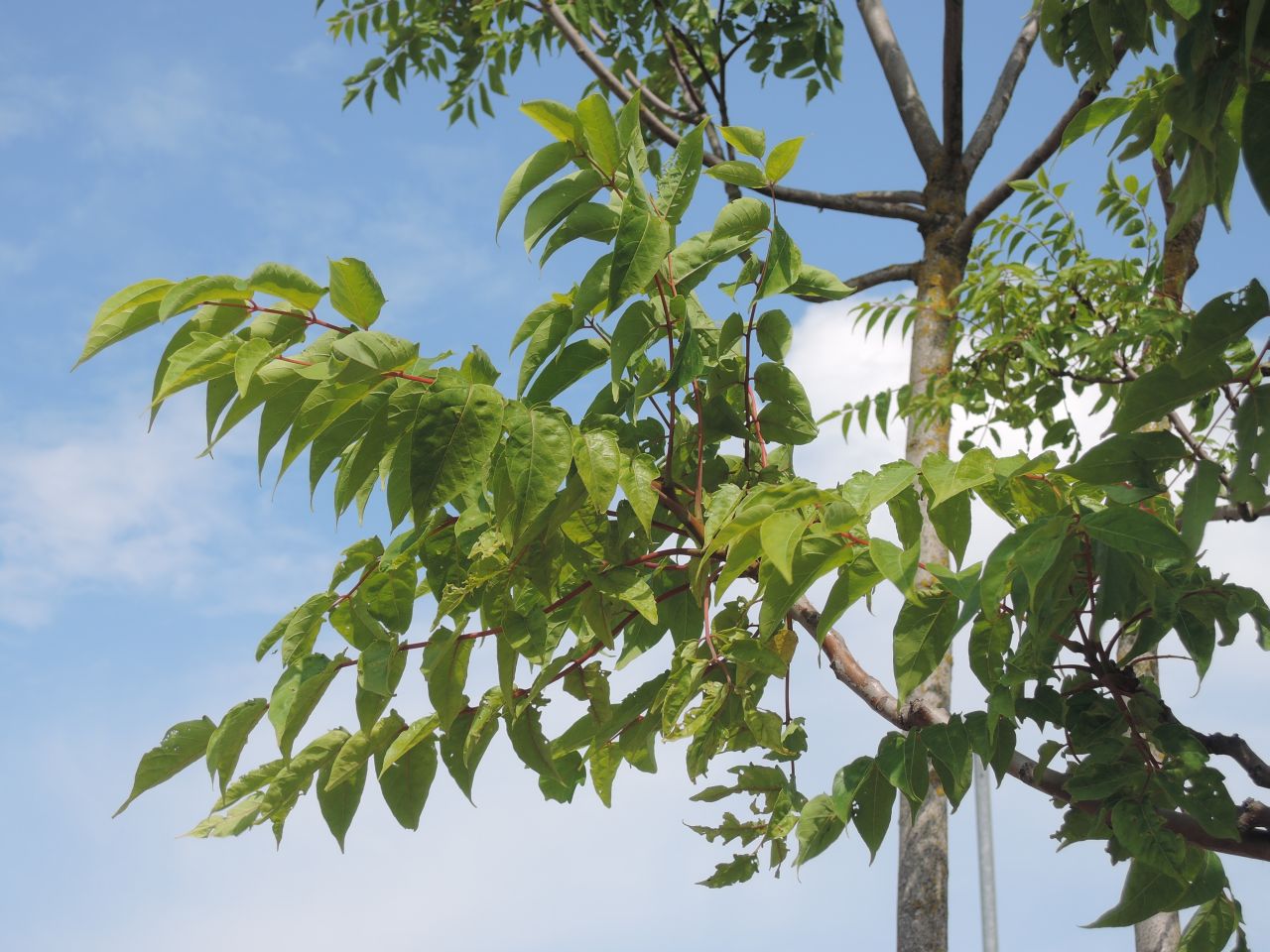
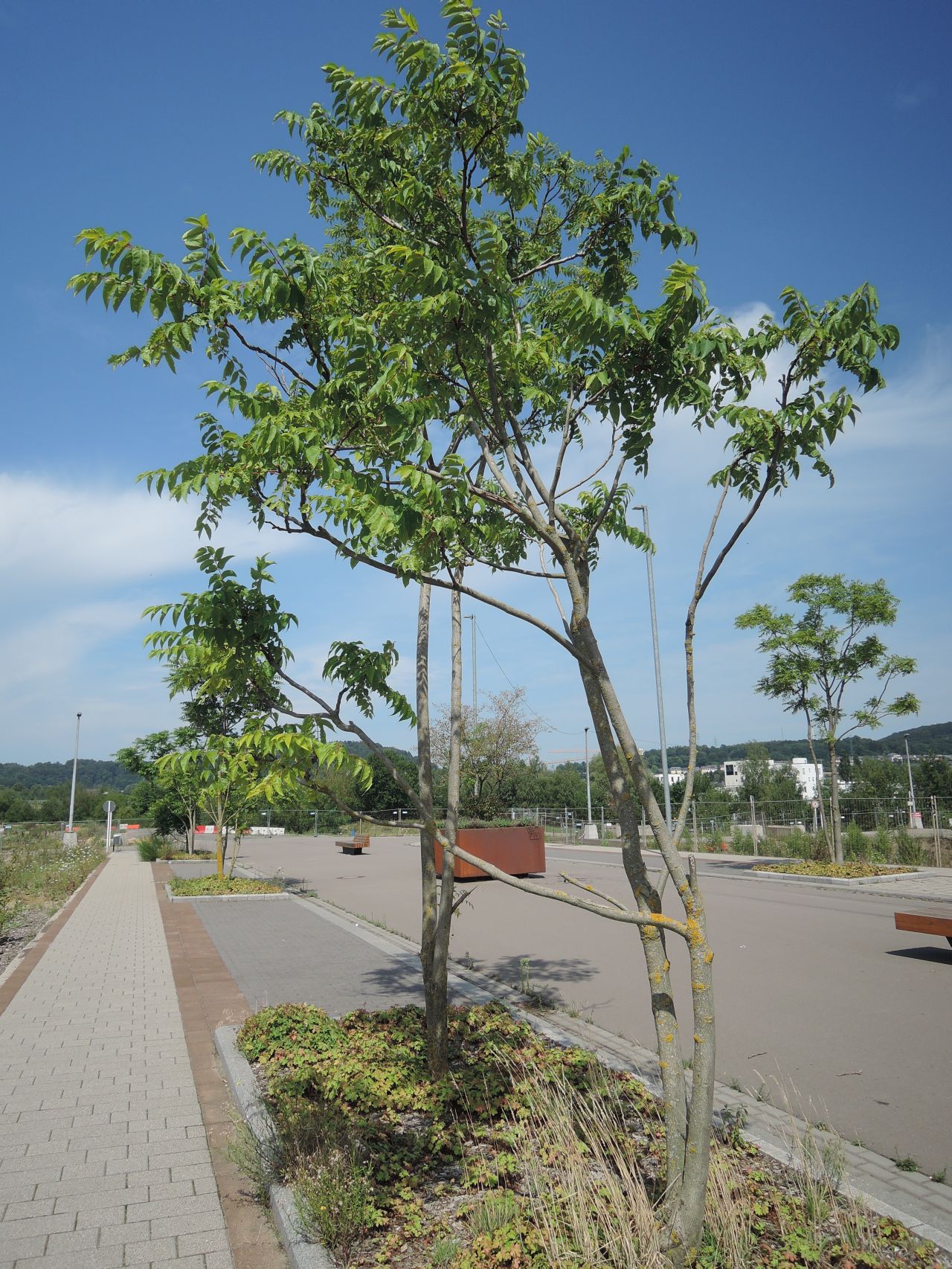
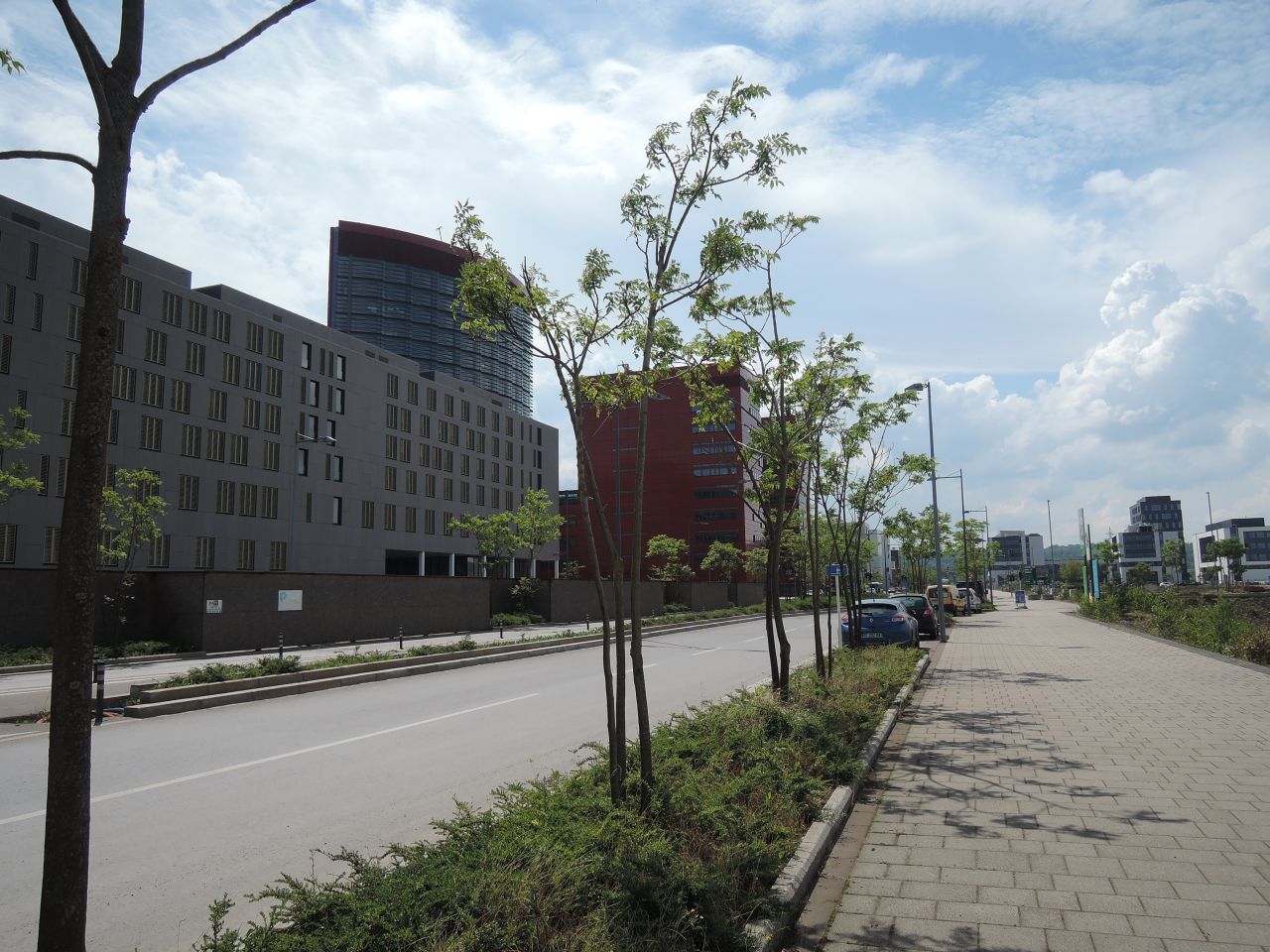
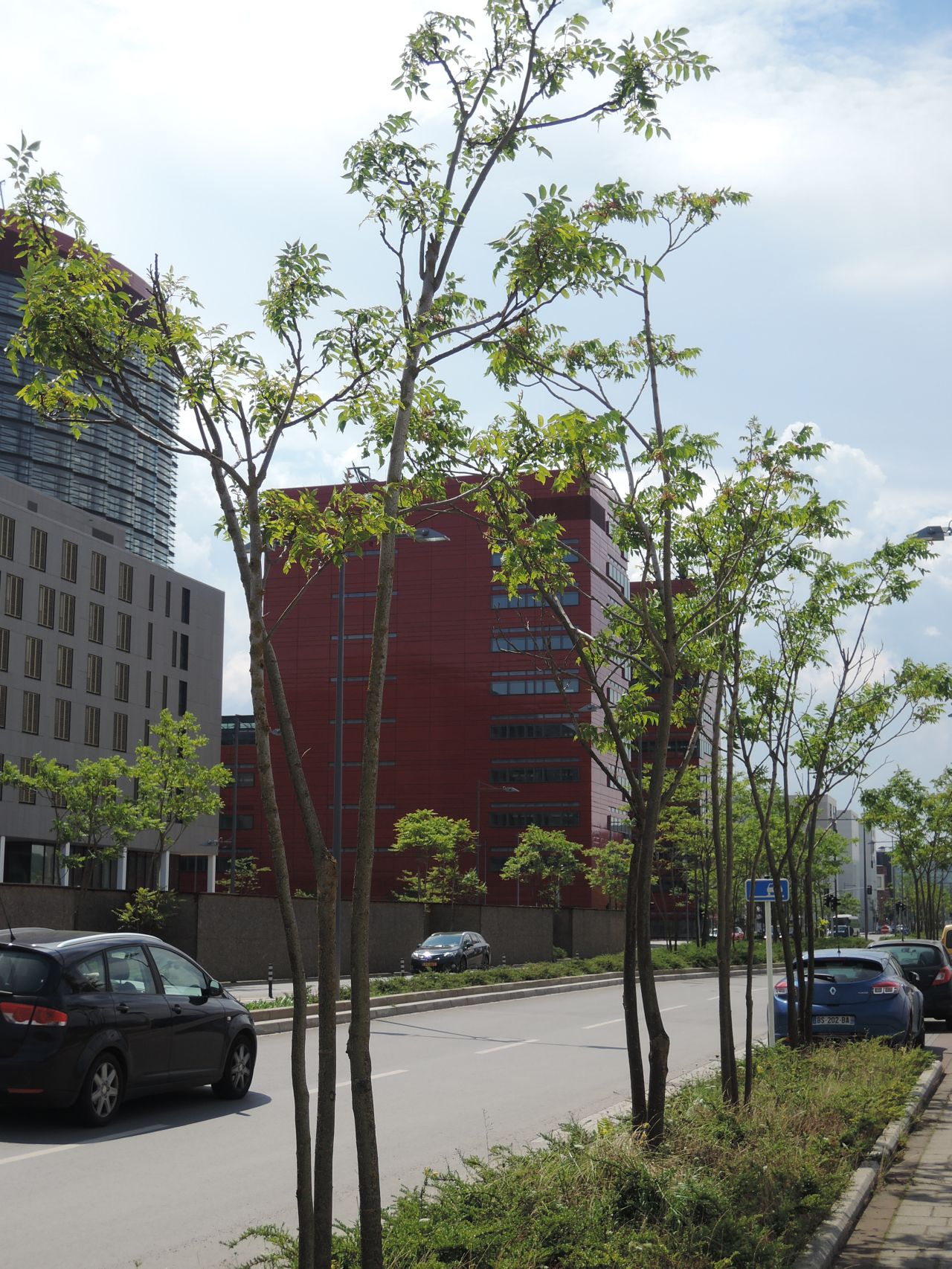
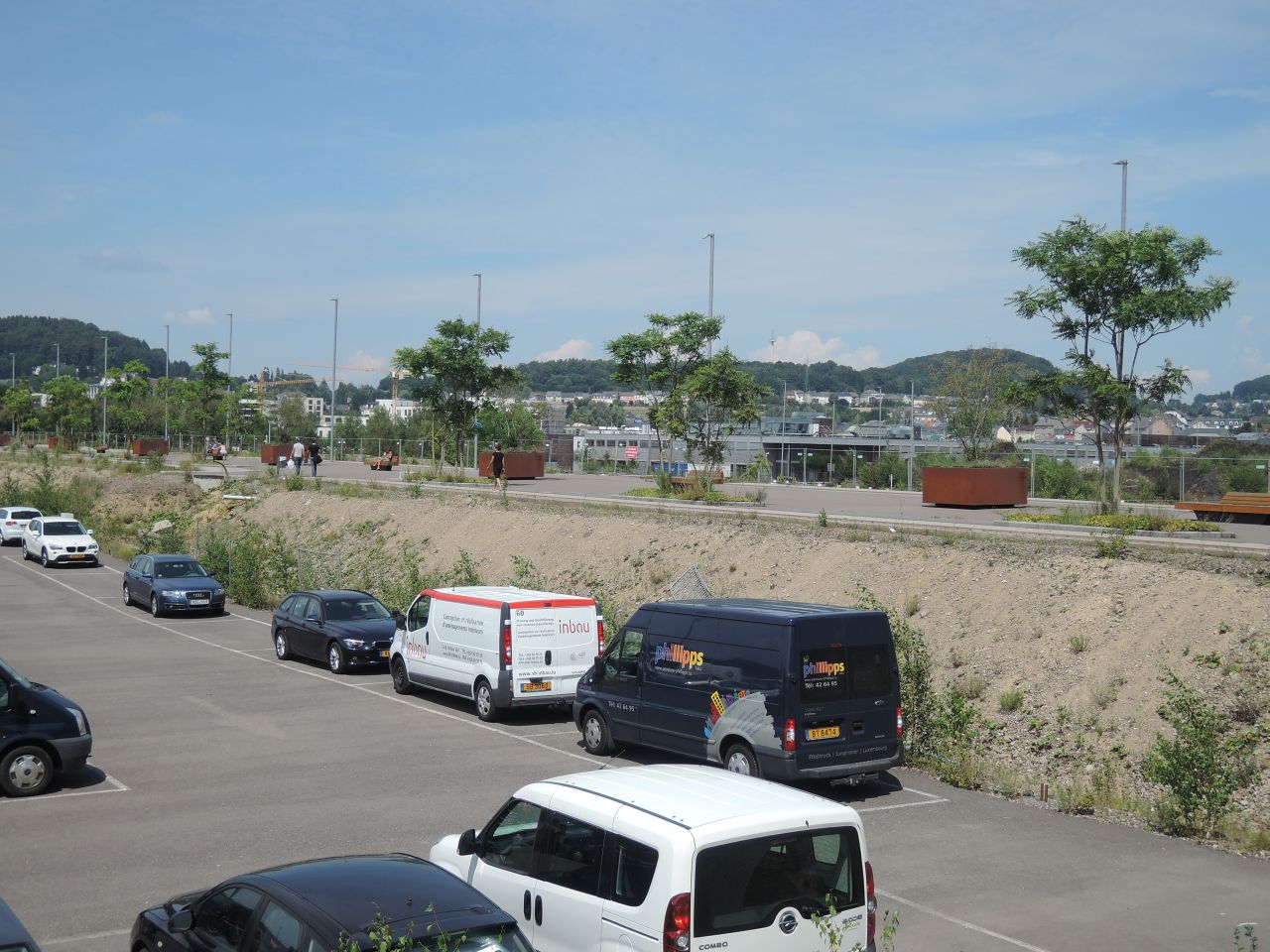
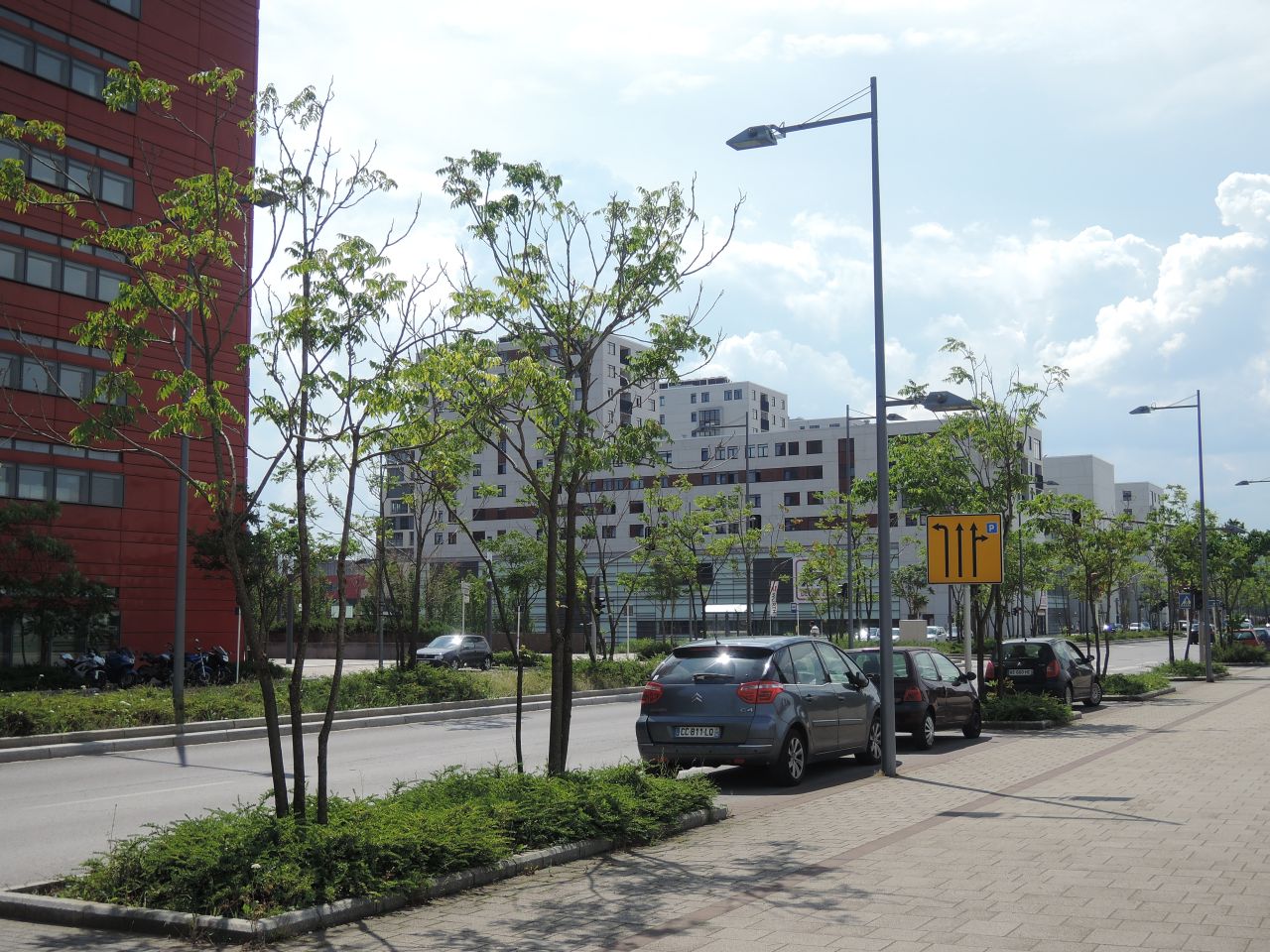
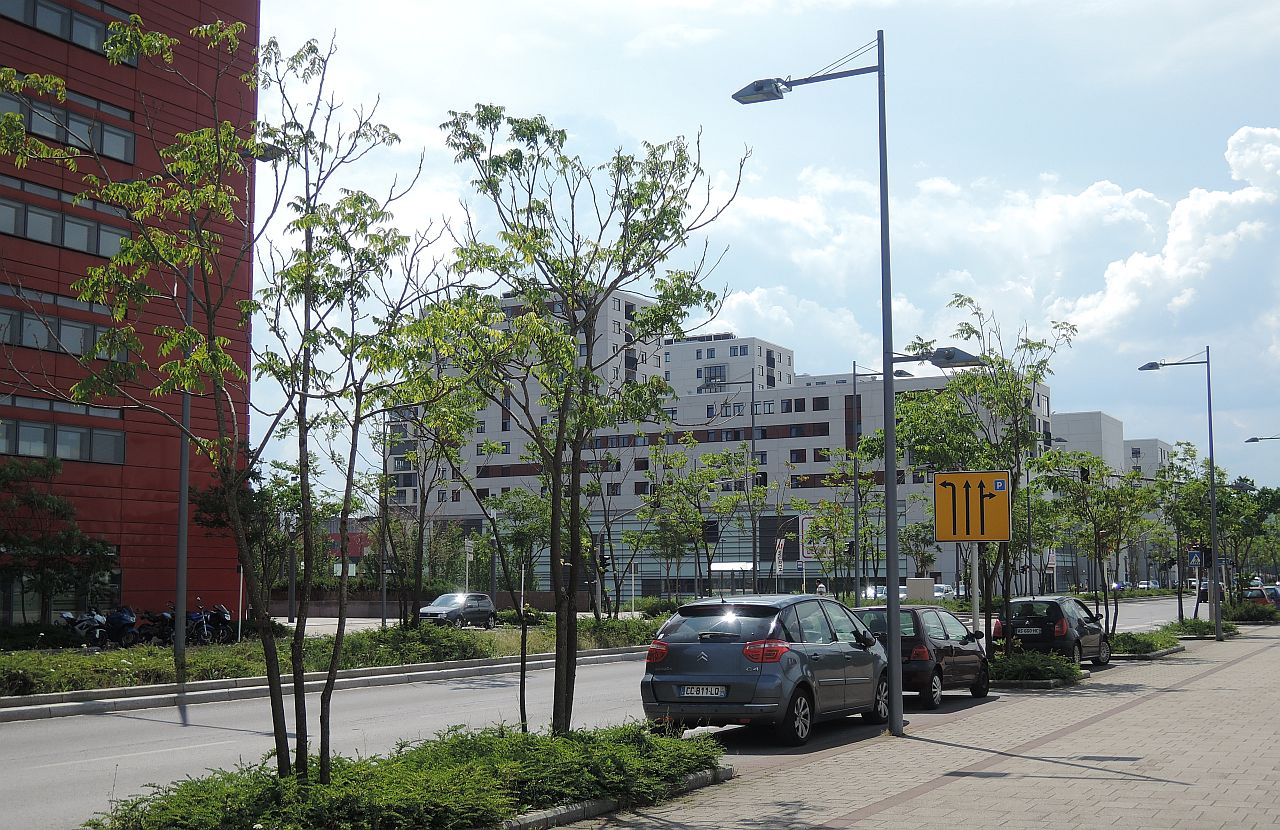
Alley of Alianthus altissima, Porte de France, Belval, Esch-sur-Alzette. Photos by Yan Steil, 23rd July 2014.

IAS of Union concern

In 2019, Ailanthus altissima was added to the list of invasive alien species of Union concern (Anonymous 2019) which implies that member states shall take all necessary steps to prevent it’s unintentional introduction or spread.

Status and distribution in Luxembourg

Records of Ailanthus altissima (Mill.) Swingle in Luxembourg. Data source: Recorder-Lux, iNaturalist & GBIF, 2026-09-21.

The oldest reference to Ailanthus altissima in Luxembourg is found in the flora of Krombach (1875: 108) who lists it as a cultivated species. To mention an old example, Jean Feltgen (1833-1904) included a specimen from a garden in Diekirch in his herbarium, unfortunately without mentioning a date (Specimen № 15467, MNHNL 2000-). It can still be considered the first documented record of the species before 1905, within Jean Feltgen’s lifetime.

The first documentation of the tree of Heaven in the wild dates from 2013, when Jerry Grün reports a grown specimen in a forest edge near Elvange (Ries & Krippel 2021). An earlier report on 13 July 1993 by Léopold Reichling in the Pfaffenthal district in Luxembourg City could not be verified as in the wild as it might have been part of the plantations in the gardens of the Hospice du Pfaffenthal (Obs. key: LUXNATFUND431045, MNHNL 2000-).

According to Lambinon & Verloove (2012: 463) the species is quite rare in urban areas (AR) and very rare in rural areas in the territory of the flora.

Ailanthus altissima is found in several parks in the country, including Tony Neuman Park (Hollman & Schroeder 1997: 22) and municipal park in Luxembourg City.

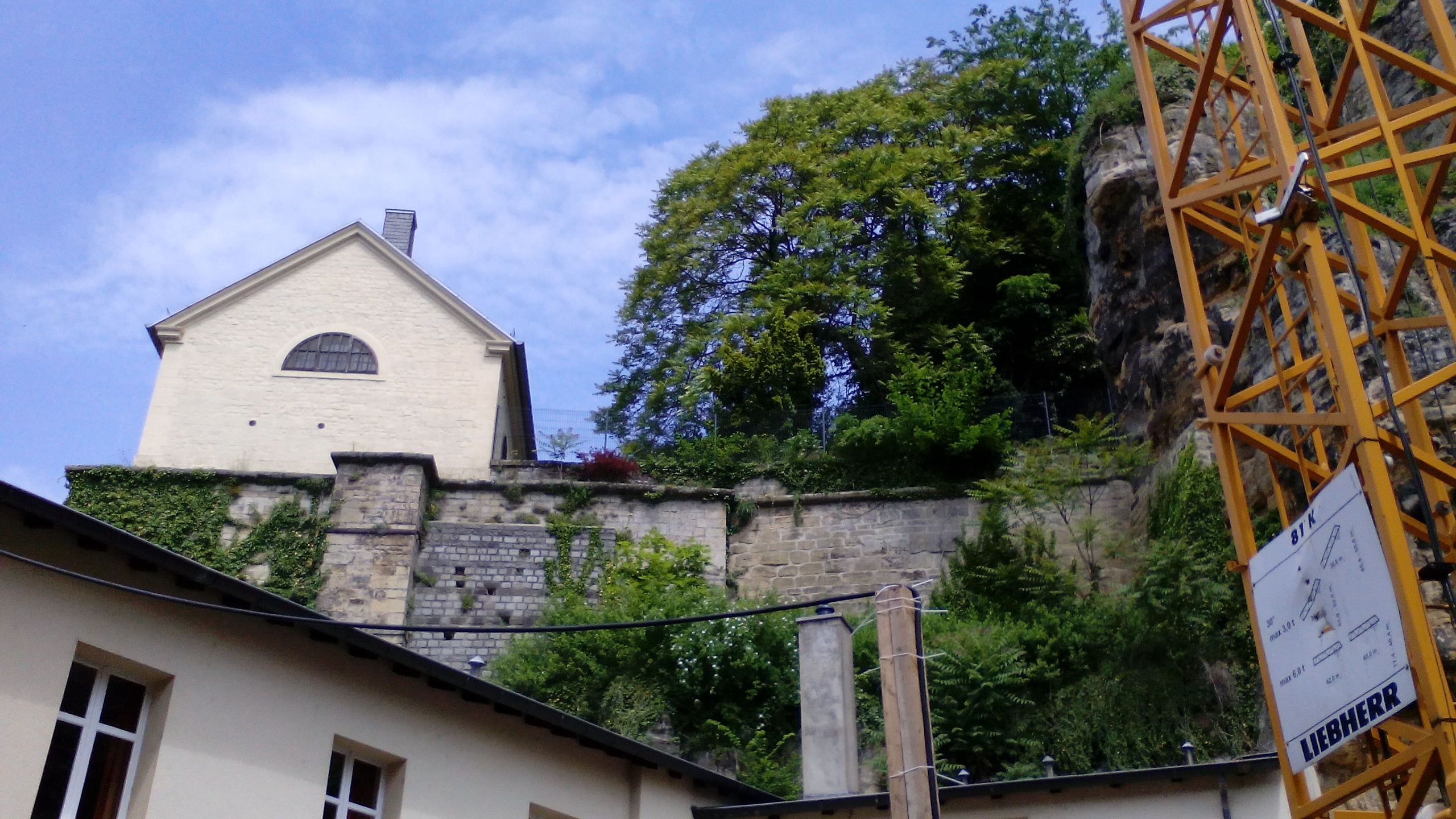
For two decades the species did not appear to have spread to the wild. It is only in recent years that the species was planted in several urban areas and appeared in the wild on sandstone cliffs in Luxembourg City (cf. also Krippel et al. 2020: 32).

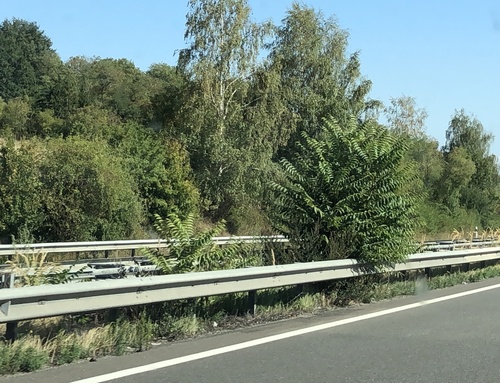
In the median strip of Highway A1 near the port of Mertert. Photo: © Yves Krippel, 20200907,

In the median strip of Highway A1 near the port of Mertert. Photo: © Yves Krippel, 20200907,

In 2020, the salt-tolerant Ailanthus altissima was detected for the first time in a motorway median strip (A1 motorway near the port of Mertert, Yves Krippel, 2020-09-07, iNaturalist).

Considering the recent expansion of the species in Luxembourg and its probable future increased spread due to climate change, and to avoid major problems urban areas experience with the tree of Heaven as a weed across Europe, Ailanthus should not be planted any more as an ornamental tree and existing populations should be eradicated.

An identification sheet of the species has been published by the MECDD in French and German.

Ailanthus as ornamental tree in urban areas

ailanthus-altissima_belval_2014-07-23_11_small

Alley of Alianthus altissima, Porte de France, Belval, Esch-sur-Alzette. Photo: Yan Steil, 23.07.2014.

  • On 23rd July 2014 a complete alley of Ailanthus altissima was discovered in the street Porte de France in Belval / Esch-sur-Alzette. It was recently planted in the course of the regeneration of the brownfield site into a large scientific and cultural centre, including the science faculty of the University of Luxembourg (Steil 2014, pers. comm.). Based on sattelite photos the alley counts more than 70 individuals.
  • A group of Ailanthus altissima trees was recently planted behind the Olympic swimming pool in the Kirchberg disctrict of Luxembourg City by the Fonds du Kirchberg. Seedlings have already started to spread on this site (Helminger 2018, pers. comm.).
  • A row of 9 Ailanthus altissima was planted before 2008 along a parking area behind the church of Walferdange (Welter et al. 2008: 81; map).
  • A single tree is present in the section of the municipal park situated between Avenue de la Porte-Neuve and Avenue Émile-Reuter in Luxembourg City (on the side of the Avenue de la Porte-Neuve in line with two trees of Corylus colurna. Two single trees can be found in the Rue du Rollingergrund, one in front of the house n°294 and another next to the residence on n°306 (Welter et al. 2008: 81).
  • A single old tree with several saplings and a single younger grown-up tree were observed on 10th June 2018 in the municipal park of Diekirch situated along the river Sûre.
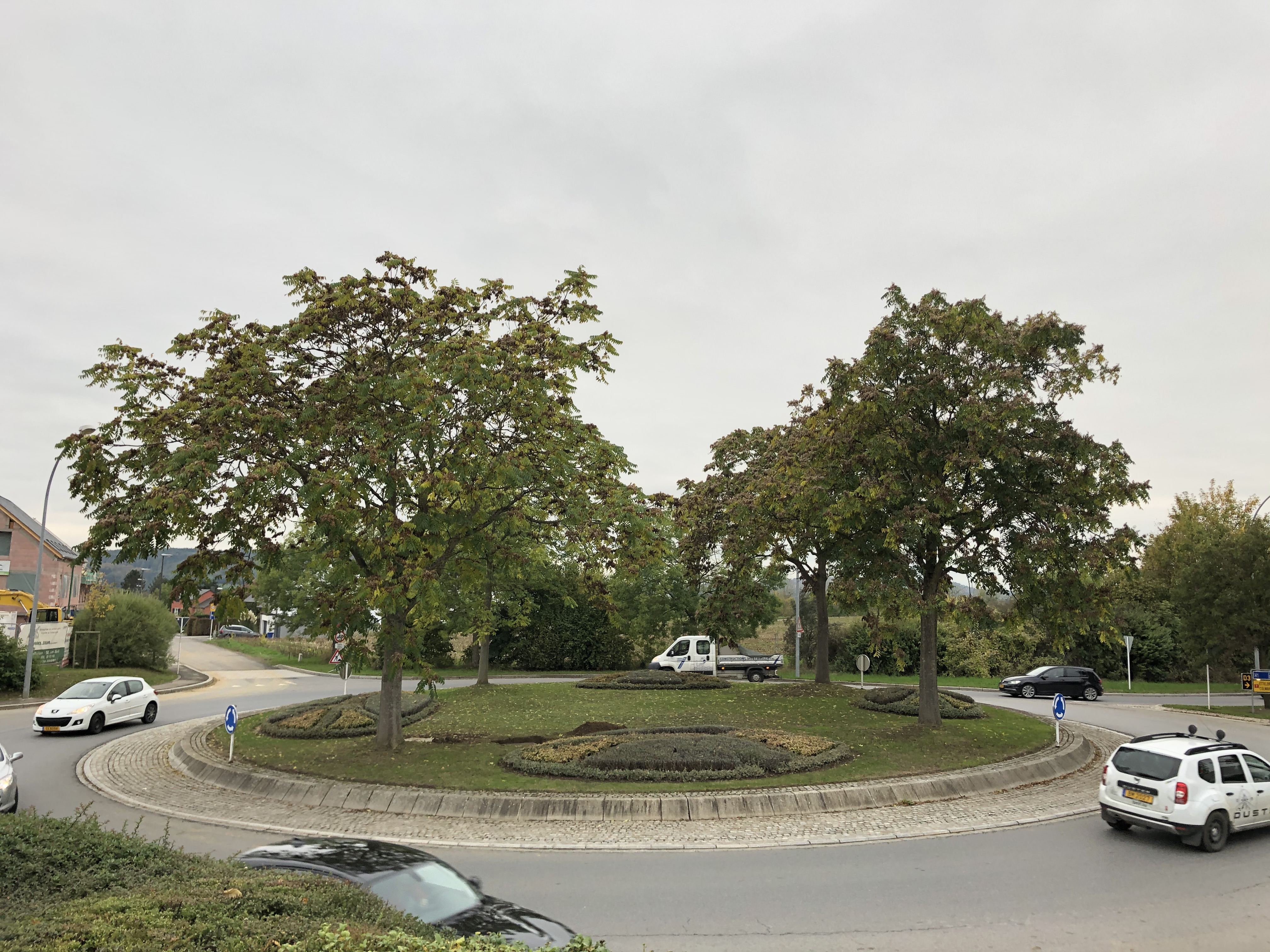
  • A group of 4 Ailanthus altissima trees grow in a roundabout on the N6 road north of Mersch and several seedlings / young plants have been found in the commercial zone east of the roundabout (Yves Krippel, pers. comm. 2020-10-27).

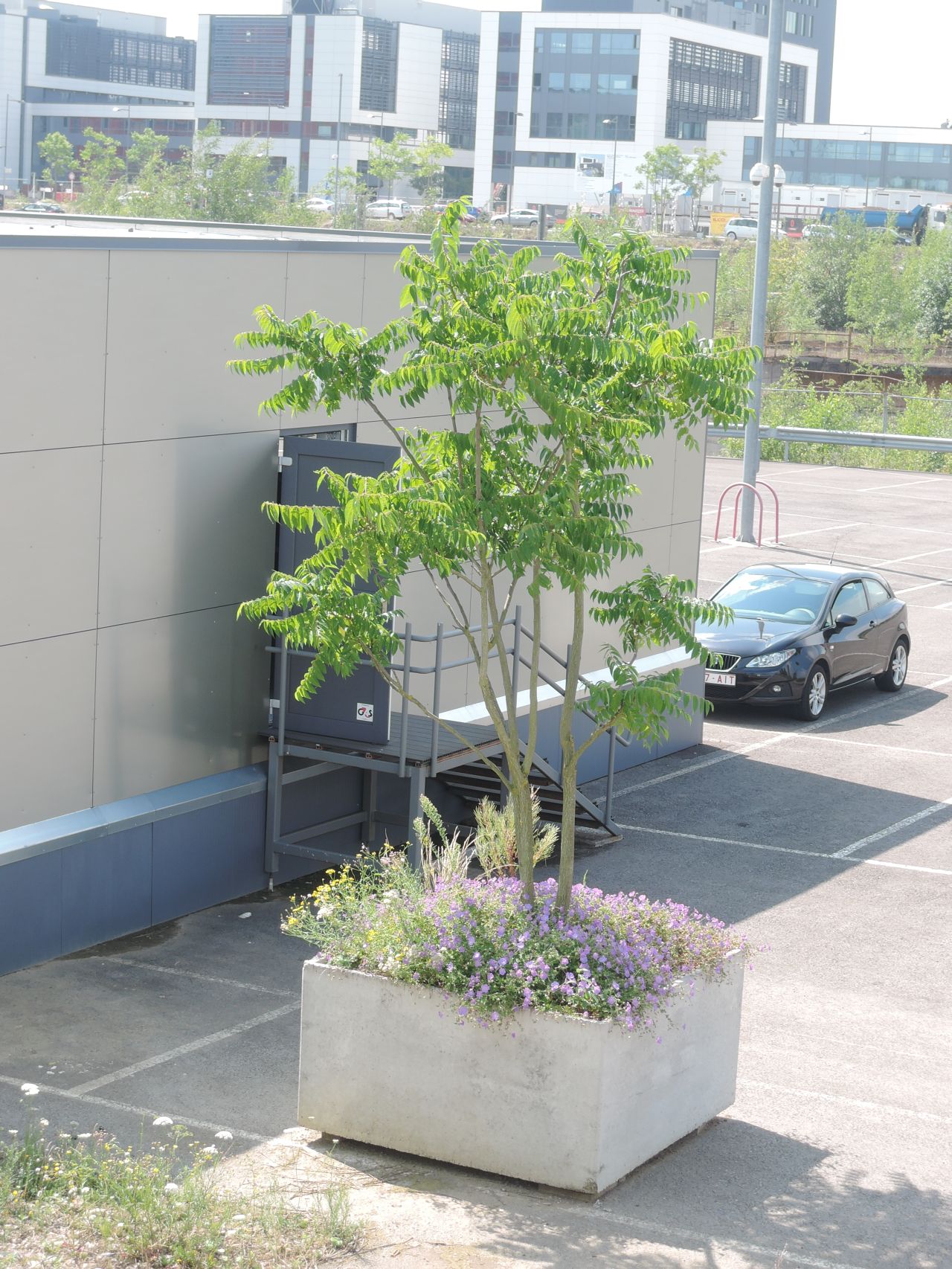
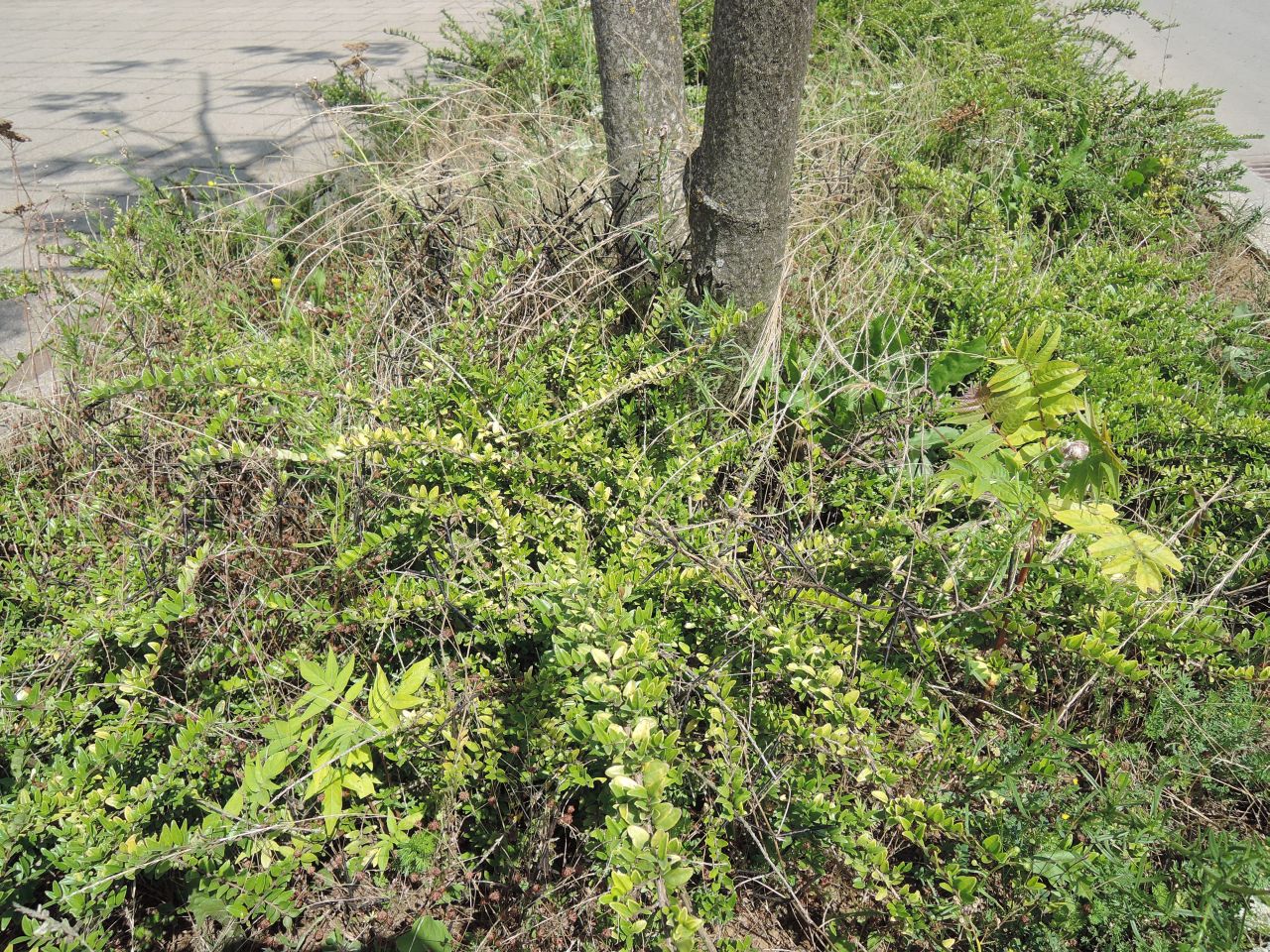
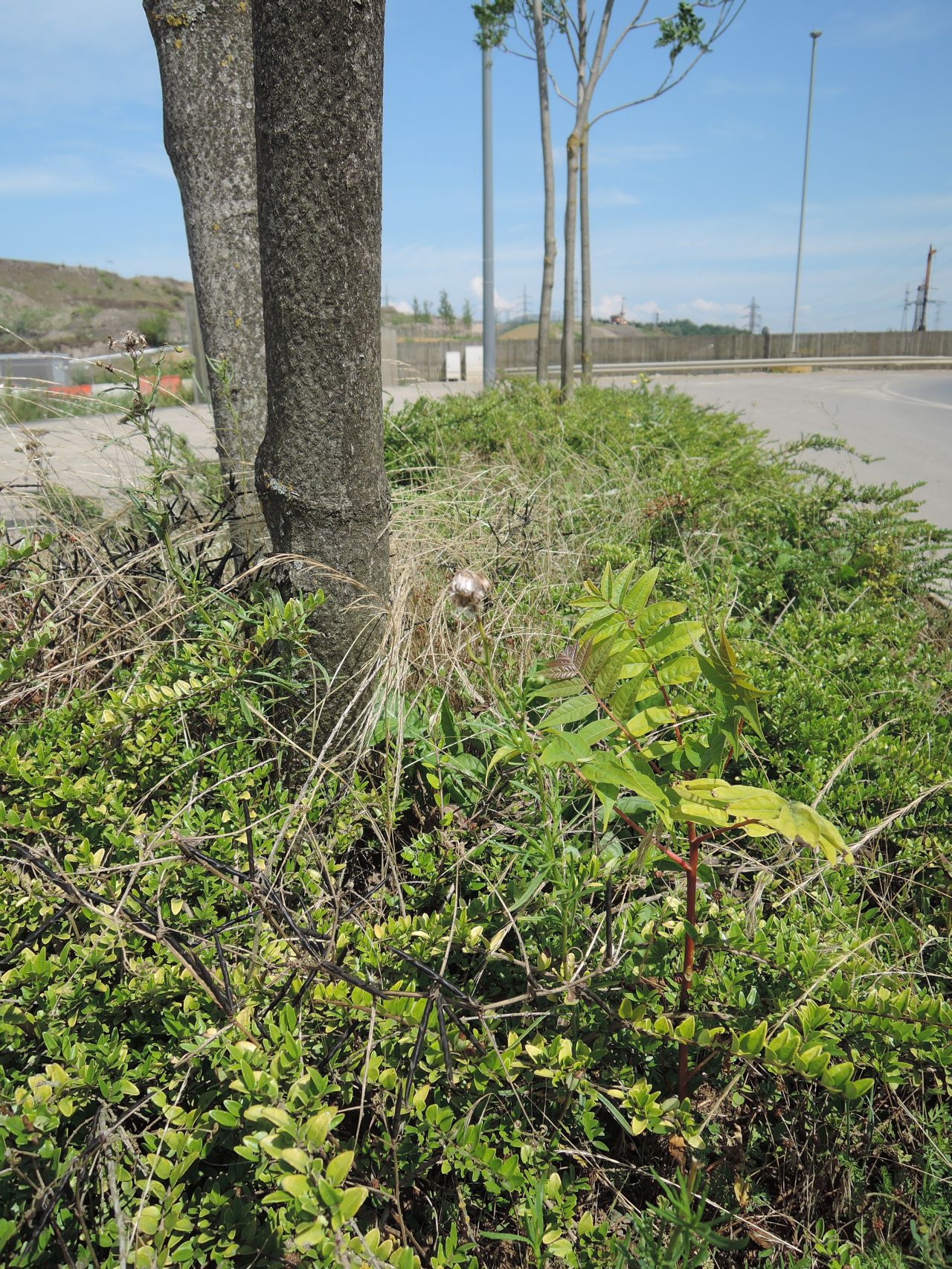
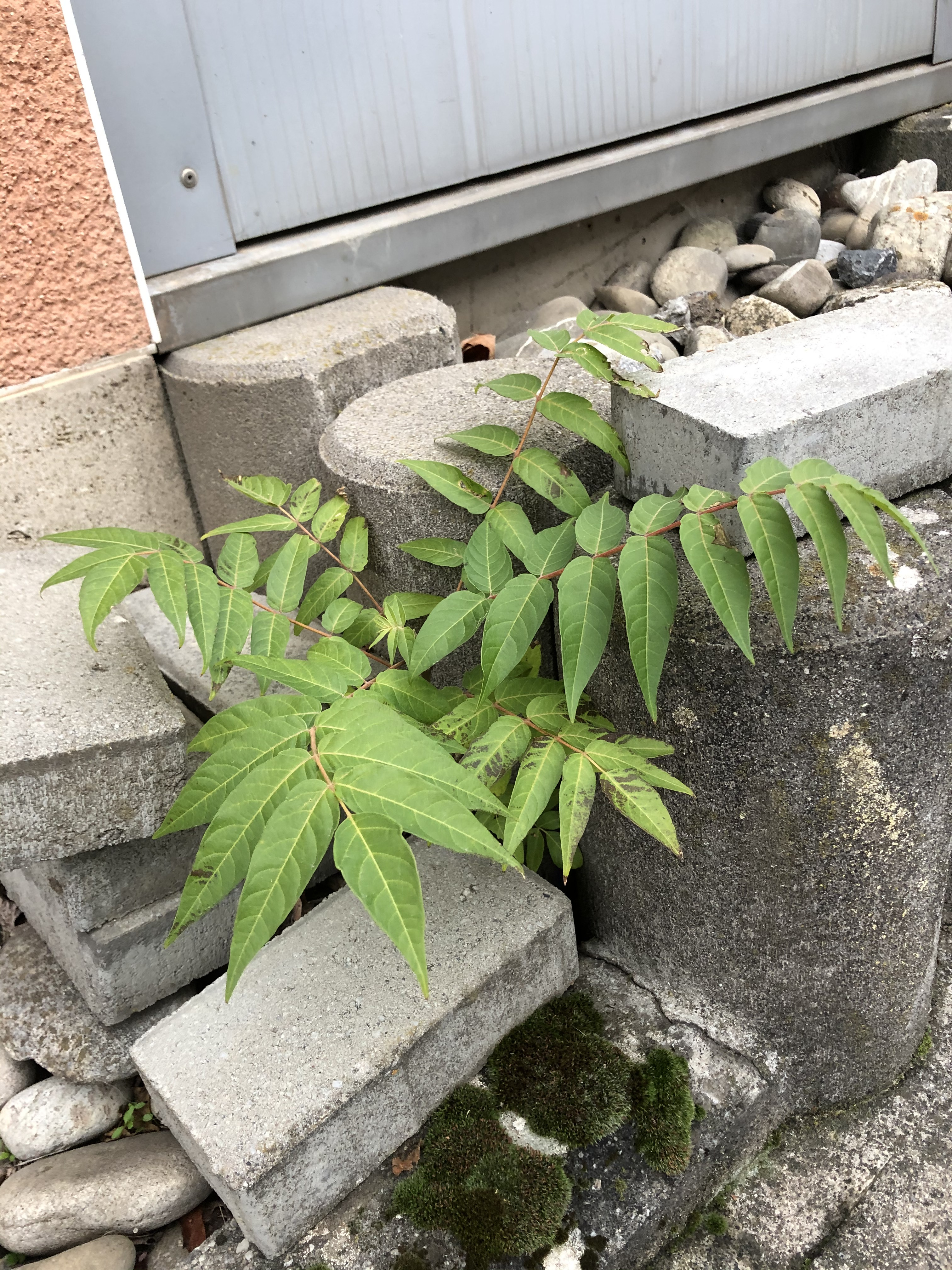
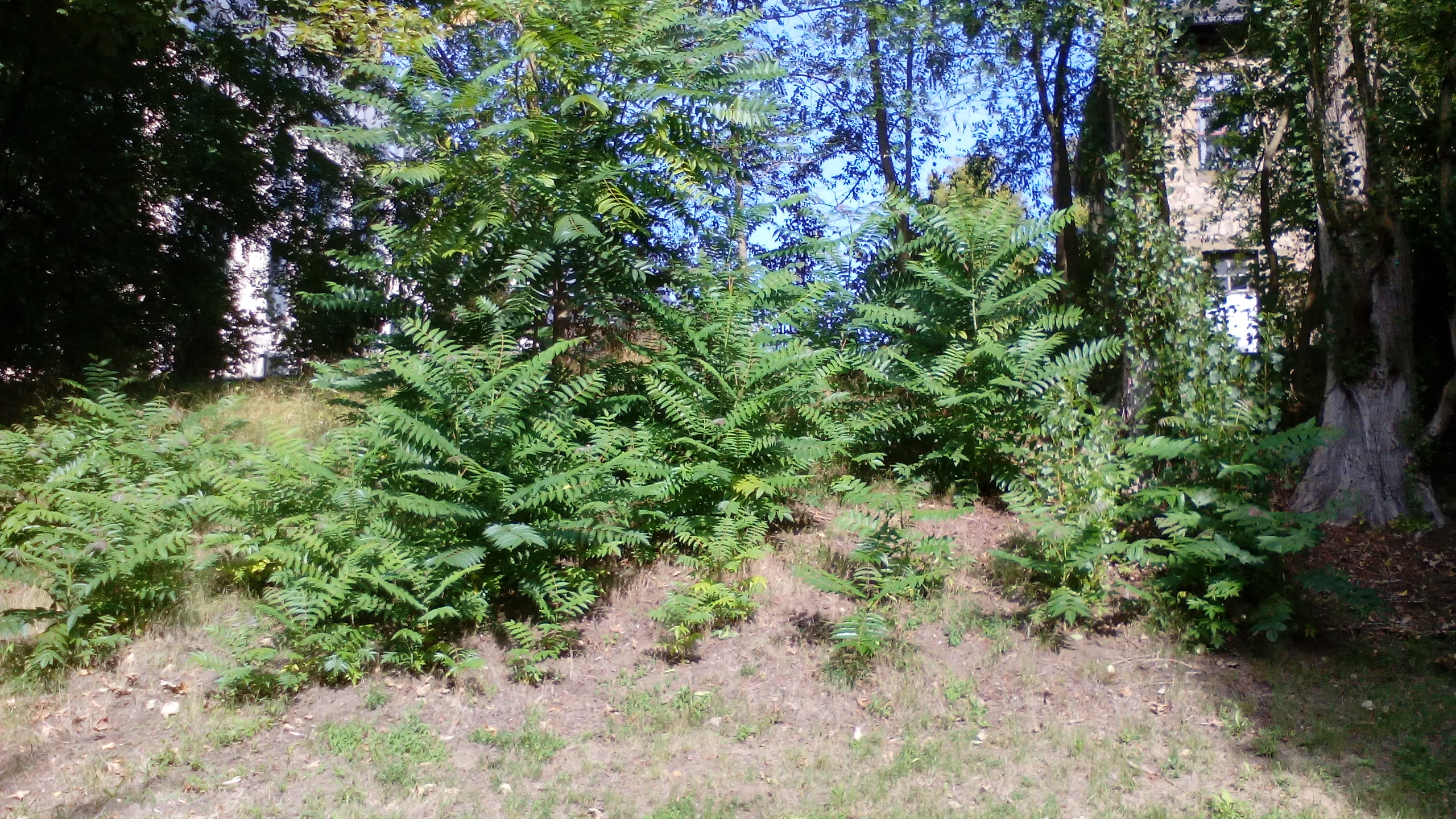
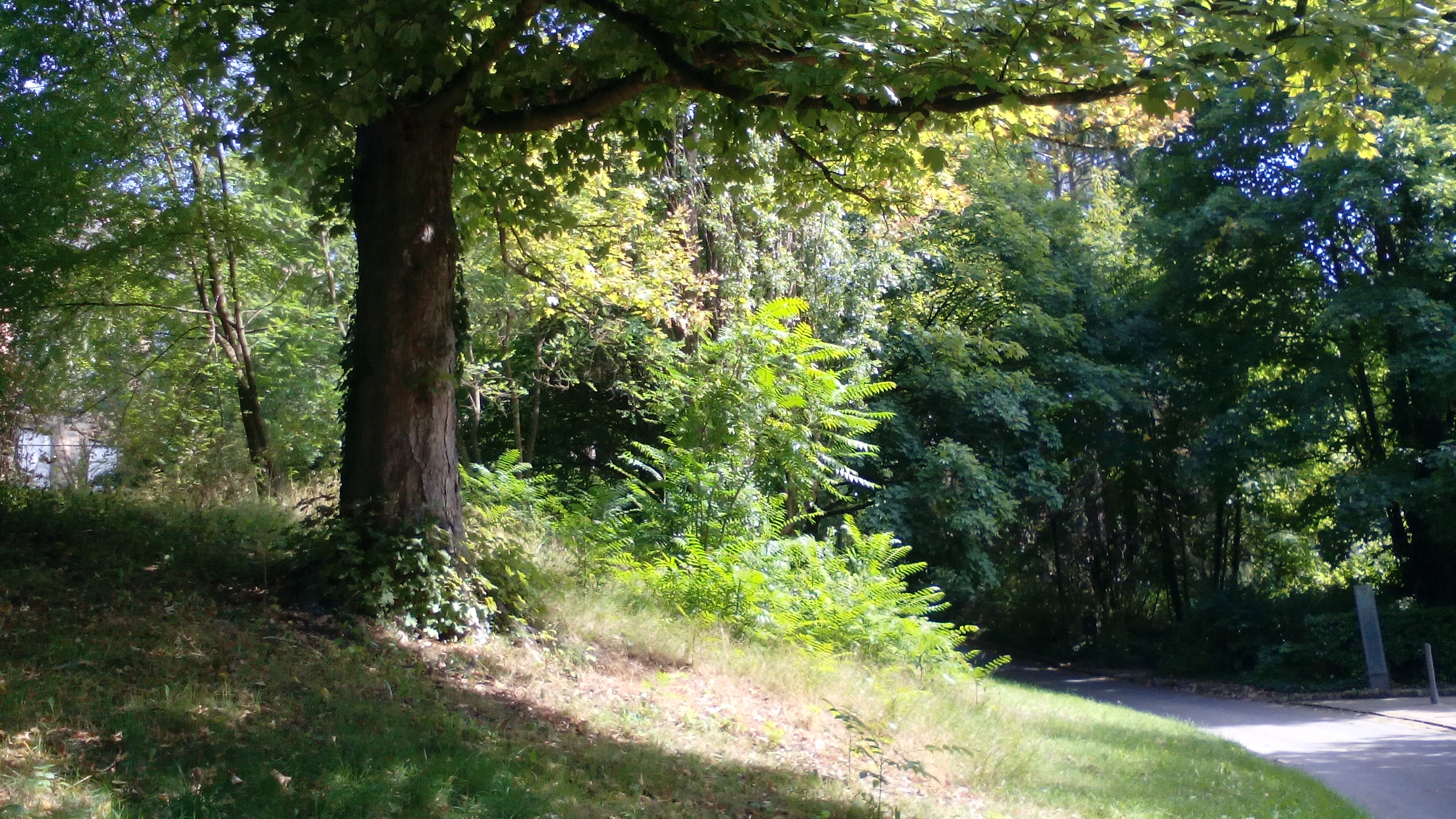
In a few decades, with climate change helping, Ailanthus might grow in many pavement rinds, flowerbeds and vague grounds all over these sites and possibly into the wild in adjacent areas, as illustrated in the following example from planted tree in a roundabout north of Mersch:

Ailanthus in the wild

In 2018, three populations of Ailanthus altissima were sighted in the wild in Luxembourg City:

  • on the edge of the cliff along the railway to Wasserbillig between the Plateau du Rham and the INS. As part of a site visit on 28/11/2019 with representatives of the Nature and Forestry Administration, Public Buildings and the MNHNL, it was decided that the management of this site will take place during winter 2019-2020 and that management should be continued until the site no longer represents a danger to the railway line below.
  • on the edge of the Plateau du Rham southeast of the former military canteen;
  • on the sandstone cliffs above n°11 Bisserweg (Grund district, Luxembourg City).

Management

A recent study in Berlin concludes that urban management strategies concerning Ailanthus would gain support from citizens when combining multiple approaches (Kowarik et al. 2021): (i) to control the species in case of realized negative impacts; (ii) to prevent the invasion of the species in areas of conservation concern; and (iii) to develop novel approaches of integrating wild Ailanthus trees into urban green spaces. These insights could support management measures that need to be established due to the EU-Regulation on Invasive Alien Species.

Action plan

The action plan dedicated to the tree of heaven, designed to limit the spread and minimise its in Luxembourg, was drafted in 2020 (Pfeiffenschneider & Hoppe 2020) and submitted for a 60 days lasting public consultation on 9 September 2020. It clearly postulates that, if its population continues to increase, this species is likely to cause ecological and economic damage.

Risk assessment

ISEIA protocol

C1 (1+1+1+1) (Ries et al. 2013: 18).

Harmonia+ protocol

Overall risk score 0,42 = (Overall Invasion score 0,74 x Overall Impact score 0,57) (Ries et al. 2020).

0,74Invasion
0,57Impact
0,42Risk

Worldwide distribution

CABI 2014: https://www.cabi.org/isc/datasheet/3889#toDistributionMaps

Bibliography

  • Anonymous, 2019. Commission implementing regulation (EU) 2019/1262 of 25 July 2019 amending Implementing Regulation (EU) 2016/1141 to update the list of invasive alien species of Union concern. Official Journal of the European Union L 199/1-2 (26.7.2019).
  • Branquart, E., S. Vanderhoeven, W. Van Landuyt, F. Van Rossum & F. Verloove, 2017. Harmonia database: Ailanthus altissima (Mill.) Swingle. Harmonia version 1.2, Belgian Forum on Invasive Species. URL: http://ias.biodiversity.be [accessed on 2019-10-23]
  • CABI, 2014. Ailanthus altissima (Mill.) Swingle [original text by Soraya Constán Nava]. In: Invasive Species Compendium. Wallingford, UK: CAB International. URL: www.cabi.org/isc [accessed 2019-11-26]
  • GISD, 2019. Species profile: Ailanthus altissima in the Global Invasive Species Database. URL: http://www.iucngisd.org/gisd/speciesname/Ailanthus+altissima [accessed 2019-11-28]
  • Hollman, A. & M. Schroeder, 1997. Parc Tony Neuman (Joyaux botanique au centre de la ville de Luxembourg, réalisé à partir de 1948 par Me Tony Neuman, notaire, Henri Luja, architecte-urbaniste, et Alphonse Hollman, jardinier en chef). AAT-Info 53, supplément. Éd. AAT – Garten und Teichfreunde Luxemburgs. Imprimerie Saint-Paul, Luxembourg. 64 pp.
  • Kowarik I., T.M. Straka, M. Lehmann, R. Studnitzky & L.K. Fischer, 2021. Between approval and disapproval: Citizens’ views on the invasive tree Ailanthus altissima and its management. NeoBiota 66: 1–30. https://doi.org/10.3897/neobiota.66.63460
  • Krippel, Y., T. Helminger & G. Colling, 2020. Notes floristiques. Observations faites au Luxembourg (2018-2019). Bulletin Soc. Nat. luxemb. 122 : 29-55. [PDF 132 KB]
  • Krombach, J.-H.-G., 1875. Flore du grand-duché de Luxembourg. Plantes phanérogames. 564 p. Luxembourg, Imprimerie Joris.
  • Lambinon J. & F. Verloove, 2012. Nouvelle flore de la Belgique, du grand-duché de Luxembourg, du Nord de la France et des régions voisines. Sixième édition. Avec la collaboration de L. Delvosalle, B. Toussaint, D. Geerinck, I. Hoste, F. Van Rossum, B. Cornier, R. Schumacker, A. Vanderpoorten et H. Vannerom. Jardin botanique national de Belgique, Meise. CXXXIX + 1195 pp. ISBN : 9789072619884.
  • MNHNL, 2000-. Ailanthus altissima in Recorder-Lux, database on the natural heritage of the Grand Duchy of Luxembourg. Musée national d’histoire naturelle, Luxembourg. URL: https://mdata.mnhn.lu [Accessed 2018-01-08]
  • Pfeiffenschneider, M. & Hoppe, F., 2020. Plan d’action pour espèces exotiques envahissantes au grand-duché de Luxembourg : Faux-vernis du Japon, Ailanthus altissima (Mill.) Swingle. Version 3.0 – 2020/09/20. Administration de la nature et des forêts, Luxembourg. 19 pp.
  • Ries C. & Y. Krippel 2020. Ailanthus altissima (Mill.) Swingle – Distribution actuelle, recensement futur et mise en oeuvre des mesures d’éradication au grand-duché de Luxembourg. Rapport au Groupe de coordination sur les espèces exotiques envahissantes au Luxembourg (MECDD), Version 1.1 (2020-11-24). 9p.
  • Ries, C. & Y. Krippel, 2021. First records of 56 invasive alien vascular plants in Luxembourg. Bulletin de la Société des naturalistes luxembourgeois 123: 115-127. [PDF 241 KB]
  • Ries, C., Y. Krippel & M. Pfeiffenschneider, 2020. Risk assessment after the Harmonia+ protocol of invasive alien vascular plant species in Luxembourg. Bull. Soc. Nat. luxemb. 122: 197-205. [PDF 132 KB]
  • Ries, C., Y. Krippel, M. Pfeiffenschneider & S. Schneider, 2013. Environmental impact assessment and black, watch and alert list classification after the ISEIA Protocol of non-native vascular plant species in Luxembourg. Bull. Soc. Nat. luxemb. 114: 15-21. [PDF 652 KB]
  • Welter A., J.Turk & J. Trossen, 2008. Les arbres introduits au Luxembourg. Inventaire des essences arborescentes non indigènes de pleine terre présentes sur le territoire du Grand-Duché de Luxembourg. Ferrantia 53, Musée national d’histoire naturelle, Luxembourg, ISSN 1682-5519, 111 pp.

 Page content last updated on 2026-09-18. Last proofread by Caroline Grounds on 2019-11-12.

Procyon lotor (Linnaeus, 1758)

English Raccoon Status LU: established.1st record: 1979.
Lëtzebuergesch Wäschbier Status Eur.: established. IAS of EU concern (2016).
Français Raton laveur RA: ISEIA: C3. Harmonia+: 0,33
Deutsch Waschbär Wikipedia: Wikipedia - English - Raccoon Wikipedia - Français - Raton laveur Wikipedia - Deutsch - Waschbär Wikipedia - Nederlands - Gewone wasbeer | Wikispecies: Wikispecies - Procyon lotor | CABI
Nederlands Gewone wasbeer Back to the list of vertebrates

Brief description

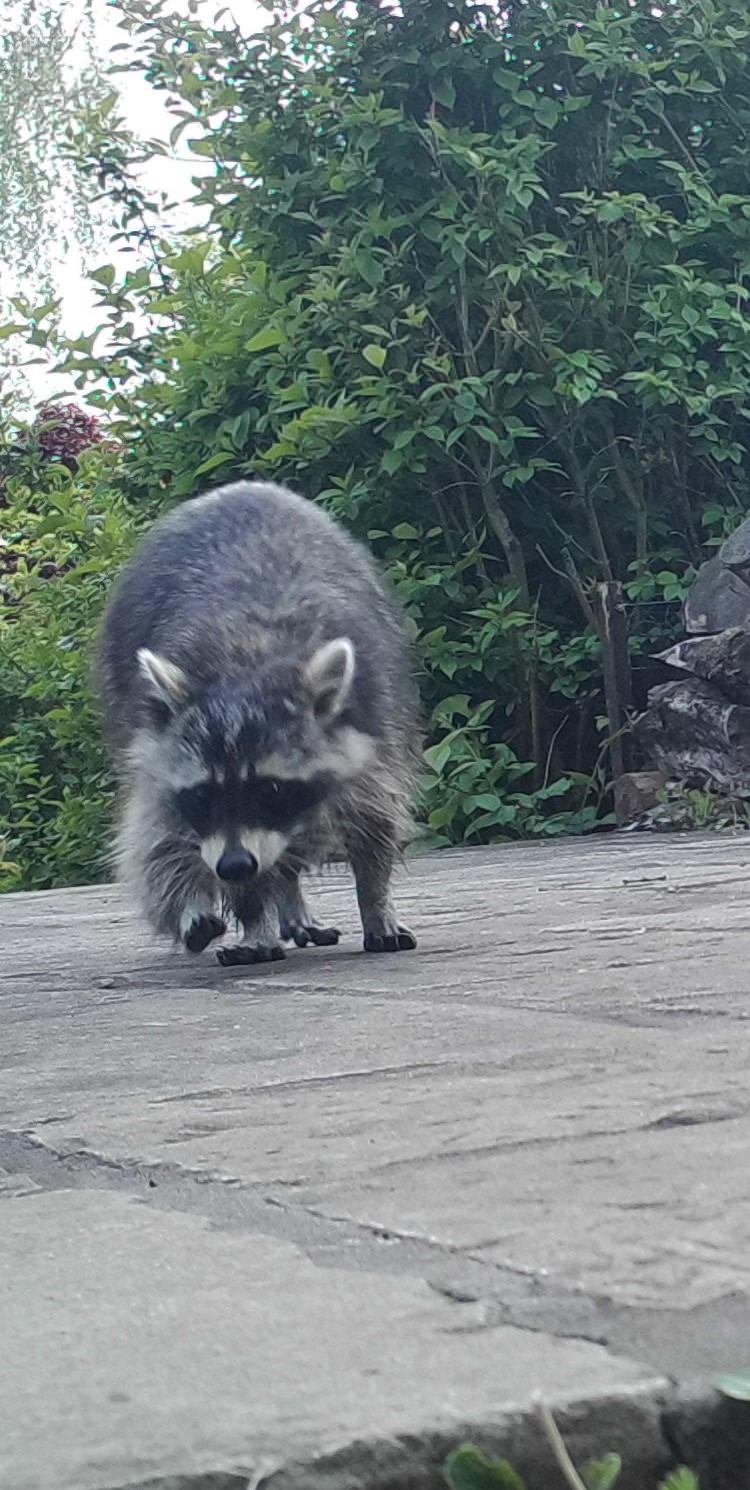
Next to a house in Ospern, Luxembourg. Photo: Moni Schulz, 2021-05-13.

Procyon lotor (Linnaeus, 1758) shows a preference for wetlands and old deciduous forests with hollow trees, often adjacent to water. The species is, however, able to adapt to a high diversity of environmental conditions, including urbanized areas. There is little evidence (but strong suspicion) of species displacement/extinction through predation or interspecific competition by raccoons in Western Europe. Food is often gathered on rubbish dumps or from bins, where the animal can be a nuisance to people. Raccoons are vectors for several diseases, including rabies. The raccoon is included in the appendix under recommendation no.77 of the Council of Europe as a species which has proved to be a threat to biological diversity and for which eradication is strongly recommended (Branquart et al. 2009).

Due to its very pronounced sense of touch, the raccoon can grab the smallest prey with its front paws. Since this often happens in the shallow water of small streams, it looks like it is washing its prey. This behaviour has given the raccoon its name in some languages, e.g. in German “Waschbär” and in French “raton laveur” (Schley & Herr 2019: 65).

IAS of Union concern

In 2016, Procyon lotor (Linnaeus, 1758) was added to the list of invasive alien species of Union concern (Anonymous 2016) which implies that member states shall take all necessary steps to prevent it’s unintentional introduction or spread.

Status and distribution in Luxembourg

Records of Procyon lotor Linnaeus, 1758 in Luxembourg. Data source: Recorder-Lux, iNaturalist & GBIF, 2026-09-21.

Procyon lotor (Linnaeus, 1758) is probably present in Luxembourg since the 1970s, mainly in the Oesling area (Becker-Krüll & Schaefer 2013). The first record in Luxembourg dates from 1979 (Pelt 1979; Schley & Herr 2019: 64). The first observation documented in the Recorder-Lux database dates from 1989 and was found in Munshausen, Municipality of Clervaux (MNHNL 2000-).

In the last few years, different cases of people keeping raccoons as illegal pets became public in Luxembourg. In August 2024, the Ministry of Agriculture, Food and Viticulture and the Ministry of Health and Social Security issued a common press release informing about the potential presence of the raccoon roundworm (Baylisascaris procyonis) within the local raccoon population and the risks associated with that parasite.

Management

Action plan

An action plan concerning the racoon has been published in 2020:

Finalised Action Plan for Procyon lotor (De Sousa 2020)

Raccoon hunt in Luxembourg

The raccoon is considered a game animal in Luxembourg since 2011.

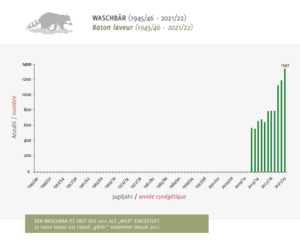
Development of the number of raccoons shot since their inclusion in the hunting list in 2011 (Jacobs & Schley 2022)

600 to 700 animals have been shot per hunting season between 2011 and 2013 (Schley et al. 2014: 25). The numbers increased in the following years to reach 900 shot raccoons in the hunting season 2017-2018 (Schley & Cellina 2018: 11) and 1.347 in 2021-2022 (Jacobs & Schley 2022). The geographical distribution of shot raccoons is in line with the raccoon distribution based on data from Recorder-Lux, GBIF and iNaturalist (MNHNL, iNaturalist & GBIF 2024). In 2021 the estimated population was around 20.000 individuals (Tiago de Sousa in Adami 2022: 5).

Risk assessment

ISEIA protocol

C3 (3+2+2+1) (Ries et al. 2014: 199).

Harmonia+ protocol

Overall risk score 0,33 = (Overall Invasion score 0,56 x Overall Impact score 0,58) (evaluated by Sandra Cellina, Roland Proess and Jan Herr).

0,56Invasion
0,58Impact
0,33Risk

Worldwide distribution

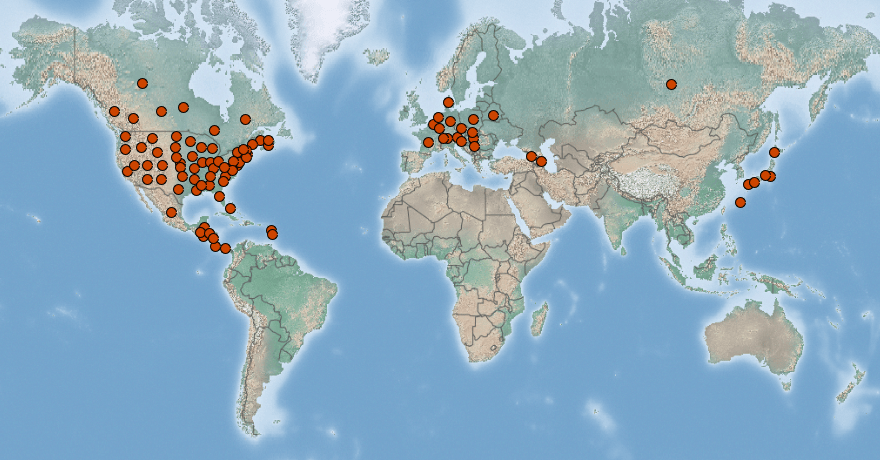
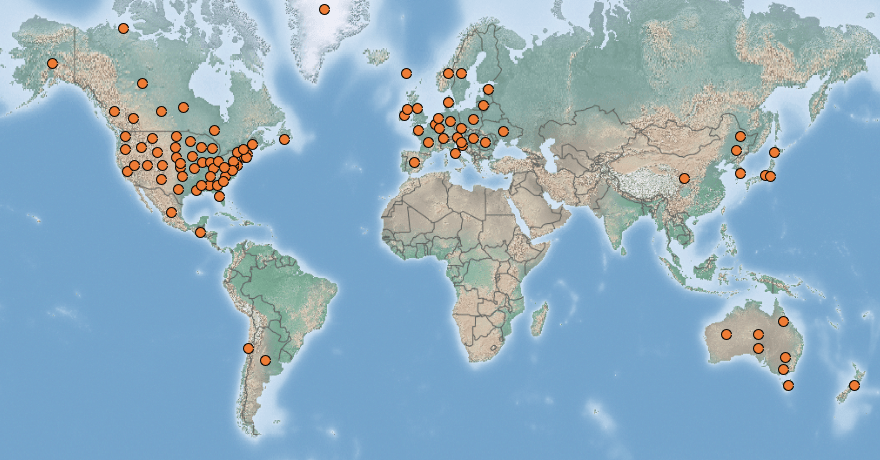
CABI 2009: https://www.cabi.org/isc/datasheet/67856#toDistributionMaps

Fact sheet

PDF fact sheet of the Nature and Forestry Administration: FR | DE

Bibliography

  • Adami, J., 2022. Invasive Tierarten: Achtung, Problembärchen. woxx n°1673: 4-5 (2022-02-25).
  • Anonymous, 2016. Commission implementing regulation (EU) 2016/1141 of 13 July 2016 adopting a list of invasive alien species of Union concern pursuant to Regulation (EU) No 1143/2014 of the European Parliament and of the Council. Official Journal of the European Union L 189: 4-5.
  • Becker-Krüll, L. & P. Schaefer, 2013. Jagdbare Wildtierarten Luxemburgs. 96 pp. 1. Aufl. Hrsg. Naturverwaltung Luxemburg. (Order or download PDF)
  • Branquart, E., M. D’aes, B. Manet, G. Motte, V. Schockert & J. Stuyck, 2009. Harmonia database: Procyon lotor (Linnaeus, 1758). Harmonia version 1.2, Belgian Forum on Invasive Species. URL: http://ias.biodiversity.be [accessed on 2019-11-26]
  • CABI, 2009. Procyon lotor (Linnaeus, 1758) [original text by Stanley Gehrt]. In: Invasive Species Compendium. Wallingford, UK: CAB International. URL: www.cabi.org/isc [accessed 2019-11-26]
  • De Sousa, T., 2020. Plan d’action pour espèces exotiques envahissantes au Grand-Duché de Luxembourg: le Raton laveur, Procyon lotor (Linnaeus, 1758). Version 2020-09-04. Administration de la nature et des forêts, Luxembourg. 23 pp.
  • Jacobs, M. & L. Schley, 2022. Bulletin technique de l’Administration de la nature et des forêts en matière de gestion de la faune sauvage et de chasse, numéro 9 (2022) 72 pages.
  • Kirsch, E., K. Klein, L. Bonblet, M. Weishaar, T. Duscher, T. De Sousa & M. Jacobs, 2021. Waschbären & Marderhunde in Luxemburg. 48 S. Hrsg.: Administration de la nature et des forêts (ANF) & Musée national d’histoire naturelle (MNHNL). [PDF >5 MB]
  • Kosik-Bogacka, D., N. Osten-Sacken, N. Łanocha-Arendarczyk, K. Kot, B. Pilarczyk, A. Tomza-Marciniak, J. Podlasińska, M. Chmielarz & M. Heddergott, A.C. Frantz, P. Steinbach, 2019. Selenium and mercury in the hair of raccoons (Procyon lotor) and European wildcats (Felis s. silvestris) from Germany and Luxembourg. Ecotoxicology https://doi.org/10.1007/s10646-019-02120-3
  • MNHNL, 2000-. Procyon lotor (Linnaeus, 1758) in Recorder-Lux, database on the natural heritage of the Grand Duchy of Luxembourg. Musée national d’histoire naturelle, Luxembourg. URL: https://mdata.mnhn.lu [Accessed 2020-02-04]
  • MNHNL, iNaturalist & GBIF, 2020. Procyon lotor (Linnaeus, 1758) in MNHNL-mdata, online portal combining species observation from Recorder-Lux, iNaturalist and GBIF. National Museum of Natural History, Luxembourg. URL: https://mdata.mnhn.lu [Accessed 2020-02-04]
  • Pelt, J., 1979. Ein überraschendes Jagderlebnis. De lëtzebuerger Jéer 3/79: 23.
  • Pir, J.B. & L. Schley, 2015. Développement des connaissances sur la répartition et l’écologie des mammifères au Luxembourg entre 1990 et 2015. Bull. Soc. Nat. luxemb. 116: 437-455. [PDF 2,04 MB]
  • Ries, C., M. Pfeiffenschneider, Engel, E., J.-C. Heidt & M. Lauff, 2014. Environmental impact assessment and black, watch and alert list classification after the ISEIA Protocol of vertebrates in Luxembourg. Bull. Soc. Nat. luxemb. 115: 195-201. [PDF 247 KB]
  • Schley, L. & J. Herr, 2019. Säugetiere Luxemburgs. Hrsg.: natur&ëmwelt a.s.b.l., Ministère du développement durable et des infrastructures, Administration de la nature et des forêts. 219 S. ISBN 978-2-9199511-0-9 [French edition: Les mammifères du Luxembourg, ISBN 978-2-9199511-2-3]
  • Schley, L., C. Schanck, M. Schaul & C. Sinner, 2001. Neubürger und Heimkehrer unter den Wildtieren Luxemburgs. Beiträge zur Jagd- und Wildforschung 26: 141-154.
  • Schley, L., R. Reding & S. Cellina, 2014. Bulletin technique de l’Administration de la nature et des forêts en matière de gestion de la faune sauvage et de chasse, n° 3, 72 pp. (Order or download PDF)
  • Schley, L. & S. Cellina, 2018. Technischer Bericht der Naturverwaltung betreffend Wildtiermanagement und Jagd, Nr. 7, 52 S. Administration de la nature et des forêts, Diekirch. [PDF 13 MB]

 Page content last updated on 2024-08-07. Last proofread by Caroline Grounds on 2019-11-28.

Epilobium ciliatum Raf.

English American willowherb Status LU: established. 1st record: LU & ITW 1950
Lëtzebuergesch Drüse-Weideréischen Status Eur.: established. 1st record: UK 1891.
Français Épilobe à tige glanduleuse RA: ISEIA: B3 – Watch List. Harmonia+: 0,15
Deutsch Drüsiges Weidenröschen Wikipedia: Wikipedia - English - American willowherb Wikipedia - Deutsch - Drüsiges Weidenröschen Wikipedia - Nederlands - Beklierde basterdwederik | Wikispecies: Wikispecies - Epilobium ciliatum | CABI
Nederlands Beklierde basterdwederik Back to the list of neophytes

Brief description

Epilobium ciliatum FWS-01

Gordon Leppig & Andrea J. Pickart, Public domain, via Wikimedia Commons

Epilobium ciliatum Raf. is a pioneer plant species that thrives mainly in man-made environments such as arable land, gardens, tree nurseries, clearcuts and ruderal areas. It may also become established in open riparian habitats. Its seeds are adapted for wind dispersion and have a high germination rate. It is one of the arable weed species with the highest rate of increase in Europe (Branquart et al. 2010).

Status and distribution in Luxembourg

Records of Epilobium ciliatum Raf. in Luxembourg. Data source: Recorder-Lux, iNaturalist & GBIF, 2026-09-21.

Epilobium ciliatum Raf. was first documented under its synonym Epilobium adenocaulon Hausskn. on 1950-07-19 in wasteland on sand between two spruce stands near Croix-des-Bourgeois (Biergerkräiz) near Bridel (municipality of Kopstal) by François Léon Lefort (1917-1975) and Léopold Reichling (1921-2009) (Reichling 1961: 68ff.; MNHNL 2000-; herbarium specimen N°17920).

The species, described by Haussknecht in 1879 based on American herbarium samples, is native to North America where it is widely distributed as several varieties that are difficult to define. Introduction in Europe: < 1900 (Great Britain, Russia), 1900 (Sweden), 1915 (Netherlands), 1916 (Finland), 1931 (East Prussia), 1950 (Luxembourg), 1952 (Belgium, France) (Reichling 1961: 74).

This North American plant species was naturalised in Europe around 1900; it is rapidly expanding (Lambinon & Verloove 2012: 434).

700 records of the species are listed in the MNHNL-mdata online portal and the plant is widespread throughout the country (MNHNL, iNaturalist & GBIF 2019).

Risk assessment

ISEIA protocol

B3 (3+3+2+1) = Watch List (Ries et al. 2013: 18).

Harmonia+ protocol

Overall risk score 0,15 = (Overall Invasion score 0,69 x Overall Impact score 0,22) (Ries et al. 2020).

0,69Invasion
0,22Impact
0,15Risk

Worldwide distribution

Bibliography

  • Branquart, E., S. Vanderhoeven, W. Van Landuyt, F. Van Rossum, F. Verloove, 2010. Harmonia database: Epilobium ciliatum Raf.. Harmonia version 1.2, Belgian Forum on Invasive Species. URL: http://ias.biodiversity.be [accessed on 2019-10-09]
  • CABI, 2019. . In: Invasive Species Compendium. Wallingford, UK: CAB International. URL: www.cabi.org/isc [accessed 2020-02-28]
  • Lambinon J. & F. Verloove, 2012. Nouvelle flore de la Belgique, du grand-duché de Luxembourg, du Nord de la France et des régions voisines. Sixième édition. Avec la collaboration de L. Delvosalle, B. Toussaint, D. Geerinck, I. Hoste, F. Van Rossum, B. Cornier, R. Schumacker, A. Vanderpoorten et H. Vannerom. Jardin botanique national de Belgique, Meise. CXXXIX + 1195 pp. ISBN : 9789072619884.
  • MNHNL, 2000-. Epilobium ciliatum Raf. in Recorder-Lux, database on the natural heritage of the Grand Duchy of Luxembourg. Musée national d’histoire naturelle, Luxembourg. URL: https://mdata.mnhn.lu [Accessed 2019-10-09]
  • MNHNL, iNaturalist & GBIF, 2019. Epilobium ciliatum Raf. in MNHNL-mdata, online portal combining species observation from Recorder-Lux, iNaturalist and GBIF. National Museum of Natural History, Luxembourg. URL: https://mdata.mnhn.lu [Accessed 2019-10-09]
  • Reichling, L., 1961. Notes floristiques 1957-1958. Bull. Soc. Nat. luxemb. 63: 19-99. [PDF 4612 KB]
  • Ries, C. & Y. Krippel, 2021. First records of 56 invasive alien vascular plants in Luxembourg. Bulletin de la Société des naturalistes luxembourgeois 123: 115-127. [PDF 241 KB]
  • Ries, C., Y. Krippel & M. Pfeiffenschneider, 2020. Risk assessment after the Harmonia+ protocol of invasive alien vascular plant species in Luxembourg. Bull. Soc. Nat. luxemb. 122: 197-205. [PDF 132 KB]
  • Ries, C., Y. Krippel, M. Pfeiffenschneider & S. Schneider, 2013. Environmental impact assessment and black, watch and alert list classification after the ISEIA Protocol of non-native vascular plant species in Luxembourg. Bull. Soc. Nat. luxemb. 114: 15-21. [PDF 652 KB]

 Page content last updated on 2026-09-18. Last proofread by Caroline Grounds on 2019-11-17.

Reynoutria ×bohemica Chrtek & Chrtková

English Bohemian Knotweed Status LU: established. 1st record: LU & ITW 2005.
Lëtzebuergesch Béimescht Knuetkraut Status Eur.: established. 1st record ITW UK 1954. IAS of EU concern (2025).
Français Renouée de bohême RA: ISEIA: A3 – Watch List. Harmonia+: 0,59
Deutsch Bastard-Knöterich Wikipedia: Wikipedia - Français - Renouée de bohême Deutsch | Wikispecies: n/a | CABI
Nederlands Boheemse duizendknoop Back to the list of neophytes

Brief description

Böhmischer StaudenknöterichLike other Asiatic knotweeds, Reynoutria ×bohemica Chrtek & Chrtková colonises a wide range of environments, with a predilection for moist and nitrogen-rich soils. It prefers sunny places or semi-shaded habitats. This pioneer plant proliferates both in ruderal and semi-natural habitats, including riparian areas and open forests. Stem and rhizomes may easily split into small pieces; fragments are able to regenerate a plant, provided a node is present. The Bohemian knotweed may produce seeds but seedling establishment is usually inefficient due to frost sensitivity. Transport of garden waste and soil contaminated with rhizomes are the major dispersal modes. Where the plant is widely consolidated on river banks it is also spread by floods and can easily colonise downstream.

Reynoutria x bohemica exhibits hybrid vigour and is reputed to be more invasive than the two parents, R. japonica and R. sachalinensis. It typically forms very dense stands, excluding native vegetation and prohibiting regeneration. It reduces plant and invertebrate species diversity, alters the habitat for wildlife, and changes light and energy conditions of the ecosystem. Once stands become established, they are extremely persistent and difficult to remove. Its development can favour river bank erosion during the winter (Branquart et al. 2010).

Uncertain status of Reynoutria xbohemica in Luxembourg

Identification of knotweed species is not always easy, especially the very similar Japanese knotweed (Reynoutria japonica) and Bohemian knotweed (Reynoutria ×bohemica), a hybrid between Japanese knotweed and Sakhalin knotweed (Reynoutria sachalinensis). Until recently, Japanese knotweed was considered much more widespread in Luxembourg than Bohemian knotweed.

To assess the accuracy of the data collected to date, the Department of Ecology of the Museum carried out a small survey in 2017:  31 specimens of knotweed populations were collected across the country, described and filed in the museum’s herbarium. Genetic analysis of the samples in the museum’s lab showed that in Luxembourg R. ×bohemica is more common than Reynoutria japonica. The data of both taxa need to be updated in the Recorder-Lux database (MNHNL, 2000-).

Status and distribution in Luxembourg

Records of Reynoutria ×bohemica Chrtek & Chrtková in Luxembourg. Data source: Recorder-Lux, iNaturalist & GBIF, 2026-09-21.

Reynoutria ×bohemica Chrtek & Chrtková was first documented in Luxembourg in the wild by Daniel Thoen on 2005-10-05 on the outskirts of the village of Saeul (Saintenoy-Simon et al. 2008: 32). The species was next reported by Manou Pfeiffenschneider on 2016-09-17 near Wilspull (Municipality of Bourscheid) (MNHNL 2000-).

As in the case of Reynoutria sachalinensis, the frequency of male-sterile and male-fertile colonies in the environment should be specified. This hybrid, long unknown, is very variable. It could have been formed by spontaneous hybridisation of both parents; but the introduction by horticulturists of hybrid strains is equally, if not more likely (Lambinon & Verloove 2012: 193).

As outlined in the section above, the status of the species has to be revised, as many records could have been misidentified, which is why we describe both Bohemian and Japanese knotweed together in the following section.

Importance and distribution of Bohemian and Japanese knotweed in Luxembourg

Bohemian and Japanese knotweed are common and widespread invasive neophytes in Luxembourg. They build huge colonies along riparian ecosystems, several major rivers of Luxembourg being affected. They regularly grow in small patches along roadsides and in waste grounds, most of these places having been “contaminated” by people getting rid of knotweed clippings from their gardens. Examples can be seen along the main road leaving Luxembourg City in the direction of Echternach. Nurseries and garden designers sometimes contribute to the spread of knotweed in gardens and public green spaces by using contaminated compost.

Risk assessment

ISEIA protocol

B1 (2+2+3+3) = Watch List (Ries et al. 2013: 18). Needs to be reassessed (see above).

Harmonia+ protocol

Overall risk score 0,59 = (Overall Invasion score 0,84 x Overall Impact score 0,70) (Ries et al. 2020).

0,84Invasion
0,70Impact
0,59Risk

Worldwide distribution

Bibliography

  • Branquart, E., S. Vanderhoeven, W. Van Landuyt, F. Van Rossum, F. Verloove & A. Vervoort, 2010. Harmonia database: Fallopia ×bohemica (Chrtek & Chrtková) J. P. Bailey. Harmonia version 1.2, Belgian Forum on Invasive Species. URL: http://ias.biodiversity.be [accessed on 2019-10-09]
  • Bailey, J.P. & A.P. Conolly, 2000. Prize-winners to pariahs – A history of Japanese Knotweed s.l. (Polygonaceae) in the British Isles. Watsonia. 23: 93–110.[PDF]
  • CABI, 2019. Fallopia x bohemica. In: Invasive Species Compendium. Wallingford, UK: CAB International. URL: www.cabi.org/isc [accessed 2020-03-02]
  • Glesener, B., M. Pfeiffenschneider & C. Ries, 2009. Die Verbreitung von Impatiens glandulifera, Fallopia japonica, F. sachalinensis, F. ×bohemica und Heracleum mantegazzianum entlang der Hauptfließgewässer Luxemburgs. Bull. Soc. Nat. luxemb. 110: 69-73. [PDF 470 KB]
  • Lambinon J. & F. Verloove, 2012. Nouvelle flore de la Belgique, du grand-duché de Luxembourg, du Nord de la France et des régions voisines. Sixième édition. Avec la collaboration de L. Delvosalle, B. Toussaint, D. Geerinck, I. Hoste, F. Van Rossum, B. Cornier, R. Schumacker, A. Vanderpoorten et H. Vannerom. Jardin botanique national de Belgique, Meise. CXXXIX + 1195 pp. ISBN : 9789072619884.
  • MNHNL, iNaturalist & GBIF, 2020. Fallopia ×bohemica in MNHNL-mdata, online portal combining species observation from Recorder-Lux, iNaturalist and GBIF. National Museum of Natural History, Luxembourg. URL: https://mdata.mnhn.lu [Accessed 2020-03-02]
  • Pfeiffenschneider, M., 2007. Über die Verbreitung von Heracleum mantegazzianum, Impatiens glandulifera, Fallopia japonica und F. sachali­nensis entlang der Gewässer Obersauer, Woltz, Clerve, Wiltz und ihrer Nebengewässer (Luxemburg). Bull. Soc. Nat. luxemb. 108: 7-10. [PDF 400 KB]
  • Pfeiffenschneider, M., P. Gräser & C. Ries, 2014. Distribution of selected neophytes along the national railway network of Luxembourg. Bull. Soc. Nat. luxemb. 115: 95-100. [PDF 1457 KB]
  • Pfeiffenschneider, M., P. Gräser & C. Ries, 2014. Distribution of selected neophytes along the main rivers of Luxembourg. Bull. Soc. Nat. luxemb. 115: 101-108. [PDF 3668 KB]
  • Ries, C. & Y. Krippel, 2021. First records of 56 invasive alien vascular plants in Luxembourg. Bulletin de la Société des naturalistes luxembourgeois 123: 115-127. [PDF 241 KB]
  • Ries, C., Y. Krippel & M. Pfeiffenschneider, 2020. Risk assessment after the Harmonia+ protocol of invasive alien vascular plant species in Luxembourg. Bull. Soc. Nat. luxemb. 122: 197-205. [PDF 132 KB]
  • Ries, C., Y. Krippel, M. Pfeiffenschneider & S. Schneider, 2013. Environmental impact assessment and black, watch and alert list classification after the ISEIA Protocol of non-native vascular plant species in Luxembourg. Bull. Soc. Nat. luxemb. 114: 15-21. [PDF 652 KB]
  • Saintenoy-Simon, J. et coll., 2008. Trouvailles floristiques récentes (2006-2007). Adoxa 59: 17-52.

 Page content last updated on 2026-09-20. Last proofread by Caroline Grounds on 2019-11-20.