First observation of Impatiens balfourii in Luxembourg

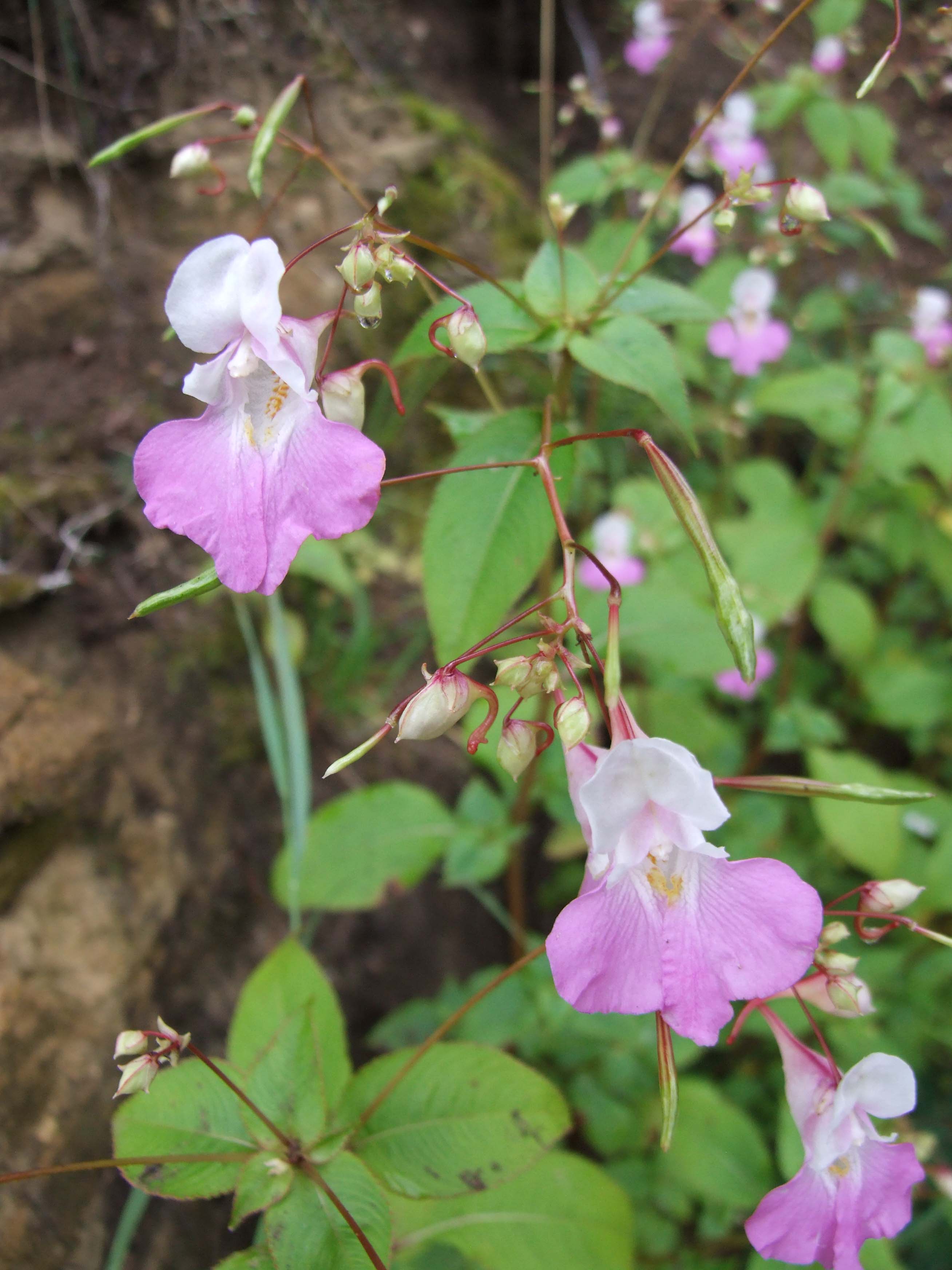
Impatiens balfourii. Luxembourg, Kirchberg. Photo: Roland Proess, 5 August 2016.

Impatiens balfourii Hook.f. was first observed in Luxembourg in the wild in 2016, on the edge of the Kirchberg plateau by Roland Proess. It is at present considered to be subspontaneous; it may however have the potential to become naturalised in Luxembourg due to climate change.

Yves Krippel & Roland Proess have written a detailed article on the subject which was published in the Bulletin of the Luxembourg Naturalist Society:

  • Krippel, Y. & R. Proess, 2017. Impatiens balfourii Hook.f. (Balsaminaceae), nouvelle espèce subspontanée au Luxembourg ?. Bull. Soc. Nat. luxemb. 119: 55-61. [PDF 2,72 MB]

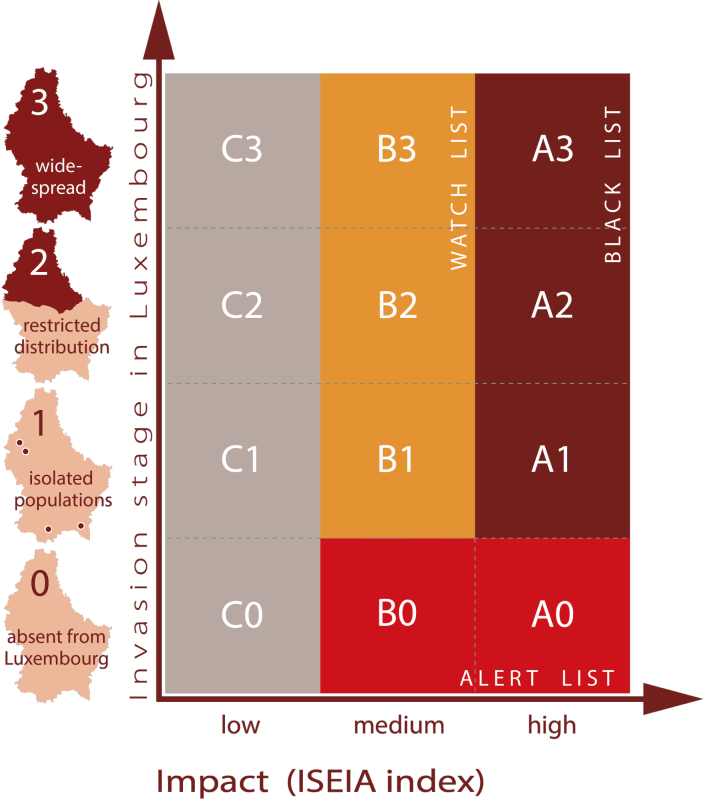
Impatiens balfourii has been assessed according to the ISEIA protocol by Yves Krippel and Christian Ries: B1, Watch List.

Two other invasive alien balsam species occur in Luxembourg: the Himalayan balsam (Impatiens glandulifera Royle), one of the most common and widespread invasive neophytes in Luxembourg, and the small balsam (Impatiens parviflora DC.), which is widespread in forest ecosystems across Luxembourg.

 Page content last updated on 2019-11-12. Last proofread by Caroline Grounds on 2019-11-12.
Impatiens balfourii Hook.f.

English Balfour’s touch-me-not, Kashmir balsam Status LU: casual. 1st record: LU <1995, ITW 2016.
Lëtzebuergesch Balfour-Sprangkraut Status Eur.: established. 1st record: FR ~1890. 1
Français Impatiente, balsamine de Balfour RA: ISEIA: B1 – Watch List. Harmonia+: 0,09.
Deutsch Balfour’s Springkraut Wikipedia: Wikipedia - English - Himalayan Balsam Wikipedia - Français - Impatiente de l'Inde | Wikispecies: Wikispecies - Impatiens glandulifera | CABI
Nederlands Tweekleurig springzaad Back to the list of neophytes

Brief description

Impatiens balfourii9Impatiens balfourii Hook.f. is a species of the genus Impatiens known by the common names Balfour’s touch-me-not, Kashmir balsam, and Poor Man’s Orchid. It belongs to the family Balsaminaceae. It is native to the Himalayas, particularly Kashmir and surrounding areas, where it grows on mountains of 5,000 to 6,000 feet. It was brought back to England and many other European countries as a garden plant. It can now be found growing wild as a garden escapee in Europe. In the wild the plant occurs along the banks of rivers, on roadsides, and in wastelands. It thrives in cool and moist areas, at an altitude of 100–600 m above sea level (Wikipedia contributors 2019).

Status and distribution in Luxembourg

Records of Impatiens balfourii Hook.f. in Luxembourg. Data source: Recorder-Lux, iNaturalist & GBIF, 2021-04-22.

In Luxembourg, Impatiens balfourii Hook.f. was first observed in 2009 in the Mediterranian Garden in Schwebsange, when “Natur & Ëmwelt Fondatioun Hëllef fir d’Natur” took over the management of the premises. The former owners recalled having brought the species from a trip to Lago Maggiore in Northern Italy in the late 1980ies or early 1990ies (Moes 2021). We thus assume the 1st record of the species is to be dated before 1995.

The species was first observed in the wild by Roland Proess on 2016-08-05 at Schëttermarjal on the edge of the Kirchberg plateau in Luxembourg City (Krippel & Proess 2017). The species is at present considered to be subspontaneous; it may however have the potential of becoming naturalised in Luxembourg due to climate change (Krippel & Proess 2017).

A second observation of this melliferous Himalayan species was made on 2020-08-28 on a ruderal stand next to a stone wall in Neudorf (MNHNL, iNaturalist & GBIF 2021).

Cultivated as an ornamental garden plant. Found subspontaneously here and there, or sometimes naturalised locally, especially in the south (Lambinon & Verloove 2012: 480).

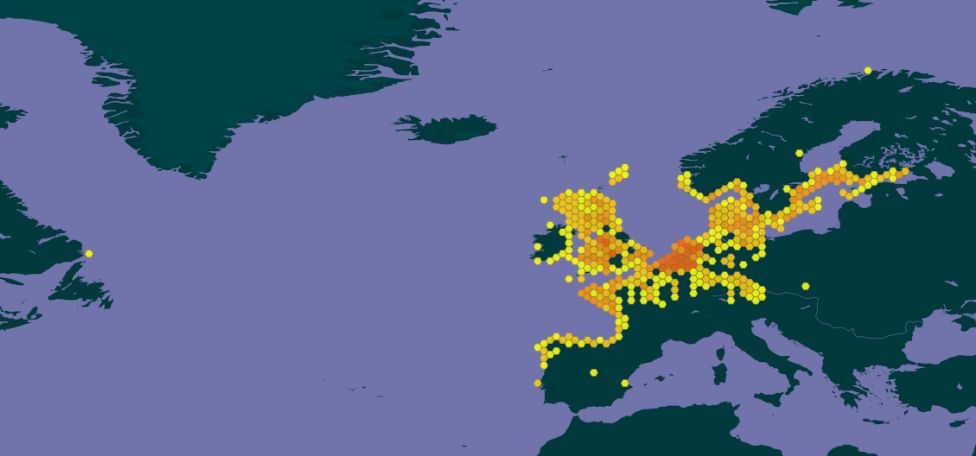
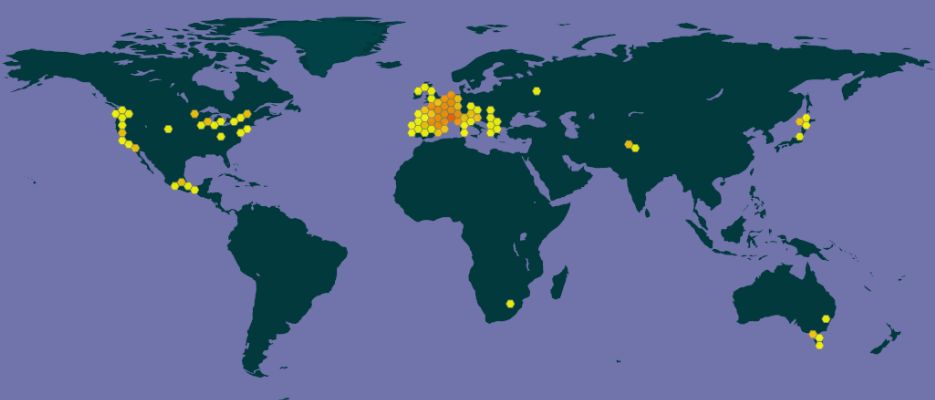
Impatiens balfourii has its origins in the west Himalayan region (Grey-Wilson 1983). This species of the Balsaminaceae family was simultaneously introduced in 1901 at the Jardin des plantes de Montpellier and the Botanical Garden of Edinburgh (Adamowski 2009). It has been cultivated in Europe as an ornamental plant since the beginning of the 20th century; in Luxembourg it is grown, for example, in the Jardin méditerranéen in Schwebsange. Nowadays the species is naturalised in major parts of south and central Europe (Adamowski 2009, Schmitz & Dericks 2010).

Other Impatiens taxa and hybrids

In 2011 the annual hybrid I. parviflora × I. balfourii was discovered in the canton of Ticino in Switzerland. The fertile hybrid with alternating leaves can be up to 60 cm high. Considerable populations of the hybrid were observed in 2014 in the canton of Ticino in the absence of the parent species (Van Valkenburg et al. 2019).

Three other alien balsam species occur in Luxembourg:

  • Impatiens balsamina L.: the garden balsam is already mentioned in Krombach’s flora of 1875 as “Introduced from the East Indies and grown in all gardens” (Krombach 1875: 56).
  • Impatiens glandulifera Royle: the invasive Himalayan Balsam, which is widespread in riparian ecosystems and forests across Luxembourg.
  • Impatiens parviflora DC.: the small balsam, which is widespread in forests across Luxembourg.

Risk assessment

ISEIA protocol

B1 (3+3+3+1) = Watch List. First assessed 16 February 2017 by Yves Krippel and Christian Ries.

Harmonia+ protocol

Overall risk score 0,09 = (Overall Invasion score 0,17 x Overall Impact score 0,30) (Ries et al. 2020).

0,17Invasion
0,30Impact
0,09Risk

Worldwide distribution

Bibliography

  • Adamowski, W., 2009. Impatiens balfourii as an emerging invader in Europe. Neobiota 8: 183-194.
  • CABI, 2019. Impatiens balfourii. In: Invasive Species Compendium. Wallingford, UK: CAB International. URL: www.cabi.org/isc [accessed 2020-03-02]
  • GBIF, 2020. Impatiens balfourii Hook.f. in GBIF Secretariat (2019). GBIF Backbone Taxonomy. Checklist dataset https://doi.org/10.15468/39omei [accessed 2020-03-02]
  • Grey-Wilson, C., 1983. A survey of the genus Impatiens in cultivation. The Plantsman 5(2): 86-102.
  • Krippel, Y. & R. Proess, 2017. Impatiens balfourii Hook.f. (Balsaminaceae), nouvelle espèce subspontanée au Luxembourg ?! Bull. Soc. Nat. luxemb. 119: 55-61 [PDF].
  • Lambinon J. & F. Verloove, 2012. Nouvelle flore de la Belgique, du grand-duché de Luxembourg, du Nord de la France et des régions voisines. Sixième édition. Avec la collaboration de L. Delvosalle, B. Toussaint, D. Geerinck, I. Hoste, F. Van Rossum, B. Cornier, R. Schumacker, A. Vanderpoorten et H. Vannerom. Jardin botanique national de Belgique, Meise. CXXXIX + 1195 pp. ISBN : 9789072619884.
  • Matthews, J., R. Beringen, E. Boer, H. Duistermaat, B. Odé, J. L. C. H. van Valkenburg, G. van der Velde & R. S. E. W. Leuven, 2015. Risks and management of non-native Impatiens species in the Netherlands. Ed. by Radboud University, FLORON and Naturalis Biodiversity Center, Reports Environmental Science 491, 2015. 177 S. [PDF]
  • MNHNL, 2000-. Impatiens balfourii Hook.f. in Recorder-Lux, database on the natural heritage of the Grand Duchy of Luxembourg. Musée national d’histoire naturelle, Luxembourg. URL: https://mdata.mnhn.lu [Accessed 2019-10-11]
  • MNHNL, iNaturalist & GBIF, 2021. Impatiens balfourii Hook.f. in MNHNL-mdata, online portal combining species observation from Recorder-Lux, iNaturalist and GBIF. National Museum of Natural History, Luxembourg. URL: https://mdata.mnhn.lu [Accessed 2021-01-12]
  • Moes, G., 2021. Personal communication by E-mail to Yves Krippel on 2021-01-09.
  • Ries, C. & Y. Krippel, 2021 [Unpublished manuscript]. First records of 56 invasive alien vascular plants in Luxembourg. MNHNL & Naturpark Öewersauer.
  • Ries, C., Y. Krippel & M. Pfeiffenschneider, 2020. Risk assessment after the Harmonia+ protocol of invasive alien vascular plant species in Luxembourg. Bull. Soc. Nat. luxemb. 122: 197-205. [PDF 132 KB]
  • Schmitz, U. & G. Dericks, 2010. Spread of alien invasive Impatiens balfourii in Europe and its temperature, light and soil moisture demands. Flora 205: 772-776.
  • Van Valkenburg, J. L. C. H., N. Schoenenberger, B. T. L. H. van de Vossenberg, W. A. Man in’t Veld, M. Westenberg & E. Boer, 2019. A natural hybrid of Impatiens, in the introduced range, demonstrated by sequence analysis of the nuclear ribosomal DNA-gene repeat. Botany Letters 166: 144-152.
  • Wikipedia contributors, 2019. Impatiens balfourii Hook.f. in Wikipedia, The Free Encyclopedia, 22 September 2019, 14:49 UTC, <https://en.wikipedia.org/w/index.php?title=Impatiens_balfourii&oldid=917160050> [accessed 2019-10-11]

 Page content last updated on 2021-04-12. Last proofread by Caroline Grounds on 2019-11-19.

Pectinatella magnifica (Leidy, 1851)

English Magnificent bryozoan Status LU: established. 1st record: ~2011.
Lëtzebuergesch Schwamp-Moosdéierchen Status Eur.: established.
Français Pectinatelle RA: ISEIA: C1. Harmonia+: n/a.
Deutsch Schwammartiges Moostierchen Wikipedia: Wikipedia - English - Greater duckweed Wikipedia - Français - Lentille d'eau géante Wikipedia - Deutsch - Vielwurzelige Teichlinse Nederlands | Wikispecies: Wikispecies - Pectinatella magnifica
Nederlands n/a Back to the list of invertebrates

Brief description

Pectinatella magnifica 02Pectinatella magnifica, the magnificent bryozoan, is a member of the Bryozoa phylum, in the order Plumatellida. It is a colony of organisms that bind together; these colonies can sometimes be 60 centimeters in diameter. These organisms can be found mostly in North America with some in Europe. They are often found attached to objects, but can be found free floating as well. They form a translucent body with many star-like blooms along the outside. The density of the organism is similar to that of gelatin, and is easily breakable into smaller chunks (Wikipedia contributors 2018).

Status and distribution in Luxembourg

Records of Pectinatella magnifica (Leidy, 1851) in Luxembourg. Data source: Recorder-Lux, iNaturalist & GBIF, 2021-04-22.

In 2012 numerous colonies of Pectinatella magnifica (Leidy, 1851) (Bryozoa, Phylactolaemata) were discovered in the reservoir of Esch-sur-Sûre (Luxembourg) fed by the river Sûre. The colonies were particularly abundant in the shallow, warm and nutrient-rich water near the riverbank, but some colonies were spotted by divers in the reservoir at a depth of 8-9 m in one site and more than 20 m in another site. There is reliable evidence that Pectinatella was present, but less conspicuous and as such not identified, in 2011 and possibly already in 2010. P. magnifica was hitherto unrecorded in Luxembourg, but known from a site near the German-Luxembourg border near Nennig (Germany, Saarland) where statoblasts were found in 2001 (Massard et al. 2013).

Three records of the species are accessible through the MNHNL-mdata portal (MNHNL, iNaturalist & GBIF, 2021).

Risk assessment

ISEIA protocol

C1 (3+2+1+1) (Ries et al. 2017: 68).

Harmonia+ protocol

Not assessed yet.

Worldwide distribution

Bibliography

  • GBIF, 2019. Pectinatella magnifica (Leidy, 1851) in GBIF Secretariat (2019). GBIF Backbone Taxonomy. Checklist dataset https://doi.org/10.15468/39omei [accessed 2020-03-13]
  • Massard, J.A., G. Geimer & E. Wille, 2013. Apparition de Pectinella magnifica (Leidy, 1851) (Bryozoa, Phylactolaemata) dans le lac de barrage d’Esch-sur-Sûre (Luxembourg). Bulletin de la Société des naturalistes luxembourgeois 114: 131-148.
  • Massard, J.A. & G. Geimer, 2015. L’’histoire de la recherche bryozoologique au Luxembourg (Phylactolémates et Gymnolémates d’eau douce). Bull. Soc. Nat. luxemb. 116: 373-379. [PDF 1,35 MB]
  • MNHNL, iNaturalist & GBIF, 2021. MNHNL-mdata, online portal combining species observation from Recorder-Lux, iNaturalist and GBIF. National Museum of Natural History, Luxembourg. URL: https://mdata.mnhn.lu [Accessed 2021-04-14]
  • Ries, C., A. Arendt, C. Braunert, S. Christian, A. Dohet, A. Frantz, G. Geimer, M. Hellers, J. A. Massard, X. Mestdagh, R. Proess, N. Schneider & M. Pfeiffenschneider, 2017. Environmental impact assessment and black, watch and alert list classification after the ISEIA Protocol of invertebrates in Luxembourg. Bull. Soc. Nat. luxemb. 119: 63-70. [PDF 360 KB]
  • Wikipedia contributors, 2018. ‘Pectinatella magnifica’, Wikipedia, The Free Encyclopedia, 3 December 2018, 23:25 UTC, <https://en.wikipedia.org/w/index.php?title=Pectinatella_magnifica&oldid=871869936> [accessed 2020-03-13]

 Page content last updated on 2021-04-14. Last proofread by Caroline Grounds on 2019-11-12.

New up-to-date distribution maps on neobiota.lu

Records of Procyon lotor Linnaeus, 1758 in Luxembourg. Data source: Recorder-Lux, iNaturalist & GBIF, 2021-04-22.

The distribution maps on neobiota.lu are from now on up to date. Every time a page concerning a species present in Luxembourg is viewed, the distribution data are retrieved on the fly by a query sent to the Recorder-Lux database of the Luxembourg National Museum of Natural History.

These data are saved on the neobiota.lu server in GPX format and displayed using the OSM (Open Street Map) WordPress plugin.

 Page content last updated on 2020-12-08. Last proofread by Caroline Grounds on 2019-11-12.

IAS coordination group for Luxembourg created by Ministerial Order

On 21 November 2016 the Minister for the Environment, Carole Dieschbourg signed the Ministerial Order creating a coordination group for invasive alien species in Luxembourg, which was published in the Memorial on 28 November 2016.

Arrêté ministériel du 21 novembre 2016 portant création du groupe de coordination sur les espèces exotiques envahissantes au Luxembourg. Mémorial B – N° 121 du 28 novembre 2016. (PDF 29 KB)

 Page content last updated on 2019-11-12. Last proofread by Caroline Grounds on 2019-11-12.

Publication of a leaflet on Ambrosia artemisiifolia

In autumn 2016 the Department for the Environment of the Luxembourg Ministry of sustainable development and infrastructures edited a leaflet in German and French about Ambrosia artemisiifolia, in co-operation with the National Museum of Natural History and efor-ersa ingénieurs-conseils. It can be downloaded here in PDF format (4 MB each).

More information on the Common Ragweed in Luxembourg can be found in a dedicated article on this website.

flyer-cover-de   flyer-cover-fr

 Page content last updated on 2020-03-30. Last proofread by Caroline Grounds on 2019-11-12.

Cheiracanthium punctorium (Villers, 1789)

English Yellow sac spider 1 Status LU: established. 1st record: 1988.
Lëtzebuergesch Getëppelten Darfanger Status Eur.: established.
Français n/a RA: ISEIA: C2. Harmonia+: n/a.
Deutsch Ammendornfinger Wikipedia: Wikipedia - English - Yellow sac spider Wikipedia - Français - Chiroconthe ponctu Wikipedia - Deutsch - Ammen-Dornfinger Wikipedia - Nederlands - Grote bermzakspin | Wikispecies: Wikispecies - Cheiracanthium punctorium | wiki.arages.de
Nederlands Grote bermzakspin Back to the list of invertebrates

Brief description

Female Cheiracanthium punctorium in opened cocoon. Clutch of eggs in the Back of the cocoon.Cheiracanthium punctorium (Villers, 1789) lives in grasslands, preferring tall stalks. Being rather similar to several native Cheiracanthium species in its biology, C. punctorium should have no greater influence on the composition of native prey species in a colonised biotope. There may, however, be some competition with similar predators.

The species is known as quite aggressive when disturbed, especially pregnant or egg-protecting females. The chelicerae (fangs) of bigger individuals can easily penetrate through human skin and inject their venom. A bite of C. punctorium is painful and causes itching and swellings, and sometimes stronger reactions like vertigo, nausea, shivering, circulatory collapse and light fever. The symptoms usually decline after 24-30 hours. As the species leads a rather hidden lifestyle, the probability for bites should be rather small. There is a certain, but unfortunately sometimes overstated, media exposure of the species and its venomousness.

Status and distribution in Luxembourg

Records of Cheiracanthium punctorium (Villers, 1789) in Luxembourg. Data source: Recorder-Lux, iNaturalist & GBIF, 2021-04-22.

Cheiracanthium punctorium (Villers, 1789) was first documented in 1988 at the Aarnescht nature conservation reserve near Oberanven, municipality of Niederanven (Hermann 1998).

The species is rather thermophilous and therefore geographically restricted to the south of Luxembourg. Most observations have been made in dry grassland in the Moselle valley. Climate warming may favour further spread of the species.

Currently, 12 records of the species are accessible through the MNHNL-mdata portal; at the previously mentioned Aarnescht, and also at Roudebierg and Haard near Dudelange (MNHNL, iNaturalist & GBIF 2021).

Risk assessment

ISEIA protocol

C2 (2+2+2+1) (Ries et al. 2017: 68).

Harmonia+ protocol

Not assessed yet.

Distribution in Europe

Source: Arachnologische Gesellschaft (2020).

Bibliography

  • Arachnologische Gesellschaft, 2020. Atlas of the European Arachnids, accessed at https://atlas.arages.de [accessed 2020-03-05]
  • Hermann, E., 1998. Die Spinnen (Araneae) ausgewählter Halbtrockenrasen im Osten Luxemburgs. Bull. Soc. Nat. luxemb. 99: 189-199. [PDF 165KB]
  • MNHNL, 2000-. Cheiracanthium punctorium (Villers, 1789) in Recorder-Lux, database on the natural heritage of the Grand Duchy of Luxembourg. Musée national d’histoire naturelle, Luxembourg. URL: https://mdata.mnhn.lu [Accessed 2019-10-24]
  • MNHNL, iNaturalist & GBIF, 2021. Cheiracanthium punctorium (Villers, 1789) in MNHNL-mdata, online portal combining species observation from Recorder-Lux, iNaturalist and GBIF. National Museum of Natural History, Luxembourg. URL: https://mdata.mnhn.lu [Accessed 2019-10-24]
  • Ries, C., A. Arendt, C. Braunert, S. Christian, A. Dohet, A. Frantz, G. Geimer, M. Hellers, J. A. Massard, X. Mestdagh, R. Proess, N. Schneider & M. Pfeiffenschneider, 2017. Environmental impact assessment and black, watch and alert list classification after the ISEIA Protocol of invertebrates in Luxembourg. Bull. Soc. Nat. luxemb. 119: 63-70. [PDF 360 KB]
  • Schneider, N., 2003. Auf Spurensuche. 22. Op der Aarnescht. Regulus 12/03: 22
  • Thiel, M., 2016. Ein unheimlicher Zuwanderer. Eine südeuropäische Giftspinne zieht zunehmend nach Norden. Luxemburger Wort, 14.9.2016.

 Page content last updated on 2021-04-14. Last proofread by Caroline Grounds on 2019-12-05.

Argiope bruennichi (Scopoli, 1772)

English Wasp spider Status LU: established. 1st record: 1906.
Lëtzebuergesch Harespelspann Status Eur.: established.
Français Argiope frelon RA: ISEIA: C3. Harmonia+: n/a
Deutsch Wespenspinne Wikipedia: Wikipedia - English - Wasp spider Wikipedia - Français - Argiope frelon Wikipedia - Deutsch - Wespenspinne Nederlands | Wikispecies: Wikispecies | CABI
Nederlands Wespspin Back to the list of invertebrates

Brief description

Argiope_bruennichi_Belgrad_060714

Argiope bruennichi in a pasture near Frisange (14.07.2006)

Like many other members of its genus, Argiope bruennichi (Scopoli, 1772) shows striking yellow and black markings on its abdomen. The spider builds a spiral orb web at dawn or dusk, commonly in long grass a little above ground level (Wikipedia contributors 2019a).

Until around 50 years ago, the wasp spider was widespread in southern Europe, and very rarely present in central Europe. Since then the species has greatly enlarged and extended its area. Now it can be found in almost all European countries, as well as in some Asian and North African countries (Wikipedia contributors 2019b). The rapid spread of the species across Europe is generally thought to be facilitated by climate warming.

On sites where this strikingly marked spider occurs, the individual number can be very high. Argiope bruennichi populations might be a certain threat for rare species of their favourite prey and provoke changes in invertebrate communities of conquered sites. However the spider seems to integrate rather well in invaded countries, causing no great damage.

Status and distribution in Luxembourg

Records of Argiope bruennichi (Scopoli, 1772) in Luxembourg. Data source: Recorder-Lux, iNaturalist & GBIF, 2021-04-22.

Argiope bruennichi (Scopoli, 1772) was first documented by Dr Ernest Feltgen on 24 August 1906 in Lintgen (Weinachter 1906; MNHNL 2000-).

Currently, 188 records of the wasp spider are accessible through the MNHNL-mdata portal (MNHNL, iNaturalist & GBIF 2019).

The species can be considered as widespread in the Grand Duchy.

Risk assessment

ISEIA protocol

C3 (2+2+2+2) (Ries et al. 2017: 68).

Harmonia+ protocol

Not assessed yet.

Worldwide distribution

Bibliography

  • CABI, 2019. Argiope bruennichi. In: Invasive Species Compendium. Wallingford, UK: CAB International. URL: www.cabi.org/isc [accessed 2020-03-04]
  • MNHNL, 2000-. Argiope bruennichi (Scopoli, 1772) in Recorder-Lux, database on the natural heritage of the Grand Duchy of Luxembourg. Musée national d’histoire naturelle, Luxembourg. URL: https://mdata.mnhn.lu [Accessed 2019-10-16]
  • MNHNL, iNaturalist & GBIF, 2019. Argiope bruennichi (Scopoli, 1772) in MNHNL-mdata, online portal combining species observation from Recorder-Lux, iNaturalist and GBIF. National Museum of Natural History, Luxembourg. URL: https://mdata.mnhn.lu [Accessed 2019-10-16]
  • Ries, C., A. Arendt, C. Braunert, S. Christian, A. Dohet, A. Frantz, G. Geimer, M. Hellers, J. A. Massard, X. Mestdagh, R. Proess, N. Schneider & M. Pfeiffenschneider, 2017. Environmental impact assessment and black, watch and alert list classification after the ISEIA Protocol of invertebrates in Luxembourg. Bull. Soc. Nat. luxemb. 119: 63-70. [PDF 360 KB]
  • Weinachter, P., 1906. Comptes Rendus des Séances Fauna 16, 10: 215. [eluxembourgensia]
  • Weiss, J., 1992. Die Ecke des Naturbeobachters. Regulus 3/92: 96-97.
  • Wikipedia contributors, 2019a. Argiope bruennichi (Scopoli, 1772) in Wikipedia, The Free Encyclopedia. URL: https://en.wikipedia.org/w/index.php?title=Argiope_bruennichi&oldid=921986406 [accessed 24 October 2019]
  • Wikipedia contributors, 2019b. Argiope bruennichi (Scopoli, 1772) in Wikipedia, Die freie Enzyklopädie. URL: https://de.wikipedia.org/w/index.php?title=Wespenspinne&oldid=192274595 [accessed 24 October 2019]

 Page content last updated on 2020-04-28. Last proofread by Caroline Grounds on 2019-12-04.

Corbicula fluminalis (O.F. Müller, 1774)

English n/a Status LU: established. 1st record: 1996.
Lëtzebuergesch Asiatesch Kuerfmuschel Status Eur.: established.
Français Corbicule asiatique RA: ISEIA: A2, Black List. Harmonia+: n/a.
Deutsch Feingerippte Körbchenmuschel Wikipedia: Wikipedia - English - Corbicula fluminalis Wikipedia - Français - Corbicula fluminalis Wikipedia - Deutsch - Nederlands | Wikispecies: n/a (2020) | CABI
Nederlands Toegeknepen korfmossel Back to the list of invertebrates

Brief description

Feingerippte, innen und außenCorbicula fluminalis (O.F. Müller, 1774) is a species of freshwater clam, an aquatic bivalve mollusk in the family Cyrenidae. This species is distinct from, but often confused with, the rather similar species Corbicula fluminea. Even though both species are native to Asia, they are both present as introduced species in the United States and Europe, and they are both commonly known as “Asian clams” (Wikipedia contributors 2019).

The original distribution area of Corbicula fluminalis includes the Near East (the type material came from the Euphrates), Central Asia (Uzbekistan) and the Caucasus (Azerbaijan) and North Africa. The animals prefer to live on sandy and muddy river bottoms. Corbicula fluminalis is found today in almost all major Central European rivers, often sympatric with Corbicula fluminea (Wikipedia Editor 2019).

Status and distribution in Luxembourg

Records of Corbicula fluminalis (O.F. Müller, 1774) in Luxembourg. Data source: Recorder-Lux, iNaturalist & GBIF, 2021-04-22.

In Luxembourg, Corbicula fluminalis (O.F. Müller, 1774) was first found by Klaus Groh on 17 June 1996 in the Moselle river in the municipality of Remich (MNHNL 2000-, Bachmann & Usseglio-Polatera 1999).

Currently, 8 records (1996-2002) of Corbicula fluminalis are accessible through the MNHNL-mdata portal, all of them from the Moselle river (MNHNL, iNaturalist & GBIF 2019).

Risk assessment

ISEIA protocol

A2 (3+3+3+3) = Black List (Ries et al. 2017: 68).

Harmonia+ protocol

Not assessed yet.

Worldwide distribution

Bibliography

  • Bachmann V. & P. Usseglio-Polatera, 1999. Contribution of the macrobenthic compartment to the oxygen budget of a large regulated river: the Mosel. Hydrobiologia. 410 (17), 39-46.
  • CABI, 2019. Corbicula fluminalis (O.F. Müller, 1774). In: Invasive Species Compendium. Wallingford, UK: CAB International. URL: www.cabi.org/isc [accessed 2020-04-21]
  • MNHNL, 2000-. Corbicula fluminalis (O.F. Müller, 1774) in Recorder-Lux, database on the natural heritage of the Grand Duchy of Luxembourg. Musée national d’histoire naturelle, Luxembourg. URL: https://mdata.mnhn.lu [Accessed 2019-10-24]
  • MNHNL, iNaturalist & GBIF, 2019. Corbicula fluminalis (O.F. Müller, 1774) in MNHNL-mdata, online portal combining species observation from Recorder-Lux, iNaturalist and GBIF. National Museum of Natural History, Luxembourg. URL: https://mdata.mnhn.lu [Accessed 2019-10-24]
  • Ries, C., A. Arendt, C. Braunert, S. Christian, A. Dohet, A. Frantz, G. Geimer, M. Hellers, J. A. Massard, X. Mestdagh, R. Proess, N. Schneider & M. Pfeiffenschneider, 2017. Environmental impact assessment and black, watch and alert list classification after the ISEIA Protocol of invertebrates in Luxembourg. Bull. Soc. Nat. luxemb. 119: 63-70. [PDF 360 KB]
  • Wikipedia Bearbeiter, 2019. Feingerippte Körbchenmuschel. In: Wikipedia, Die freie Enzyklopädie. Bearbeitungsstand: 20. Dezember 2019, 15:19 UTC. URL: https://de.wikipedia.org/w/index.php?title=Feingerippte_K%C3%B6rbchenmuschel&oldid=195082277 [accessed 2020-04-21]
  • Wikipedia contributors, 2019. Corbicula fluminalis, Wikipedia, The Free Encyclopedia, 10 April 2019, 21:39 UTC, <https://en.wikipedia.org/w/index.php?title=Corbicula_fluminalis&oldid=891900774> [accessed 2020-04-21]

 Page content last updated on 2020-04-28.

Corbicula fluminea (O.F. Müller, 1774)

English Asian clam Status LU: established. 1st record: 1996.
Lëtzebuergesch Kleng asiatesch Kuerfmuschel Status Eur.: established.
Français Palourde asiatique RA: ISEIA: A2, Black List. Harmonia+: n/a.
Deutsch Asiatische Körbchenmuschel Wikipedia: Wikipedia - English - Asian clam Wikipedia - Français - Palourde asiatique Wikipedia - Deutsch - Asiatische Körbchenmuschel Nederlands | Wikispecies: n/a (2020) | CABI
Nederlands Aziatische korfmossel Back to the list of invertebrates

Brief description

Corbicula flumineaCorbicula fluminea (O.F. Müller, 1774) is an inland water, filter-feeding bivalve native to southeast Asia but causing numerous problems in its new range of distribution in the Americas, Europe and Australia. C. fluminea spreads when it is attached to boats or carried in ballast water, used as bait, sold through the aquarium trade and carried with water currents. Its reproductive success and ability to spread rapidly has resulted in this species having one of the most rapid expansions of any non-native species in North America. Before the invasion of the zebra mussel Dreissena polymorpha, in North America, C. fluminea was described by McMahon (1983) as ‘one of the most important molluscan pest species ever introduced into the United States’. Aldridge and Muller (2001) review the potential impacts that the spread of C. fluminea may have on British industry and aquatic systems. In the DAISIE project, C. fluminea is listed on the 100 worst invasive species (CABI 2019).

Status and distribution in Luxembourg

Records of Corbicula fluminea (O.F. Müller, 1774) in Luxembourg. Data source: Recorder-Lux, iNaturalist & GBIF, 2021-04-22.

In Luxembourg, Corbicula fluminea (O.F. Müller, 1774) was first documented by Klaus Groh on 17 June 1996 in the Moselle river in the municipality of Remich (MNHNL 2000-). It was expected by 1995 that the species would soon appear in the Moselle (Dhur & Massard 1995: 150).

Currently, 16 records are accessible through the MNHNL-mdata portal (MNHNL, iNaturalist & GBIF 2019).

Risk assessment

ISEIA protocol

A2 (3+3+3+3) = Black List (Ries et al. 2017: 68).

Harmonia+ protocol

Not assessed yet.

Worldwide distribution

Bibliography

  • CABI, 2019. Corbicula fluminea (O.F. Müller, 1774). In: Invasive Species Compendium. Wallingford, UK: CAB International. URL: www.cabi.org/isc [accessed 2020-04-21]
  • Dhur, G. & J.A. Massard, 1995. Étude historique et faunistique des Invertébrés immigrés ou introduits dans la Moselle luxembourgeoise et ses affluents. Bull. Soc. Nat. luxemb. 96: 127-156. [PDF 1896 KB]
  • MNHNL, 2000-. Corbicula fluminea (O.F. Müller, 1774) in Recorder-Lux, database on the natural heritage of the Grand Duchy of Luxembourg. Musée national d’histoire naturelle, Luxembourg. URL: https://mdata.mnhn.lu [Accessed 2019-10-24]
  • MNHNL, iNaturalist & GBIF, 2019. Corbicula fluminea (O.F. Müller, 1774) in MNHNL-mdata, online portal combining species observation from Recorder-Lux, iNaturalist and GBIF. National Museum of Natural History, Luxembourg. URL: https://mdata.mnhn.lu [Accessed 2019-10-24]
  • Ries, C., A. Arendt, C. Braunert, S. Christian, A. Dohet, A. Frantz, G. Geimer, M. Hellers, J. A. Massard, X. Mestdagh, R. Proess, N. Schneider & M. Pfeiffenschneider, 2017. Environmental impact assessment and black, watch and alert list classification after the ISEIA Protocol of invertebrates in Luxembourg. Bull. Soc. Nat. luxemb. 119: 63-70. [PDF 360 KB]

 Page content last updated on 2020-04-28.