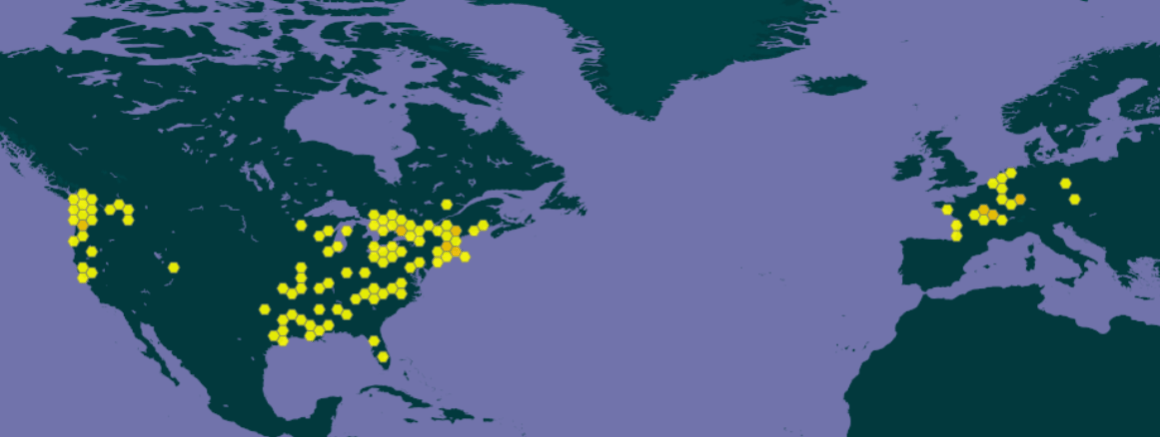
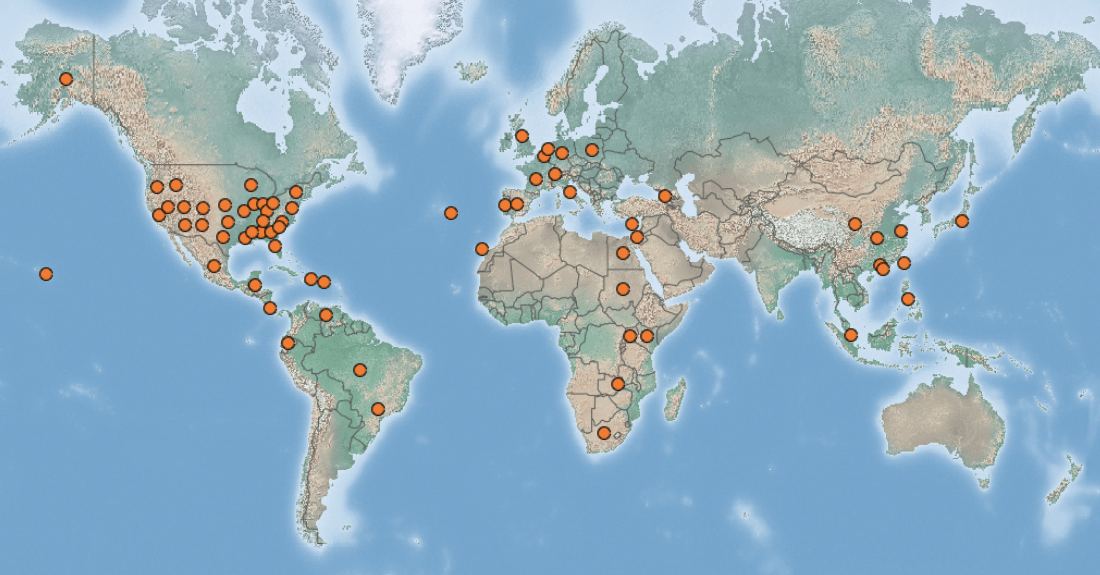
Pectinatella magnifica, the magnificent bryozoan, is a member of the Bryozoa phylum, in the order Plumatellida. It is a colony of organisms that bind together; these colonies can sometimes be 60 centimeters in diameter. These organisms can be found mostly in North America with some in Europe. They are often found attached to objects, but can be found free floating as well. They form a translucent body with many star-like blooms along the outside. The density of the organism is similar to that of gelatin, and is easily breakable into smaller chunks (Wikipedia contributors 2018).
Status and distribution in Luxembourg
Records of Pectinatellamagnifica (Leidy, 1851) in Luxembourg. Data source: Recorder-Lux, iNaturalist & GBIF, 2026-10-14.
In 2012 numerous colonies of Pectinatella magnifica (Leidy, 1851) (Bryozoa, Phylactolaemata) were discovered in the reservoir of Esch-sur-Sûre (Luxembourg) fed by the river Sûre. The colonies were particularly abundant in the shallow, warm and nutrient-rich water near the riverbank, but some colonies were spotted by divers in the reservoir at a depth of 8-9 m in one site and more than 20 m in another site. There is reliable evidence that Pectinatella was present, but less conspicuous and as such not identified, in 2011 and possibly already in 2010. P. magnifica was hitherto unrecorded in Luxembourg, but known from a site near the German-Luxembourg border near Nennig (Germany, Saarland) where statoblasts were found in 2001 (Massard et al. 2013).
Massard, J.A., G. Geimer & E. Wille, 2013. Apparition de Pectinella magnifica (Leidy, 1851) (Bryozoa, Phylactolaemata) dans le lac de barrage d’Esch-sur-Sûre (Luxembourg). Bulletin de la Société des naturalistes luxembourgeois 114: 131-148.
Massard, J.A. & G. Geimer, 2015. L’histoire de la recherche bryozoologique au Luxembourg (Phylactolémates et Gymnolémates deau douce). Bull. Soc. Nat. luxemb. 116: 373-379. [PDF 1,35 MB]
MNHNL, iNaturalist & GBIF, 2021. MNHNL-mdata, online portal combining species observation from Recorder-Lux, iNaturalist and GBIF. National Museum of Natural History, Luxembourg. URL: https://mdata.mnhn.lu [Accessed 2021-04-14]
Ries, C., A. Arendt, C. Braunert, S. Christian, A. Dohet, A. Frantz, G. Geimer, M. Hellers, J. A. Massard, X. Mestdagh, R. Proess, N. Schneider & M. Pfeiffenschneider, 2017. Environmental impact assessment and black, watch and alert list classification after the ISEIA Protocol of invertebrates in Luxembourg. Bull. Soc. Nat. luxemb. 119: 63-70. [PDF 360 KB]
Records of ProcyonlotorLinnaeus, 1758 in Luxembourg. Data source: Recorder-Lux, iNaturalist & GBIF, 2026-10-14.
The distribution maps on neobiota.lu are from now on up to date. Every time a page concerning a species present in Luxembourg is viewed, the distribution data are retrieved on the fly by a query sent to the Recorder-Lux database of the Luxembourg National Museum of Natural History.
These data are saved on the neobiota.lu server in GPX format and displayed using the OSM (Open Street Map) WordPress plugin.
Page content last updated on 2020-12-08. Last proofread by Caroline Grounds on 2019-11-12.
WordPress OSM plugin (Openstreetmaps & Open Layers)
http://wiki.openstreetmap.org/wiki/Wordpress
Function works
DONE: program web service to get GPS data from Recorder in GPX format. This web service is available at http://data.mnhn.lu/export/neobiota/get.php?taxon_list_item_key=MNHSYSCP00044946 where MNHSYSCP00044946 is the taxon key for Pinus nigra as an example
Maybe we will need some minor adaptations concerning for example the date_y of each observation.
DONE: program a function to fetch the actual GPS data for a taxon and save it in a GPX file in the directory https://neobiota.lu/gpx/.
Adapt the function to be able to transmit the taxon key as a variable within the function shortcode (show_gpx).
If the server of Recorder is down for some reason (= the query has no result), then the existing file should not be overwritten as it will be used to display the map.
Insert the function shortcode (show_gpx) to every species page where data are available in the Recorder database.
The resulting map looks like this for Pinus nigra:
Lorem ipsum dolor sit amet, consectetur adipiscing elit. Etiam metus felis, iaculis et leo at, cursus fringilla nisi. Aenean volutpat nisi in velit luctus mollis. Donec in vehicula enim. Class aptent taciti sociosqu ad litora torquent per conubia nostra, per inceptos himenaeos. Mauris fringilla lobortis enim nec consectetur. Phasellus vitae iaculis libero, a posuere dui. Pellentesque habitant morbi tristique senectus et netus et malesuada fames ac turpis egestas. Vestibulum ornare felis ut aliquet feugiat. Curabitur a tristique magna, vel maximus augue. Maecenas eleifend elit magna, sit amet scelerisque urna posuere a. Curabitur felis dolor, eleifend in eros eget, maximus varius eros. Aenean hendrerit sollicitudin urna, id interdum erat dapibus eu. Lorem ipsum dolor sit amet, consectetur adipiscing elit. Aliquam gravida magna tellus, vitae efficitur nisl volutpat vel. Curabitur felis dolor, eleifend in eros eget, maximus varius eros. Aenean hendrerit sollicitudin urna, id interdum erat dapibus eu. Lorem ipsum dolor sit amet, consectetur adipiscing elit. Aliquam gravida magna tellus, vitae efficitur nisl volutpat vel.
send query for a specific taxon to Recorder cache database
receive the data for the taxon as a text file with seperators
Parse the code and transform to gpx or kml on the fly
Include the gpx or kml file into OSM plugin
Points 2 & 3 could be merged if Recorder sends a ready to use gpx or kml file.
Maybe the solution should be, like Armand proposed, to automatically generate these kml files every day on the recorder server and to use them as OSM maps on the website.
Während déi Säit geluede gëtt schéckt e PHP-Skript op däer Säit eng Ufro un de Recorder oder un eng speziell Cache-Datebank.
Resultat ass een Datesaz, wou déi Quadranten all dra stinn, wou déi Aart virkënnt.
Déi Donnéeën ginn on the fly an en transparente Kaartelayer am SVG-Format a gedroen, ënnert deem eng spezifesch Kaart ugewise gëtt (do kann een verschidden Kaarten-Alternativen ubidden).
De Rescht vun der Säit gëtt gelueden an am Browser duergestallt.
Ech huelen jo un datt d’Verbreedung vun enger Aart a Quadranten am Recorder op reell präzis Koordinaten baséiert. Fir d’Duerstellung a km2-Quadranten rechent de Recorder dat jo ëm a wees a wat fir eng Quadranten déi Aart virkënnt.
Hunn d’km2-Quadranten am Recorder all eng Nummer oder Koordinaten?
Egal wéi déi Donnéeë virleien, si kënnen jo an engem standardiséierte Format produzéiert ginn oder an enger Cache-Datebank zur Verfügung gestalt ginn, déi regelméisseg automatesch à jour gesat gëtt.
Esou een Datesaz aus dem Recorder kéint dann esou ausgesinn:
Ech wier frou wa mer kéinten esou en einfache Query oder esou eng einfach Cache-Datebank séier zur Verfügung gest
alt kréien sou datt mir dëst deemnächst kéinten op neobiota.lu implementéieren. Dee selwechte Code kéint dann och benotzt ginn fir Verbreedungskaarten op mnhn.lu duerzestellen.
On 21 November 2016 the Minister for the Environment, Carole Dieschbourg signed the Ministerial Order creating a coordination group for invasive alien species in Luxembourg, which was published in the Memorial on 28 November 2016.
Arrêté ministériel du 21 novembre 2016 portant création du groupe de coordination sur les espèces exotiques envahissantes au Luxembourg. Mémorial B – N° 121 du 28 novembre 2016. (PDF 29 KB)
Page content last updated on 2019-11-12. Last proofread by Caroline Grounds on 2019-11-12.
In autumn 2016 the Department for the Environment of the Luxembourg Ministry of sustainable development and infrastructures edited a leaflet in German and French about Ambrosia artemisiifolia, in co-operation with the National Museum of Natural History and efor-ersa ingénieurs-conseils. It can be downloaded here in PDF format (4 MB each).
VarroadestructorAnderson&Trueman, 2000 is an external parasitic mite that attack and feeds on the honey bees Apis cerana and Apis mellifera. The disease caused by the mites is called varroosis. The Varroa mite can only reproduce in a honey bee colony. It attaches to the body of the bee and weakens the bee by sucking fat bodies. The species is a vector for at least five debilitating bee viruses, including RNA viruses such as the deformed wing virus (DWV). A significant mite infestation leads to the death of a honey bee colony, usually in the late autumn through early spring. The Varroa mite is the parasite with possibly the most pronounced economic impact on the beekeeping industry. Varroa is considered to be one of multiple stress factors contributing to the higher levels of bee losses around the world.
The adult female mite is reddish-brown in color, while the male is white. Varroa mites are flat, having a button shape. They are 1–1.8 mm long and 1.5–2 mm wide, and have eight legs. Mites reproduce on a 10-day cycle (Wikipedia contributors 2020).
Status and distribution in Luxembourg
VarroadestructorAnderson&Trueman, 2000 was observed for the first time in Luxembourg in 1985 (Meisch 1986). Claude Meisch recalls: “At that time it was a delicate matter, no beekeeper wanted to admit that he had the parasite in his hives. I remember well that I was the first to admit in meetings that I had found Varroa in my hives. Probably Varroa was already widespread in the whole country at that time” (Meisch 2018).
In the 1980s, Varroa spread throughout the country and is nowadays present in every beehive.
There is no distribution map available because no data has been entered into the Recorder-Lux database so far (MNHNL, iNaturalist & GBIF 2019).
CABI, 2008. VarroadestructorAnderson&Trueman, 2000 [original text by Claire Beverley]. In: Invasive Species Compendium. Wallingford, UK: CAB International. URL: www.cabi.org/isc [accessed 2019-11-26]
MNHNL, iNaturalist & GBIF, 2019. MNHNL-mdata, online portal combining species observation from Recorder-Lux, iNaturalist and GBIF. National Museum of Natural History, Luxembourg. URL: https://mdata.mnhn.lu [Accessed 2019-10-24]
Meisch, C., 1986. Die Varroamilbe. Geschichte der Ausbreitung, Portrait und Biologie. Pp. 174-177 in: Livre d’or du centenaire 1886-1986. Fédération des unions d’apiculteurs du grand-duché de Luxembourg.
Meisch, C., 2018. Personal communication to Lucie Lentz during Summer 2018.
Ries, C., A. Arendt, C. Braunert, S. Christian, A. Dohet, A. Frantz, G. Geimer, M. Hellers, J. A. Massard, X. Mestdagh, R. Proess, N. Schneider & M. Pfeiffenschneider, 2017. Environmental impact assessment and black, watch and alert list classification after the ISEIA Protocol of invertebrates in Luxembourg. Bull. Soc. Nat. luxemb. 119: 63-70. [PDF 360 KB]
Opilio canestrinii is a species of harvestman. Males reach a body length up to 6 mm, females up to 8 mm. While males are yellowish brown to reddish, females are lighter. Males have dark legs, but yellow coxae and “knees”; the legs of females show alternately light and dark rings. The backs of females sport a dark, saddle-like pattern with a light longitudinal stripe in the middle. Adults can be found from June to December.
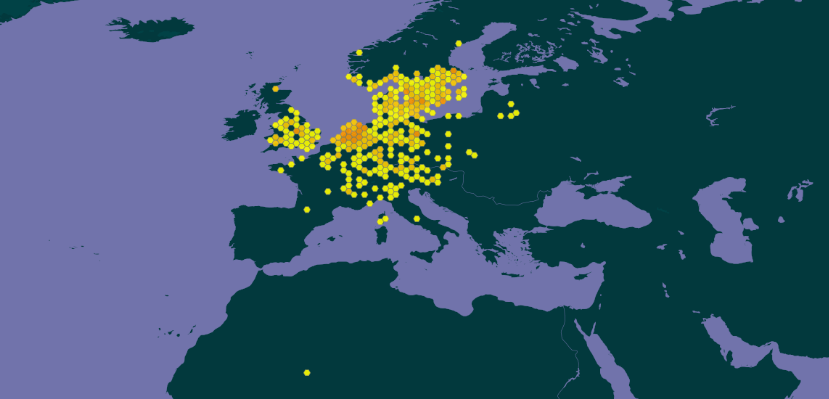
O. canestrinii probably originates from Italy, but has invaded Central Europe since the late 1970, and has since almost everywhere replaced the similar O. parietinus. It is most often found on house walls (Wikipedia contributors 2019).
Status and distribution in Luxembourg
Records of Opiliocanestrinii (Thorell, 1876) in Luxembourg. Data source: Recorder-Lux, iNaturalist & GBIF, 2026-10-14.
The first documented occurrence of the species in Luxembourg dates from 2009. It was found by C. Muster on 20th August 2009 in Fort Berlaimont (Municipality of Luxembourg).
Opilio canestrinii is the second most common harvestman in Luxembourg and can be found in every region of the country.
Opilio canestrinii colonises a number of open habitats independently of their moisture levels. It is very successful in man-made landscapes, even in bigger cities. It is a strong competitor to native species and seems able to displace or even replace them. There are indicators that the similar Opilio parietinus, traditionally a common species on house walls, has nearly vanished, just a few years after the arrival of O. canestrinii.
Several sources describe this harvestman as a typical species of urban areas. In Luxembourg however, the data provided from different projects show evidence that the species occurs in great numbers and important percentages even in close-to-nature areas. Since the 1960s, O. canestrinii has spread extremely quickly northwards through Europe and has become a more or less common species in their new areas.
MNHNL, iNaturalist & GBIF, 2020. Opilio canestrinii in MNHNL-mdata, online portal combining species observation from Recorder-Lux, iNaturalist and GBIF. National Museum of Natural History, Luxembourg. URL: https://mdata.mnhn.lu [Accessed 2020-03-05]
Muster, C. & M. Meyer, 2014. Verbreitungsatlas der Weberknechte des Großherzogtums Luxemburg. Ferrantia 70. Musée national d’histoire naturelle, Luxembourg, 112 S. (PDF 3.8 MB)
Ries, C., A. Arendt, C. Braunert, S. Christian, A. Dohet, A. Frantz, G. Geimer, M. Hellers, J. A. Massard, X. Mestdagh, R. Proess, N. Schneider & M. Pfeiffenschneider, 2017. Environmental impact assessment and black, watch and alert list classification after the ISEIA Protocol of invertebrates in Luxembourg. Bull. Soc. Nat. luxemb. 119: 63-70. [PDF 360 KB]
Weber, D. (Hrsg.), 2014. Die Höhlenfauna Luxemburgs. Ferrantia 69. Musée national d’histoire naturelle Luxembourg, 408 pp. + CD-Rom (PDF 19 MB)
Wikipedia contributors, 2019. Opilio canestrinii. Wikipedia, The Free Encyclopedia, 17 January 2019, 10:39 UTC, <https://en.wikipedia.org/w/index.php?title=Opilio_canestrinii&oldid=878854172> [accessed 2020-03-05]
Page content last updated on 2026-09-22. Last proofread by Caroline Grounds on 2019-12-10.
In 2015, six Dermacentor ticks were collected in SE-Luxembourg. Previously, these individuals had been identified as DermacentormarginatusLeach, 1815. However, morphological re-investigation as well as DNA barcoding identified the specimens as Dermacentorreticulatus (Fabricius, 1794). Thus only D. reticulatus is known from Luxembourg (Weigand et al. 2020).
Brief description
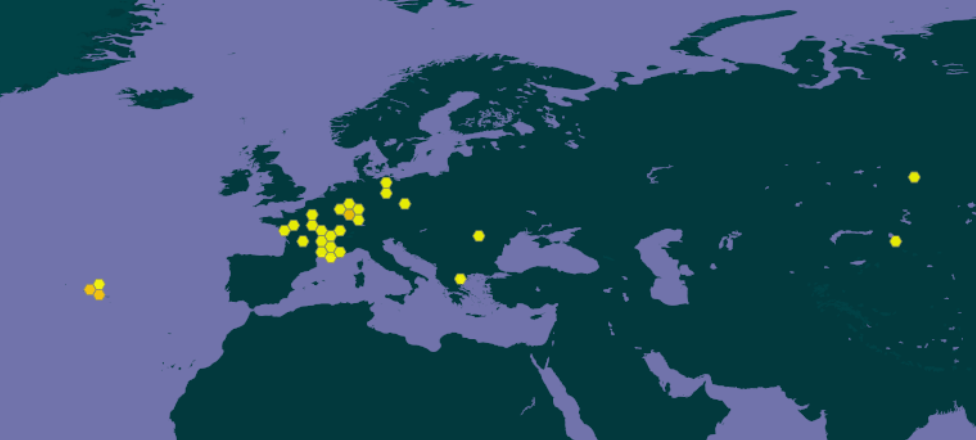
DermacentormarginatusLeach, 1815 is a species of tick of the family Ixodidae, which is a vector of several zoonotic diseases, which is why this tick is considered to pose particular eco-epidemiological and public health risks for humans (Wikipedia contributors 2019).
In Central Europe the sheep tick is the most common species of the genus. It lives here only in heat islands and on sunny slopes or dry grasslands. Mammals, including humans, are preferred as hosts. The animals of the genus transmit tularemia (Francisella tularensis), Rocky Mountain spotted fever (Rickettsia richettsii), Q-fever (Rickettsia burneti), bovine anaplasmosis, puppy-babesiosis (Babesia canis) (Source: http://www.ijon.de/zecken/system.html#zecke).
It is one of the species that could be favoured by global warming, which would allow it to move northwards, but also upwards (Wikipedia contributors 2019).
Status and distribution in Luxembourg
The tick DermacentormarginatusLeach, 1815 is absent from Luxembourg.
Risk assessment
ISEIA protocol
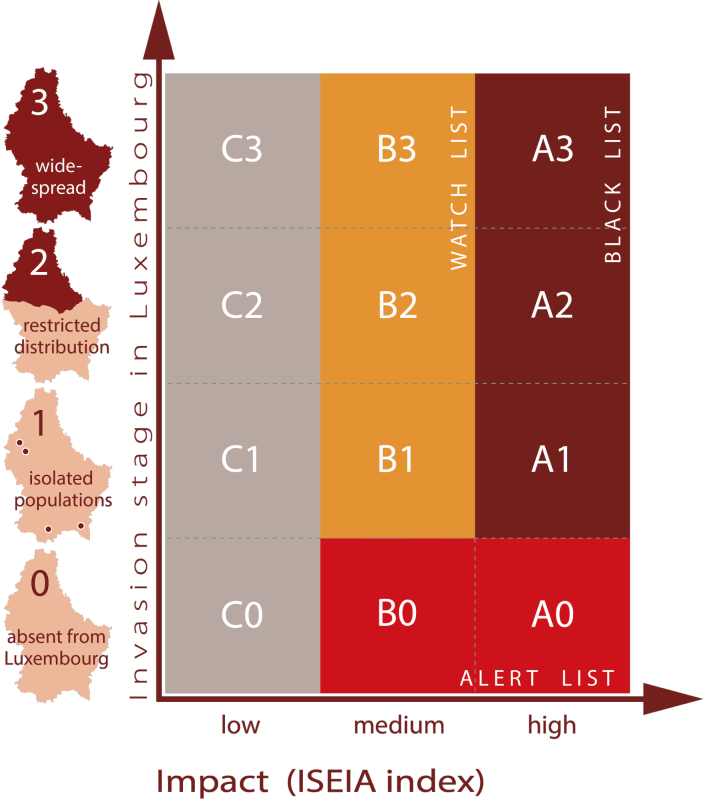
Following the morphological re-investigation as well as DNA barcoding that identified all the specimens as Dermacentorreticulatus (Fabricius, 1794) (Weigand et al. 2020), Dermacentor marginatus is considered absent from Luxembourg and was reassessed on 29 October 2020 to C0 (2+1+2+1). Initial assessment: C1 (2+1+2+1) (Ries et al. 2017: 68).
Ries, C., A. Arendt, C. Braunert, S. Christian, A. Dohet, A. Frantz, G. Geimer, M. Hellers, J. A. Massard, X. Mestdagh, R. Proess, N. Schneider & M. Pfeiffenschneider, 2017. Environmental impact assessment and black, watch and alert list classification after the ISEIA Protocol of invertebrates in Luxembourg. Bull. Soc. Nat. luxemb. 119: 63-70. [PDF 360 KB]
Weigand, A., J. Teixeira & S. Christian, 2020. First record of Hyalomma marginatum sensu stricto C.L. Koch, 1844 and distribution of Dermacentor reticulatus (Fabricius, 1794) (Acari, Ixodidae) in Luxembourg. Bull. Soc. nat. luxemb. 122 : 253-263.
Procambarusclarkii (Girard, 1852) is a species of cambarid freshwater crayfish, native to northern Mexico, and southern and southeastern United States, but also introduced elsewhere, where it is often an invasive pest. P. clarkii is typically dark red, with long claws and head, small or no spines on the sides of its carapace just below the head, and rows of bright red bumps on the front and side of the first leg (Wikipedia contributors 2020).
The red swamp crayfish is most commonly found in warm fresh water, such as slowly flowing rivers, marshes, reservoirs, irrigation systems and rice paddies. It is considered to be the most ecologically plastic species in the order Decapoda, and is able to grow quickly even in only seasonally present water, being able to tolerate dry spells of up to four months. The red swamp crayfish grows quickly, and is capable of reaching weights in excess of 50 g, and sizes of 5.5–12 cm long. It is also able to tolerate slightly saline water, which is unusual for a crayfish. Additionally, P. clarkii are physiologically capable of tolerating relatively low dissolved oxygen concentrations. The average lifetime of Procambarus clarkii is five years (Wikipedia contributors 2020).
The burrowing activities of the red swamp crayfish can lead to damage to water courses and to crops, particularly rice, and its feeding can disrupt native ecosystems. It may out-compete the native crayfish species, and is a vector for the crayfish plague fungus Aphanomyces astaci, for crayfish virus vibriosis, and a number of worms parasitic on vertebrates. Their burrowing activities may also be a threat to civil infrastructure such as storm ponds and levees (Wikipedia contributors 2020).
Status and distribution in Luxembourg
Records of Procambarusclarkii (Girard, 1852) in Luxembourg. Data source: Recorder-Lux, iNaturalist & GBIF, 2026-10-14.
The Louisiana crayfish was sighted in Luxembourg for the first time on 21 September 2021 in Lake Echternach. This discovery was made as part of the LUXIAS monitoring programme (a specific monitoring programme targeting invasive alien species) carried out by LIST (Luxembourg Institute of Science and Technology). In 2022, the ANF ran a trapping campaign using traps baited with fish pellets. Using 12 traps, a total of 267 Louisiana crayfish were caught between 26 August 2022 and 10 November 2022, including numerous egg-bearing females, females carrying larvae and juveniles. Currently (August 2026), Lake Echternach remains the only known location of the Louisiana crayfish in Luxembourg. An action plan relating to the species was published in 2024.
MNHNL, iNaturalist & GBIF, 2020. Procambarus clarkii in MNHNL-mdata, online portal combining species observation from Recorder-Lux, iNaturalist and GBIF. National Museum of Natural History, Luxembourg. URL: https://mdata.mnhn.lu [accessed 2026-08-13]
Ries, C., A. Arendt, C. Braunert, S. Christian, A. Dohet, A. Frantz, G. Geimer, M. Hellers, J. A. Massard, X. Mestdagh, R. Proess, N. Schneider & M. Pfeiffenschneider, 2017. Environmental impact assessment and black, watch and alert list classification after the ISEIA Protocol of invertebrates in Luxembourg. Bull. Soc. Nat. luxemb. 119: 63-70. [PDF 360 KB]
GammarustigrinusSexton, 1939 has eliminated some native species in parts of the river Rhine and the Baltic Sea; it is frequently a superior predator in comparison to indigenous species.
GammarustigrinusSexton, 1939 was first documented on 22 May 1991 in the Moselle river across from Bech-Kleinmacher, municipality of Schengen (Massard & Geimer 1992). Dhur (1993) showed that Gammarus tigrinus was present in the Moselle all the way from Schengen to Wasserbillig.
There is no distribution map available because no data has been entered into the Recorder-Lux database so far (MNHNL, iNaturalist & GBIF 2019).
Dhur, G., 1993. Étude des espèces d’invertébrés immigrées ou introduites dans la Moselle luxembourgeoise et dans les écosystèmes aquatiques qui en dépendent. Historique et répartition actuelle. Centre univ. Luxemb., Dép. Form. pédag., mém. sci., 213 pp.
Dhur, G. & J.A. Massard, 1995. Etude historique et faunistique des Invertébrés immigrés ou introduits dans la Moselle luxembourgeoise et ses affluents. Bull. Soc. Nat. luxemb. 96: 127-156. [PDF 1896 KB]
Massard, J.A. & G. Geimer, 1992. Découverte de Gammarus tigrinus Sexton, 1939 dans la Moselle frontalière entre le Luxembourg et l’Allemagne (Crustacea: Amphipoda). Bull. Soc. Nat. luxemb. 93: 195-198. [PDF 173 KB]
Meisch, C. & J.A. Massard, 2015. Les recherches sur les crustacés (Crustacea) du Luxembourg : aperçu historique. Bull. Soc. Nat. luxemb. 116: 381-390. [PDF 1,22 MB]
MNHNL, iNaturalist & GBIF, 2019. MNHNL-mdata, online portal combining species observation from Recorder-Lux, iNaturalist and GBIF. National Museum of Natural History, Luxembourg. URL: https://mdata.mnhn.lu [Accessed 2019-10-24]
Ries, C., A. Arendt, C. Braunert, S. Christian, A. Dohet, A. Frantz, G. Geimer, M. Hellers, J. A. Massard, X. Mestdagh, R. Proess, N. Schneider & M. Pfeiffenschneider, 2017. Environmental impact assessment and black, watch and alert list classification after the ISEIA Protocol of invertebrates in Luxembourg. Bull. Soc. Nat. luxemb. 119: 63-70. [PDF 360 KB]
Page content last updated on 2026-09-22. Last proofread by Caroline Grounds on 2019-12-10.


 | Wikispecies: