Brigittea civica (Lucas, 1850)

English n/a Status LU: established. 1st record: 2008.
Lëtzebuergesch Biergerlech Mauerspann1 Status Eur.: established.
Français n/a RA: ISEIA: C3. Harmonia+: n/a.
Deutsch Echte Mauerspinne2 Wikipedia: Wikipedia - English - Brigittea civica Nederlands - Zuiders kaardertje | Wikispecies: n/a (2017)
Nederlands Zuiders kaardertje Back to the list of invertebrates

Brief description

Brigittea civica 02

Syrio, CC BY-SA 4.0 Wikimedia Commons

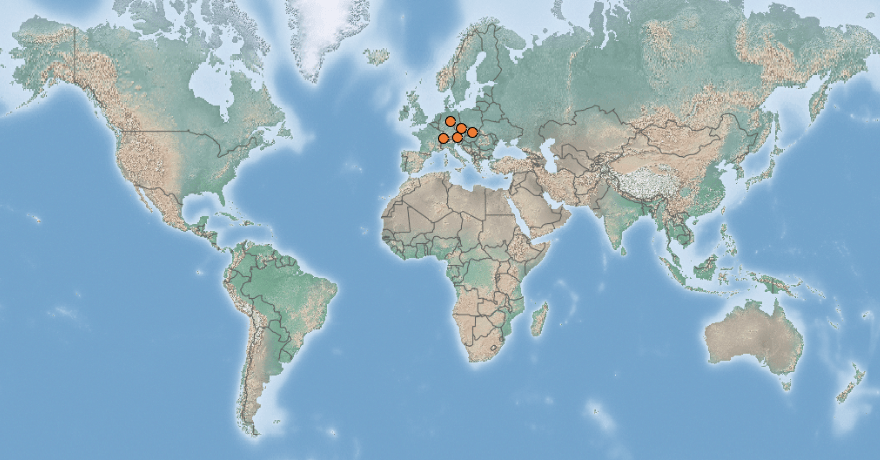
Brigittea civica (Lucas, 1850) is distributed in Europe, North Africa, Turkey, Iran and introduced to North America (Nentwig et al. 2020). In Central Europe, it is mainly known as a resident of house facades, which gave it the trivial name “wall spider”. On structured walls it spins around its hiding place, usually a recess in the plaster, a ruffled web up to the size of a palm. In this net not only the prey of the spider is caught, but also street dust, so that the settlement of even light-coloured house walls can be easily recognised from a distance (Hohner 2019). The species occurs synanthropically in central European conditions. It is well adapted to coexistence with humans, and since there is no natural enemy, it may freely redistribute (Novotný et al. 2017).

Status and distribution in Luxembourg

Records of Brigittea civica (Lucas, 1850) in Luxembourg. Data source: Recorder-Lux, iNaturalist & GBIF, 2026-09-21.

Since 2008, 30 occurrences of the species have been documented in Luxembourg in the Recorder-Lux database under it’s synonym Dictyna civica (MNHNL, iNaturalist & GBIF 2020). The status appears unclear and is estimated to be very common in Luxembourg. The current (2020) distribution is probably linked to the fact that the only person reporting the species is living in the Moselle area.

The status of the species seems unclear in other European countries, e.g. in the Czech Republic, where it is considered to probably be non-native; furthermore a study suggests that Brigittea civica is much more common than was previously mapped and the presence of this species in the Czech Republic was underestimated (Novotný et al. 2017).

Risk assessment

ISEIA protocol
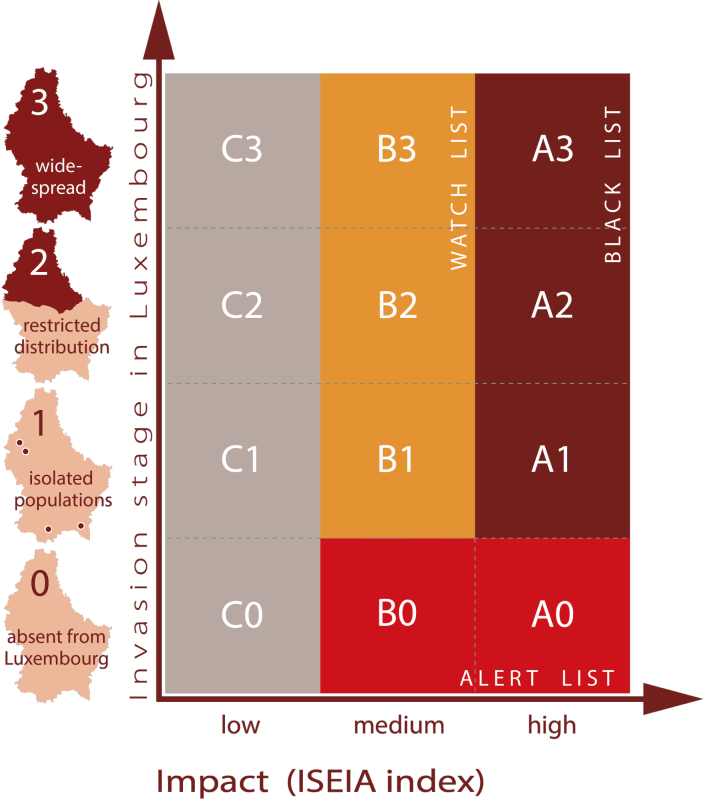
C3 (2+1+2+1) (Ries et al. 2017: 68).

Harmonia+ protocol

Not assessed yet.

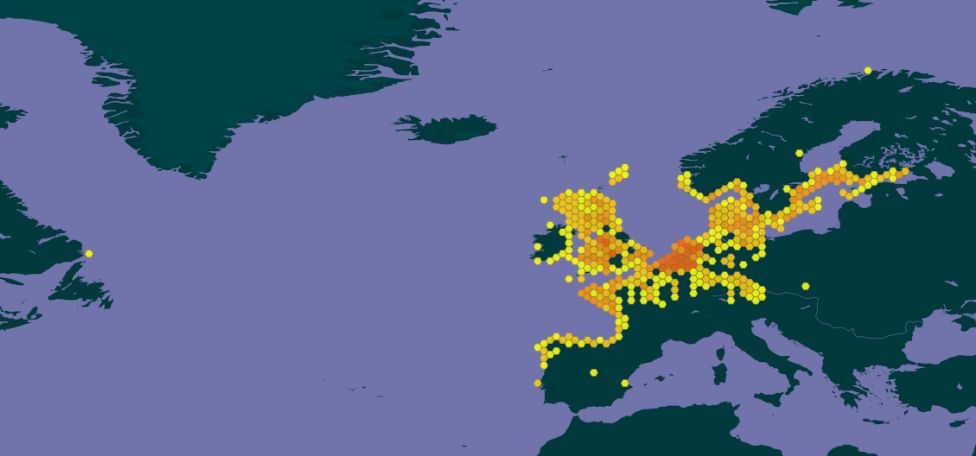
Distribution in Europe
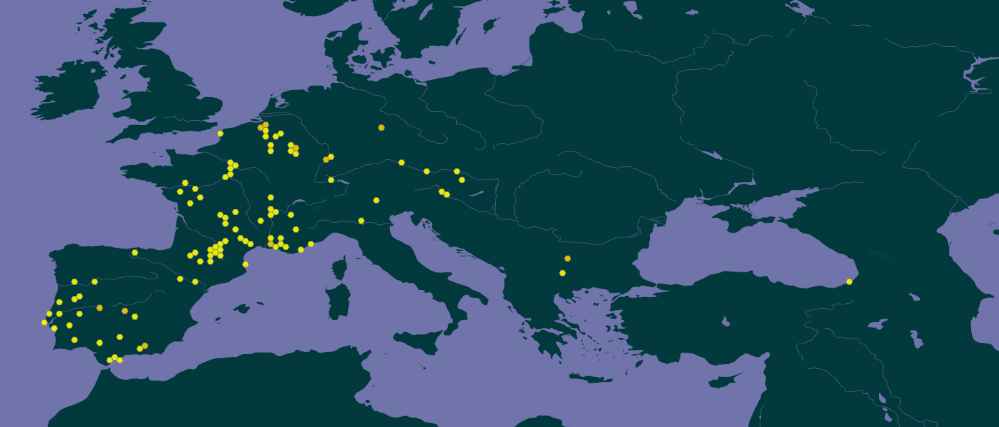
Source: https://www.gbif.org/species/7555806

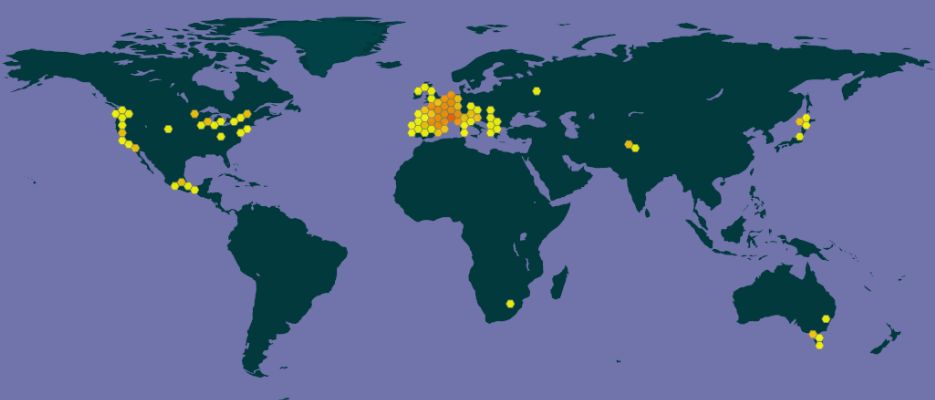
Worldwide distribution
Bibliography

  • CABI, 2019. Brigittea civica (Lucas, 1850) . In: Invasive Species Compendium. Wallingford, UK: CAB International. URL: www.cabi.org/isc [accessed 2020-03-04]
  • GBIF, 2020. Brigittea civica (Lucas, 1850) in GBIF Secretariat (2019). GBIF Backbone Taxonomy. Checklist dataset https://doi.org/10.15468/39omei [accessed 2020-03-04]
  • Hohner, M., 2019. Neue Nachweise von Brigittea civica (Araneae: Dictynidae) in Bayern. Arachnologische Mitteilungen: Arachnology Letters 57(1): 84-86.
  • MNHNL, iNaturalist & GBIF, 2020. in MNHNL-mdata, online portal combining species observation from Recorder-Lux, iNaturalist and GBIF. National Museum of Natural History, Luxembourg. URL: https://mdata.mnhn.lu [Accessed 2020-03-04]
  • Nentwig W, Blick T, Bosmans R, Gloor D, Hänggi A, Kropf C, 2020. Version {2}.2020. Online at https://www.araneae.nmbe.ch. https://doi.org/10.24436/1 [Accessed 2020-03-04]
  • Novotný, B., V. Hula & J. Niedobová, 2017. Insufficiency in Distributional Faunistic Data in Synanthropic Spiders: a Case Study of the Occurrence of Brigittea Civica (Araneae, Dictynidae) in South Moravia, Czech Republic. Acta Universitatis Agriculturae et Silviculturae Mendelianae Brunensis 65(3):899-906. DOI: 10.11118/actaun201765030899
  • Ries, C., A. Arendt, C. Braunert, S. Christian, A. Dohet, A. Frantz, G. Geimer, M. Hellers, J. A. Massard, X. Mestdagh, R. Proess, N. Schneider & M. Pfeiffenschneider, 2017. Environmental impact assessment and black, watch and alert list classification after the ISEIA Protocol of invertebrates in Luxembourg. Bull. Soc. Nat. luxemb. 119: 63-70. [PDF 360 KB]
  • Wiki der Arachnologischen Gesellschaft e. V.-Bearbeiter, 2020. Brigittea civica. Wiki der Arachnologischen Gesellschaft e. V. URL: https://wiki.arages.de/index.php?title=Brigittea_civica&oldid=118852 [accessed 2020-03-05]

 Page content last updated on 2026-09-20.

  1. Brigittea = DE: Mauerspinnen = LB: Mauerspannen. LA: Adj. civicus = LB: biergerlech.[]
  2. Cf. Wiki der Arachnologischen Gesellschaft e. V.-Bearbeiter (2020).[]

Cochlearia danica L.

English Danish scurvygrass Status LU: established. 1st record: LU & ITW 2011.
Lëtzebuergesch Dänescht Läffelblat Status Eur.: established.
Français Cochléaire du Danemark RA: ISEIA: C1. Harmonia+: 0,02
Deutsch Dänisches Löffelkraut Wikipedia: Wikipedia - English - Danish scurvygrass Wikipedia - Français - Wikipedia - Deutsch - Dänisches Löffelkraut Wikipedia - Nederlands - Deens lepelblad | Wikispecies: Wikispecies - Cochlearia danica
Nederlands Deens lepelblad Back to the list of neophytes

Brief description

Danish scurvygrass

Robert Flogaus-Faust, CC BY 4.0, via Wikimedia Commons

Cochlearia danica L. is native to coastal habitats in the following countries in Europe: Belgium, Denmark, United Kingdom, France, Finland, Netherlands, Ireland, Germany, Norway, Portugal, Russia, Spain and Sweden (Fekete et al. 2018: 27). This salt-tolerant coastal flowering plant is now flourishing along roads and motorways in Europe, especially under the crash barriers in the central reservation. Its success has been attributed to its ability to survive the effects of salts distributed by gritters in winter and its small seeds being spread by the high speed of cars in the fast lane. Literature data indicate a rapid spread of this species along European roads, of 62–65 km/year (Fekete et al. 2018: 28). Full of vitamin C, the Danish scurvygrass gets its name from sailors chewing it to avoid scurvy. The mauve flowers are 4-5mm in diameter (Wikipedia contributors 2019).

Status and distribution in Luxembourg

Records of Cochlearia danica L. in Luxembourg. Data source: Recorder-Lux, iNaturalist & GBIF, 2026-09-21.

Cochlearia danica L. was first collected on 2011-05-05 in Luxembourg-Kirchberg by Jean-Claude Kirpach (MNHNL 2000-).1 Since this first observation, the species has been spotted twice along the controlled-access A6 highway near Windhof and Aire de Capellen (Krippel et al. 2018: 61-62). The Danish scurvygrass continues to expand eastward along this highway (Krippel et al. 2020).

In a recent survey of salt-tolerant vascular plant species along roads in Luxembourg (Ehl et al. 2019), the Danish scurvygrass was not recorded, although it was expected to be found, as it was recently recorded in Trier in Germany (Hand et al. 2016) and Arlon in Belgium (Remacle 2015).

On 2018-04-11, its presence was confirmed also along the A1 motorway to Germany, more than 100,000 plants especially along the central berm, but also along the lateral strips, over several km with interruptions (Krippel et al. 2020).

In April 2021, further occurrences of the species were discovered, as white flowering patches along the A7 motorway between Mersch and Schieren: Mierscherbierg-Rouscht, after the Colmarbierg slip road and at the Schieren exit (Krippel in litt. 2021).

The general spread of Cochlearia danica has been following the pattern of roads leading from the coast to the hinterland (Brandes 2009). The Danish scurvygrass, quite common on the coasts of Western Europe, is expanding inland mainly in the north and centre of the flora territory, following the massive use of snow removal salts in winter, especially along highways (Lambinon & Verloove 2012: 270-271).

Risk assessment

ISEIA protocol

C1 (1+1+1+1). First assessed 24 January 2019 by Manou Pfeiffenschneider and Christian Ries.

Harmonia+ protocol

Overall risk score 0,02 = (Overall Invasion score 0,42 x Overall Impact score 0,07) (Ries et al. 2020).

0,42Invasion
0,07Impact
0,02Risk

Worldwide distribution

Bibliography

  • Brandes, D., 2009. Autobahnen als Wuchsorte und Ausbreitungswege von Ruderal- und Adventivpflanzen. Braunschweiger Naturkundliche Schriften 8(2): 373-394.
  • Ehl, S., K. Mildenberger, T. Frankenberg & C. Ries, 2019. Halophytes in roadside habitats: a survey of salt-tolerant vascular plant species along roads in Luxembourg. Bulletin de la Société des naturalistes luxembourgeois 121: 37-51. [PDF 24.03 MB]
  • Fekete, R., A. Mesterházy, O. Valkó & V. A. Molnár, 2018. A hitchhiker from the beach: the spread of the maritime halophyte Cochlearia danica along salted continental roads. Preslia 90: 23–37. DOI: 10.23855/preslia.2018.023
  • GBIF 2020. Cochlearia danica L. in GBIF Secretariat (2019). GBIF Backbone Taxonomy. Checklist dataset https://doi.org/10.15468/39omei accessed via GBIF.org on 2020-02-28.
  • Hand, R., H. Reichert, W. Bujnoch, U. Kottke & S. Caspari, 2016. Flora der Region Trier (1. & 2. Band). Verlag Michael Weyand GmbH, Trier, 1637 pp.
  • Krippel, Y., T. Helminger & G. Colling, 2018. Notes floristiques. Observations faites au Luxembourg (2016-2017). Bull. Soc. Nat. luxemb. 120: 57-76. [PDF 265 KB]
  • Krippel, Y., T. Helminger & G. Colling, 2020. Notes floristiques. Observations faites au Luxembourg (2018-2019). Bulletin Soc. Nat. luxemb. 122 : 29-55. [PDF 132 KB]
  • Lambinon J. & F. Verloove, 2012. Nouvelle flore de la Belgique, du grand-duché de Luxembourg, du Nord de la France et des régions voisines. Sixième édition. Avec la collaboration de L. Delvosalle, B. Toussaint, D. Geerinck, I. Hoste, F. Van Rossum, B. Cornier, R. Schumacker, A. Vanderpoorten et H. Vannerom. Jardin botanique national de Belgique, Meise. CXXXIX + 1195 pp. ISBN : 9789072619884.
  • MNHNL, 2000-. Cochlearia danica L. in Recorder-Lux, database on the natural heritage of the Grand Duchy of Luxembourg. Musée national d’histoire naturelle, Luxembourg. URL: https://mdata.mnhn.lu [Accessed 2019-09-05]
  • MNHNL, iNaturalist & GBIF, 2019. Cochlearia danica L. in MNHNL-mdata, online portal combining species observation from Recorder-Lux, iNaturalist and GBIF. National Museum of Natural History, Luxembourg. URL: https://mdata.mnhn.lu [Accessed 2019-09-06]
  • Remacle, A., 2015. L’intérêt botanique des espaces verts autoroutiers : le cas de l’autoroute E411 près d’Arlon (province de Luxembourg, Belgique). Dumortiera 107: 3-21.
  • Ries, C. & Y. Krippel, 2021. First records of 56 invasive alien vascular plants in Luxembourg. Bulletin de la Société des naturalistes luxembourgeois 123: 115-127. [PDF 241 KB]
  • Ries, C., Y. Krippel & M. Pfeiffenschneider, 2020. Risk assessment after the Harmonia+ protocol of invasive alien vascular plant species in Luxembourg. Bull. Soc. Nat. luxemb. 122: 197-205. [PDF 132 KB]
  • Wikipedia contributors, 2019. Cochlearia danica L. in Wikipedia, The Free Encyclopedia, 16 September 2019. URL: https://en.wikipedia.org/w/index.php?title=Cochlearia_danica&oldid=916018993 [accessed 3 October 2019]

Not cited bibliography concerning our neighbouring areas

  • Cochard, P.-O., 2005. Cochlearia danica L., une halophyte adventice des autoroutes. Symbioses nouvelle série 13 : 69-74. [http://pierreo.cochard.free.fr/cv_poc/Cochard_Cochlearia.pdf]
  • Havrenne, A., 1995. Cochlearia danica, plante halophile nouvelle pour le Hainaut. Natura Mosana 48 : 68-69.
  • Mennema, J., 1986. Cochlearia danica L. op weg naar de binnenlanden van België en West-Duitsland. Dumortiera 34-35 : 139-142.
  • Olivier, J.-F., 1996. Nouvelles stations de Cochlearia danica L. près de Bruxelles. Dumortiera 66 : 1-3.
  • Remacle, A., 2015. L’intérêt botanique des espaces verts autoroutiers : le cas de l’autoroute E411 près d’Arlon (province de Luxembourg, Belgique). Dumortiera 107 : 3-21.
  • Robyns, J., 1978. Floristische mededelingen : Cochlearia danica te Ezemaal. Dumortiera 10 : 296.
  • Zwaenepoel, A., 1994. Cochlearia danica L. als bermhalofyt langs verkeerswegen in het Vlaamse binnenland. Dumortiera 55-57 : 43-49.

 Page content last updated on 2026-09-18. Last proofread by Caroline Grounds on 2019-11-12.

  1. The specimen was determined by Thierry Helminger, MNHNL.[]

Impatiens balfourii Hook.f.

English Balfour’s touch-me-not, Kashmir balsam Status LU: casual. 1st record: LU <1995, ITW 2016.
Lëtzebuergesch Balfour-Sprangkraut Status Eur.: established. 1st record: FR ~1890.1
Français Impatiente, balsamine de Balfour RA: ISEIA: B1 – Watch List. Harmonia+: 0,09.
Deutsch Balfour’s Springkraut Wikipedia: Wikipedia - English - Himalayan Balsam Wikipedia - Français - Impatiente de l'Inde | Wikispecies: Wikispecies - Impatiens glandulifera | CABI
Nederlands Tweekleurig springzaad Back to the list of neophytes

Brief description

Impatiens balfourii9

Joan Simon, CC BY-SA 2.0, via Wikimedia Commons

Impatiens balfourii Hook.f. is a species of the genus Impatiens known by the common names Balfour’s touch-me-not, Kashmir balsam, and Poor Man’s Orchid. It belongs to the family Balsaminaceae. It is native to the Himalayas, particularly Kashmir and surrounding areas, where it grows on mountains of 5,000 to 6,000 feet. It was brought back to England and many other European countries as a garden plant. It can now be found growing wild as a garden escapee in Europe. In the wild the plant occurs along the banks of rivers, on roadsides, and in wastelands. It thrives in cool and moist areas, at an altitude of 100–600 m above sea level (Wikipedia contributors 2019).

Status and distribution in Luxembourg

Records of Impatiens balfourii Hook.f. in Luxembourg. Data source: Recorder-Lux, iNaturalist & GBIF, 2026-09-21.

In Luxembourg, Impatiens balfourii Hook.f. was first observed in 2009 in the Mediterranian Garden in Schwebsange, when “Natur & Ëmwelt Fondatioun Hëllef fir d’Natur” took over the management of the premises. The former owners recalled having brought the species from a trip to Lago Maggiore in Northern Italy in the late 1980ies or early 1990ies (Moes 2021). We thus assume the 1st record of the species is to be dated before 1995.

The species was first observed in the wild by Roland Proess on 2016-08-05 at Schëttermarjal on the edge of the Kirchberg plateau in Luxembourg City (Krippel & Proess 2017). The species is at present considered to be subspontaneous; it may however have the potential of becoming naturalised in Luxembourg due to climate change (Krippel & Proess 2017).

A second observation of this melliferous Himalayan species was made on 2020-08-28 on a ruderal stand next to a stone wall in Neudorf (MNHNL, iNaturalist & GBIF 2021).

Cultivated as an ornamental garden plant. Found subspontaneously here and there, or sometimes naturalised locally, especially in the south (Lambinon & Verloove 2012: 480).

Impatiens balfourii has its origins in the west Himalayan region (Grey-Wilson 1983). This species of the Balsaminaceae family was simultaneously introduced in 1901 at the Jardin des plantes de Montpellier and the Botanical Garden of Edinburgh (Adamowski 2009). It has been cultivated in Europe as an ornamental plant since the beginning of the 20th century; in Luxembourg it is grown, for example, in the Jardin méditerranéen in Schwebsange. Nowadays the species is naturalised in major parts of south and central Europe (Adamowski 2009, Schmitz & Dericks 2010).

Alien Impatiens taxa

Six alien balsam species have been reported in Luxembourg, Impatiens noli-tangere L. being the only native species.

  • Impatiens balfourii Hook.f.: Balfour’s touch-me-not, first observed in 2016 in the wild in Luxembourg.
  • Impatiens balsamina L.: the garden balsam is already mentioned in Krombach’s flora of 1875 as “Introduced from the East Indies and grown in all gardens” (Krombach 1875: 56).
  • Impatiens capensis Meerb. is an annual plant native to eastern North America that is currently spreading across Europe. In Luxembourg, it was first reported on 2021-10-11 from the Moselle valley.
  • Impatiens glandulifera Royle: the invasive Himalayan Balsam, which is widespread in riparian ecosystems and forests across Luxembourg.
  • Impatiens parviflora DC.: the small balsam, which is widespread in forests across Luxembourg.
  • Impatiens walleriana Hopok. f. was reported once as cultivated in Rumelange in 1946.

In 2011 the annual hybrid Impatiens parviflora × I. balfourii was discovered in the canton of Ticino in Switzerland. The fertile hybrid with alternating leaves can be up to 60 cm high. Considerable populations of the hybrid were observed in 2014 in the canton of Ticino in the absence of the parent species (Van Valkenburg et al. 2019).

Risk assessment

ISEIA protocol

B1 (3+3+3+1) = Watch List. First assessed 16 February 2017 by Yves Krippel and Christian Ries.

Harmonia+ protocol

Overall risk score 0,09 = (Overall Invasion score 0,17 x Overall Impact score 0,30) (Ries et al. 2020).

0,17Invasion
0,30Impact
0,09Risk

Worldwide distribution

Bibliography

  • Adamowski, W., 2009. Impatiens balfourii as an emerging invader in Europe. Neobiota 8: 183-194.
  • CABI, 2019. Impatiens balfourii. In: Invasive Species Compendium. Wallingford, UK: CAB International. URL: www.cabi.org/isc [accessed 2020-03-02]
  • GBIF, 2020. Impatiens balfourii Hook.f. in GBIF Secretariat (2019). GBIF Backbone Taxonomy. Checklist dataset https://doi.org/10.15468/39omei [accessed 2020-03-02]
  • Grey-Wilson, C., 1983. A survey of the genus Impatiens in cultivation. The Plantsman 5(2): 86-102.
  • Krippel, Y. & R. Proess, 2017. Impatiens balfourii Hook.f. (Balsaminaceae), nouvelle espèce subspontanée au Luxembourg ?! Bull. Soc. Nat. luxemb. 119: 55-61 [PDF].
  • Lambinon J. & F. Verloove, 2012. Nouvelle flore de la Belgique, du grand-duché de Luxembourg, du Nord de la France et des régions voisines. Sixième édition. Avec la collaboration de L. Delvosalle, B. Toussaint, D. Geerinck, I. Hoste, F. Van Rossum, B. Cornier, R. Schumacker, A. Vanderpoorten et H. Vannerom. Jardin botanique national de Belgique, Meise. CXXXIX + 1195 pp. ISBN : 9789072619884.
  • Matthews, J., R. Beringen, E. Boer, H. Duistermaat, B. Odé, J. L. C. H. van Valkenburg, G. van der Velde & R. S. E. W. Leuven, 2015. Risks and management of non-native Impatiens species in the Netherlands. Ed. by Radboud University, FLORON and Naturalis Biodiversity Center, Reports Environmental Science 491, 2015. 177 S. [PDF]
  • MNHNL, 2000-. Impatiens balfourii Hook.f. in Recorder-Lux, database on the natural heritage of the Grand Duchy of Luxembourg. Musée national d’histoire naturelle, Luxembourg. URL: https://mdata.mnhn.lu [Accessed 2019-10-11]
  • MNHNL, iNaturalist & GBIF, 2021. Impatiens balfourii Hook.f. in MNHNL-mdata, online portal combining species observation from Recorder-Lux, iNaturalist and GBIF. National Museum of Natural History, Luxembourg. URL: https://mdata.mnhn.lu [Accessed 2021-01-12]
  • Moes, G., 2021. Personal communication by E-mail to Yves Krippel on 2021-01-09.
  • Ries, C. & Y. Krippel, 2021. First records of 56 invasive alien vascular plants in Luxembourg. Bulletin de la Société des naturalistes luxembourgeois 123: 115-127. [PDF 241 KB]
  • Ries, C., Y. Krippel & M. Pfeiffenschneider, 2020. Risk assessment after the Harmonia+ protocol of invasive alien vascular plant species in Luxembourg. Bull. Soc. Nat. luxemb. 122: 197-205. [PDF 132 KB]
  • Schmitz, U. & G. Dericks, 2010. Spread of alien invasive Impatiens balfourii in Europe and its temperature, light and soil moisture demands. Flora 205: 772-776.
  • Van Valkenburg, J. L. C. H., N. Schoenenberger, B. T. L. H. van de Vossenberg, W. A. Man in’t Veld, M. Westenberg & E. Boer, 2019. A natural hybrid of Impatiens, in the introduced range, demonstrated by sequence analysis of the nuclear ribosomal DNA-gene repeat. Botany Letters 166: 144-152.
  • Wikipedia contributors, 2019. Impatiens balfourii Hook.f. in Wikipedia, The Free Encyclopedia, 22 September 2019, 14:49 UTC, <https://en.wikipedia.org/w/index.php?title=Impatiens_balfourii&oldid=917160050> [accessed 2019-10-11]

 Page content last updated on 2026-09-19. Last proofread by Caroline Grounds on 2019-11-19.

  1. Cf. Matthews et al. 2015: 46.[]

Pectinatella magnifica (Leidy, 1851)

English Magnificent bryozoan Status LU: established. 1st record: ~2011.
Lëtzebuergesch Schwamp-Moosdéierchen Status Eur.: established.
Français Pectinatelle RA: ISEIA: C1. Harmonia+: n/a.
Deutsch Schwammartiges Moostierchen Wikipedia: Wikipedia - English - Greater duckweed Wikipedia - Français - Lentille d'eau géante Wikipedia - Deutsch - Vielwurzelige Teichlinse Nederlands | Wikispecies: Wikispecies - Pectinatella magnifica
Nederlands n/a Back to the list of invertebrates

Brief description

Pectinatella magnifica 02Pectinatella magnifica, the magnificent bryozoan, is a member of the Bryozoa phylum, in the order Plumatellida. It is a colony of organisms that bind together; these colonies can sometimes be 60 centimeters in diameter. These organisms can be found mostly in North America with some in Europe. They are often found attached to objects, but can be found free floating as well. They form a translucent body with many star-like blooms along the outside. The density of the organism is similar to that of gelatin, and is easily breakable into smaller chunks (Wikipedia contributors 2018).

Status and distribution in Luxembourg

Records of Pectinatella magnifica (Leidy, 1851) in Luxembourg. Data source: Recorder-Lux, iNaturalist & GBIF, 2026-09-21.

In 2012 numerous colonies of Pectinatella magnifica (Leidy, 1851) (Bryozoa, Phylactolaemata) were discovered in the reservoir of Esch-sur-Sûre (Luxembourg) fed by the river Sûre. The colonies were particularly abundant in the shallow, warm and nutrient-rich water near the riverbank, but some colonies were spotted by divers in the reservoir at a depth of 8-9 m in one site and more than 20 m in another site. There is reliable evidence that Pectinatella was present, but less conspicuous and as such not identified, in 2011 and possibly already in 2010. P. magnifica was hitherto unrecorded in Luxembourg, but known from a site near the German-Luxembourg border near Nennig (Germany, Saarland) where statoblasts were found in 2001 (Massard et al. 2013).

Risk assessment

ISEIA protocol

C1 (3+2+1+1) (Ries et al. 2017: 68).

Harmonia+ protocol

Not assessed yet.

Worldwide distribution

Bibliography

  • GBIF, 2019. Pectinatella magnifica (Leidy, 1851) in GBIF Secretariat (2019). GBIF Backbone Taxonomy. Checklist dataset https://doi.org/10.15468/39omei [accessed 2020-03-13]
  • Massard, J.A., G. Geimer & E. Wille, 2013. Apparition de Pectinella magnifica (Leidy, 1851) (Bryozoa, Phylactolaemata) dans le lac de barrage d’Esch-sur-Sûre (Luxembourg). Bulletin de la Société des naturalistes luxembourgeois 114: 131-148.
  • Massard, J.A. & G. Geimer, 2015. L’’histoire de la recherche bryozoologique au Luxembourg (Phylactolémates et Gymnolémates d’eau douce). Bull. Soc. Nat. luxemb. 116: 373-379. [PDF 1,35 MB]
  • MNHNL, iNaturalist & GBIF, 2021. MNHNL-mdata, online portal combining species observation from Recorder-Lux, iNaturalist and GBIF. National Museum of Natural History, Luxembourg. URL: https://mdata.mnhn.lu [Accessed 2021-04-14]
  • Ries, C., A. Arendt, C. Braunert, S. Christian, A. Dohet, A. Frantz, G. Geimer, M. Hellers, J. A. Massard, X. Mestdagh, R. Proess, N. Schneider & M. Pfeiffenschneider, 2017. Environmental impact assessment and black, watch and alert list classification after the ISEIA Protocol of invertebrates in Luxembourg. Bull. Soc. Nat. luxemb. 119: 63-70. [PDF 360 KB]
  • Wikipedia contributors, 2018. ‘Pectinatella magnifica’, Wikipedia, The Free Encyclopedia, 3 December 2018, 23:25 UTC, <https://en.wikipedia.org/w/index.php?title=Pectinatella_magnifica&oldid=871869936> [accessed 2020-03-13]

 Page content last updated on 2023-08-21. Last proofread by Caroline Grounds on 2019-11-12.

Varroa destructor Anderson & Trueman, 2000

English Varroa mite Status LU: established. 1st record: 1985.
Lëtzebuergesch Varroamilb Status Eur.: established.
Français n/a RA: ISEIA: A3, Black List. Harmonia+: n/a.
Deutsch Varroamilbe Wikipedia: Wikipedia - English - Varroa mite Wikipedia - Français - Varroa destructor Wikipedia - Deutsch - Varroamilbe Nederlands | Wikispecies: Wikispecies - Varroa destructor | CABI
Nederlands Varroamijt Back to the list of invertebrates

Brief description

7-Varroa destructor on head bee pupa3 by Gilles San MartinVarroa destructor Anderson & Trueman, 2000 is an external parasitic mite that attack and feeds on the honey bees Apis cerana and Apis mellifera. The disease caused by the mites is called varroosis. The Varroa mite can only reproduce in a honey bee colony. It attaches to the body of the bee and weakens the bee by sucking fat bodies. The species is a vector for at least five debilitating bee viruses, including RNA viruses such as the deformed wing virus (DWV). A significant mite infestation leads to the death of a honey bee colony, usually in the late autumn through early spring. The Varroa mite is the parasite with possibly the most pronounced economic impact on the beekeeping industry. Varroa is considered to be one of multiple stress factors contributing to the higher levels of bee losses around the world.

The adult female mite is reddish-brown in color, while the male is white. Varroa mites are flat, having a button shape. They are 1–1.8 mm long and 1.5–2 mm wide, and have eight legs. Mites reproduce on a 10-day cycle (Wikipedia contributors 2020).

Status and distribution in Luxembourg

Varroa destructor Anderson & Trueman, 2000 was observed for the first time in Luxembourg in 1985 (Meisch 1986). Claude Meisch recalls: “At that time it was a delicate matter, no beekeeper wanted to admit that he had the parasite in his hives. I remember well that I was the first to admit in meetings that I had found Varroa in my hives. Probably Varroa was already widespread in the whole country at that time” (Meisch 2018).

In the 1980s, Varroa spread throughout the country and is nowadays present in every beehive.

There is no distribution map available because no data has been entered into the Recorder-Lux database so far (MNHNL, iNaturalist & GBIF 2019).

Risk assessment

ISEIA protocol

A3 (3+3+3+3) = Black List (Ries et al. 2017: 68).

Harmonia+ protocol

Not assessed yet.

Worldwide distribution

CABI 2008: https://www.cabi.org/isc/datasheet/107784#toDistributionMaps

Bibliography

  • CABI, 2008. Varroa destructor Anderson & Trueman, 2000 [original text by Claire Beverley]. In: Invasive Species Compendium. Wallingford, UK: CAB International. URL: www.cabi.org/isc [accessed 2019-11-26]
  • MNHNL, iNaturalist & GBIF, 2019. MNHNL-mdata, online portal combining species observation from Recorder-Lux, iNaturalist and GBIF. National Museum of Natural History, Luxembourg. URL: https://mdata.mnhn.lu [Accessed 2019-10-24]
  • Meisch, C., 1986. Die Varroamilbe. Geschichte der Ausbreitung, Portrait und Biologie. Pp. 174-177 in: Livre d’or du centenaire 1886-1986. Fédération des unions d’apiculteurs du grand-duché de Luxembourg.
  • Meisch, C., 2018. Personal communication to Lucie Lentz during Summer 2018.
  • Ries, C., A. Arendt, C. Braunert, S. Christian, A. Dohet, A. Frantz, G. Geimer, M. Hellers, J. A. Massard, X. Mestdagh, R. Proess, N. Schneider & M. Pfeiffenschneider, 2017. Environmental impact assessment and black, watch and alert list classification after the ISEIA Protocol of invertebrates in Luxembourg. Bull. Soc. Nat. luxemb. 119: 63-70. [PDF 360 KB]
  • Wikipedia contributors, 2020. ‘Varroa destructor’, Wikipedia, The Free Encyclopedia, 19 February 2020, 15:24 UTC, <https://en.wikipedia.org/w/index.php?title=Varroa_destructor&oldid=941598994> [accessed 2020-03-13]

 Page content last updated on 2021-05-14. Last proofread by Caroline Grounds on 2019-12-12.

Opilio canestrinii (Thorell, 1876)

English n/a Status LU: established. 1st record: 2009.
Lëtzebuergesch Roude Schneider Status Eur.: established.
Français n/a RA: ISEIA: B3, Watch List. Harmonia+: n/a.
Deutsch Apenninen-Kanker Wikipedia: Wikipedia - English - Opilio canestrinii Wikipedia - Français - Opilio canestrinii Nederlands | Wikispecies: n/a (2020) | CABI
Nederlands Rode hooiwagen Back to the list of invertebrates

Brief description

Opilio canestrinii LC0163Opilio canestrinii is a species of harvestman. Males reach a body length up to 6 mm, females up to 8 mm. While males are yellowish brown to reddish, females are lighter. Males have dark legs, but yellow coxae and “knees”; the legs of females show alternately light and dark rings. The backs of females sport a dark, saddle-like pattern with a light longitudinal stripe in the middle. Adults can be found from June to December.

O. canestrinii probably originates from Italy, but has invaded Central Europe since the late 1970, and has since almost everywhere replaced the similar O. parietinus. It is most often found on house walls (Wikipedia contributors 2019).

Status and distribution in Luxembourg

Records of Opilio canestrinii (Thorell, 1876) in Luxembourg. Data source: Recorder-Lux, iNaturalist & GBIF, 2026-09-21.

The first documented occurrence of the species in Luxembourg dates from 2009. It was found by C. Muster on 20th August 2009 in Fort Berlaimont (Municipality of Luxembourg).

Opilio canestrinii is the second most common harvestman in Luxembourg and can be found in every region of the country.

Opilio canestrinii colonises a number of open habitats independently of their moisture levels. It is very successful in man-made landscapes, even in bigger cities. It is a strong competitor to native species and seems able to displace or even replace them. There are indicators that the similar Opilio parietinus, traditionally a common species on house walls, has nearly vanished, just a few years after the arrival of O. canestrinii.

Several sources describe this harvestman as a typical species of urban areas. In Luxembourg however, the data provided from different projects show evidence that the species occurs in great numbers and important percentages even in close-to-nature areas. Since the 1960s, O. canestrinii has spread extremely quickly northwards through Europe and has become a more or less common species in their new areas.

Risk assessment

ISEIA protocol

B3 (3+2+3+1) = Watch List (Ries et al. 2017: 68).

Harmonia+ protocol

Not assessed yet.

Worldwide distribution

Bibliography

  • CABI, 2019. Opilio canestrinii. In: Invasive Species Compendium. Wallingford, UK: CAB International. URL: www.cabi.org/isc [accessed 2020-03-05]
  • GBIF, 2020. Opilio canestrinii in GBIF Secretariat (2019). GBIF Backbone Taxonomy. Checklist dataset https://doi.org/10.15468/39omei [accessed 2020-03-05]
  • MNHNL, iNaturalist & GBIF, 2020. Opilio canestrinii in MNHNL-mdata, online portal combining species observation from Recorder-Lux, iNaturalist and GBIF. National Museum of Natural History, Luxembourg. URL: https://mdata.mnhn.lu [Accessed 2020-03-05]
  • Muster, C. & M. Meyer, 2014. Verbreitungsatlas der Weberknechte des Großherzogtums Luxemburg. Ferrantia 70. Musée national d’histoire naturelle, Luxembourg, 112 S. (PDF 3.8 MB)
  • Ries, C., A. Arendt, C. Braunert, S. Christian, A. Dohet, A. Frantz, G. Geimer, M. Hellers, J. A. Massard, X. Mestdagh, R. Proess, N. Schneider & M. Pfeiffenschneider, 2017. Environmental impact assessment and black, watch and alert list classification after the ISEIA Protocol of invertebrates in Luxembourg. Bull. Soc. Nat. luxemb. 119: 63-70. [PDF 360 KB]
  • Weber, D. (Hrsg.), 2014. Die Höhlenfauna Luxemburgs. Ferrantia 69. Musée national d’histoire naturelle Luxembourg, 408 pp. + CD-Rom (PDF 19 MB)
  • Wikipedia contributors, 2019. Opilio canestrinii. Wikipedia, The Free Encyclopedia, 17 January 2019, 10:39 UTC, &lt;https://en.wikipedia.org/w/index.php?title=Opilio_canestrinii&amp;oldid=878854172&gt; [accessed 2020-03-05]

 Page content last updated on 2021-05-14. Last proofread by Caroline Grounds on 2019-12-10.

Leiobunum sp.

English n/a Status LU: established. 1st record: ?
Lëtzebuergesch n/a Status Eur.: established. 1st record: ~2000 (NL).
Français n/a RA: ISEIA: C2. Harmonia+: n/a.
Deutsch Namenloser Rückenkanker Wikipedia: Wikipedia - English - Leiobunum Wikipedia - Deutsch - Namenloser Rückenkanker Nederlands | Wikispecies: n/a (2020)
Nederlands n/a Back to the list of invertebrates

Brief description

Mainz fg03Since probably 2000, a completely unknown harvestman started its quick expansion through Central Europe. The species could be classified in the genus Leiobunum, but is different from other European species. It has been named provisionally as Leiobunum sp. (sensu Wijnhoven et al. 2007). It is assumed that it arrived with ships from overseas, probably reaching the Netherlands first. It is still unknown exactly where it came from (Wijnhoven et al. 2007).

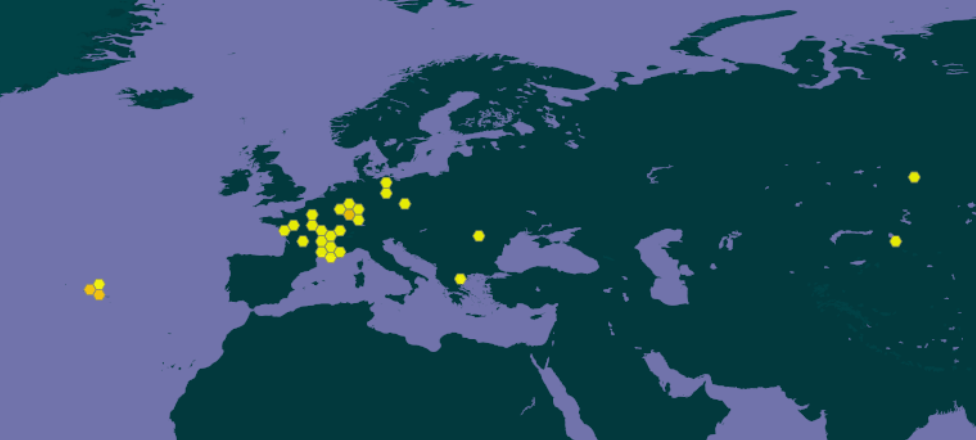
The area of origin is unknown to date, since about 2000 the species has probably spread from the Netherlands into Western Germany on both sides of the Rhine valley to Switzerland and Vorarlberg (Wijnhoven et al. 2007), in the meantime also to Schleswig-Holstein (Staudt 2012).

Habitat: Primarily possibly a rock dweller, in Europe in habitats of anthropogenic origin: industrial wastelands, ruins and house walls (Wijnhoven et al. 2007). Leiobunum sp. generally tend to cluster together during the day. This behaviour is even more pronounced in the species in question. Mass aggregations of several hundreds of individuals have been observed. Many observations show that in spite of its high reproduction rate this “new” Leiobunum sp. seems to coexist well with indigenous species and integrates in the native fauna without great damage. But surely great colonies of the species compete for food with other similar predators.

Status and distribution in Luxembourg

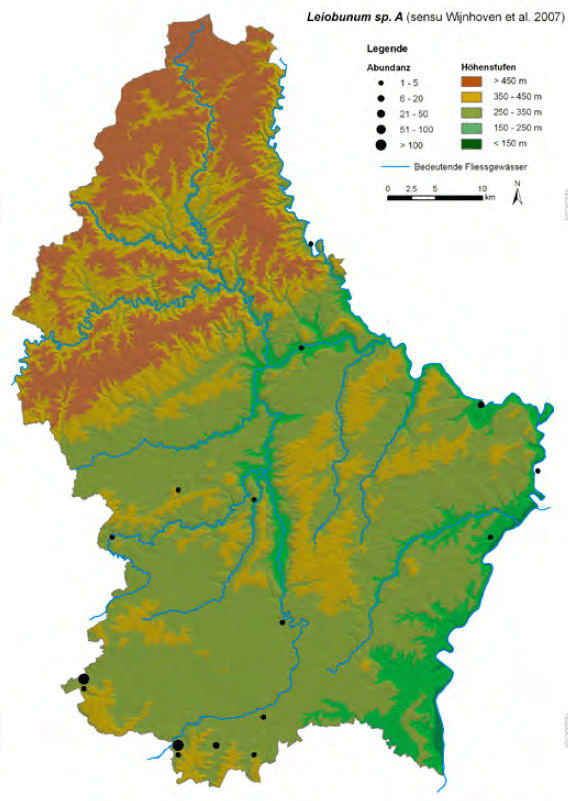
Distribution map of Leiobunum sp. in Luxembourg. Source: Muster & Meyer 2014: 80.

No records of Leiobunum sp. (sensu Wijnhoven et al. 2007) are present in the MNHNL-mdata portal (MNHNL, iNaturalist & GBIF, 2020).

Already widespread in the Gutland, Leiobunum sp. still largely absent in the Ösling (Muster & Meyer 2014: 79). In Luxembourg exclusively synanthropic, larger aggregations have so far only been observed on industrial ruins in the Minette area, in small numbers of individuals in many places on average house walls.

Remarks (Muster & Meyer 2014: 82): Due to the occurrence of mass aggregations with > 1000 specimens the species became the focus of media and sensation-hungry public after 2007. Suddenly, weavers were the focus of exhibitions, local publications, radio and television broadcasts. Wijnhoven et al. (2007) also warned urgently of an imminent invasion of unprecedented proportions and possible dramatic effects on the native opilionid fauna. A few years after this initial uncertainty, the situation is now much more relaxed. Despite the now widespread distribution in Luxembourg, no mass increases could be registered. Only in the former Goodyear test site near Esch-sur-Alzette and at industrial ruins near Rodange larger colonies of 100-200 specimens were sighted. Otherwise only smaller groups of maximum 10 specimens were observed, often only single specimens. It was noticeable that often only one dwelling house per small village was inhabited, while other similar houses remained unoccupied. In this context, observations from the Ruhr area seem interesting, according to which the animals show a preference for calcareous surfaces rich in structure (Toss 2010). The effects on other weaver’s apprentice species are also likely to be less severe than originally assumed. Leiobunum rotundum is often found at or even within aggregations of the Nameless Spine Anchor, while they even seem to evade Dicranopalpus ramosus (Wijnhoven 2011).

Risk assessment

ISEIA protocol

C2 (2+2+2+1) (Ries et al. 2017: 68).

Harmonia+ protocol

Not assessed yet.

Bibliography

  • MNHNL, iNaturalist & GBIF, 2020. MNHNL-mdata, online portal combining species observation from Recorder-Lux, iNaturalist and GBIF. National Museum of Natural History, Luxembourg. URL: https://mdata.mnhn.lu [Accessed 2020-03-05]
  • Muster, C. & M. Meyer, 2014. Verbreitungsatlas der Weberknechte des Großherzogtums Luxemburg, Ferrantia 70. Musée national d’histoire naturelle, Luxembourg, 112 S. [pp. 79-82] (PDF 3.8 MB)
  • Ries, C., A. Arendt, C. Braunert, S. Christian, A. Dohet, A. Frantz, G. Geimer, M. Hellers, J. A. Massard, X. Mestdagh, R. Proess, N. Schneider & M. Pfeiffenschneider, 2017. Environmental impact assessment and black, watch and alert list classification after the ISEIA Protocol of invertebrates in Luxembourg. Bull. Soc. Nat. luxemb. 119: 63-70. [PDF 360 KB]
  • Staudt, A., 2012. Nachweiskarten der Spinnentiere Deutschlands (Arachnida: Araneae, Opiliones, Pseudoscorpiones). http://www.spiderling.de/arages/
  • Toss, K., 2010. Auffällig unauffällig: Der bislang unbestimmte Weberknecht der Gattung Leiobunum ist im westlichen Ruhrgebiet weit verbreitet. Elektronische Aufsätze der Biologischen Station Westliches Ruhrgebiet 19: 1-5.
  • Wijnhoven, H., A.L. Schönhofer & J. Martens, 2007. An unidentified harvestman Leiobunum sp. alarmingly invading Europe (Arachnida: Opiliones). Arachnol. Mitt. 34: 27-38. (https://www.natur-in-nrw.de/Download/Martens_Leiobunum_2007.pdf)

 Page content last updated on 2020-03-05. Last proofread by Caroline Grounds on 2019-12-10.

Dermacentor marginatus Leach, 1815

English Sheep tick Status LU: absent
Lëtzebuergesch Schofszeck Status Eur.: established.
Français n/a RA: ISEIA: C0. Harmonia+: n/a.
Deutsch Schafzecke Wikipedia: Wikipedia - Français - Dermacentor marginatus Wikipedia - Deutsch - Schafzecke | Wikispecies: Wikispecies - Dermacentor marginatus
Nederlands  n/a Back to the list of invertebrates

Important note

In 2015, six Dermacentor ticks were collected in SE-Luxembourg. Previously, these individuals had been identified as Dermacentor marginatus Leach, 1815. However, morphological re-investigation as well as DNA barcoding identified the specimens as Dermacentor reticulatus (Fabricius, 1794). Thus only D. reticulatus is known from Luxembourg (Weigand et al. 2020).

Brief description

Dermacentor marginatusDermacentor marginatus Leach, 1815 is a species of tick of the family Ixodidae, which is a vector of several zoonotic diseases, which is why this tick is considered to pose particular eco-epidemiological and public health risks for humans (Wikipedia contributors 2019).

In Central Europe the sheep tick is the most common species of the genus. It lives here only in heat islands and on sunny slopes or dry grasslands. Mammals, including humans, are preferred as hosts. The animals of the genus transmit tularemia (Francisella tularensis), Rocky Mountain spotted fever (Rickettsia richettsii), Q-fever (Rickettsia burneti), bovine anaplasmosis, puppy-babesiosis (Babesia canis) (Source: http://www.ijon.de/zecken/system.html#zecke).

It is one of the species that could be favoured by global warming, which would allow it to move northwards, but also upwards (Wikipedia contributors 2019).

Status and distribution in Luxembourg

The tick Dermacentor marginatus Leach, 1815 is absent from Luxembourg.

Risk assessment

ISEIA protocol

Following the morphological re-investigation as well as DNA barcoding that identified all the specimens as Dermacentor reticulatus (Fabricius, 1794) (Weigand et al. 2020), Dermacentor marginatus is considered absent from Luxembourg and was reassessed on 29 October 2020 to C0 (2+1+2+1). Initial assessment: C1 (2+1+2+1) (Ries et al. 2017: 68).

Harmonia+ protocol

Not assessed yet.

Worldwide distribution

Bibliography

  • Direction de la Santé, 2016. Attention aux tiques! Comment se protéger? Dépliant. Luxembourg. URL: https://sante.public.lu/fr/prevention/tiques/
  • GBIF, 2020. Dermacentor marginatus in GBIF Secretariat (2019). GBIF Backbone Taxonomy. Checklist dataset https://doi.org/10.15468/39omei [accessed 2020-03-05]
  • Ries, C., A. Arendt, C. Braunert, S. Christian, A. Dohet, A. Frantz, G. Geimer, M. Hellers, J. A. Massard, X. Mestdagh, R. Proess, N. Schneider & M. Pfeiffenschneider, 2017. Environmental impact assessment and black, watch and alert list classification after the ISEIA Protocol of invertebrates in Luxembourg. Bull. Soc. Nat. luxemb. 119: 63-70. [PDF 360 KB]
  • Weigand, A., J. Teixeira & S. Christian, 2020. First record of Hyalomma marginatum sensu stricto C.L. Koch, 1844 and distribution of Dermacentor reticulatus (Fabricius, 1794) (Acari, Ixodidae) in Luxembourg. Bull. Soc. nat. luxemb. 122 : 253-263.
  • Wikipedia contributors, 2019. Dermacentor marginatus. Wikipédia, l’encyclopédie libre. URL: https://fr.wikipedia.org/wiki/Dermacentor_marginatus [accessed 2020-03-05]

 Page content last updated on 2022-04-27. Last proofread by Caroline Grounds on 2019-12-10.

Procambarus clarkii (Girard, 1852)

English Red swamp crayfish, Louisiana crayfish Status LU: isolated, first record: 2021
Lëtzebuergesch Roude Suppekriibs Status Eur.: established. IAS of EU concern (2016).
Français Écrevisse de Louisiane RA: ISEIA: A1, Black List.
Deutsch Roter Amerikanischer Sumpfkrebs Wikipedia: Wikipedia - English - Signal crayfish Wikipedia - Français - Ecrevisse de Californie Wikipedia - Deutsch - Signalkrebs Nederlands | Wikispecies: Wikispecies | CABI
Nederlands Rode rivierkreeft Back to the list of invertebrates

Brief description

Procambarus clarkii (Girard, 1852) is a species of cambarid freshwater crayfish, native to northern Mexico, and southern and southeastern United States, but also introduced elsewhere, where it is often an invasive pest. P. clarkii is typically dark red, with long claws and head, small or no spines on the sides of its carapace just below the head, and rows of bright red bumps on the front and side of the first leg (Wikipedia contributors 2020).

The red swamp crayfish is most commonly found in warm fresh water, such as slowly flowing rivers, marshes, reservoirs, irrigation systems and rice paddies. It is considered to be the most ecologically plastic species in the order Decapoda, and is able to grow quickly even in only seasonally present water, being able to tolerate dry spells of up to four months. The red swamp crayfish grows quickly, and is capable of reaching weights in excess of 50 g, and sizes of 5.5–12 cm long. It is also able to tolerate slightly saline water, which is unusual for a crayfish. Additionally, P. clarkii are physiologically capable of tolerating relatively low dissolved oxygen concentrations. The average lifetime of Procambarus clarkii is five years (Wikipedia contributors 2020).

The burrowing activities of the red swamp crayfish can lead to damage to water courses and to crops, particularly rice, and its feeding can disrupt native ecosystems. It may out-compete the native crayfish species, and is a vector for the crayfish plague fungus Aphanomyces astaci, for crayfish virus vibriosis, and a number of worms parasitic on vertebrates. Their burrowing activities may also be a threat to civil infrastructure such as storm ponds and levees (Wikipedia contributors 2020).

Status and distribution in Luxembourg

Records of Procambarus clarkii (Girard, 1852) in Luxembourg. Data source: Recorder-Lux, iNaturalist & GBIF, 2026-09-21.

The Louisiana crayfish was sighted in Luxembourg for the first time on 21 September 2021 in Lake Echternach. This discovery was made as part of the LUXIAS monitoring programme (a specific monitoring programme targeting invasive alien species) carried out by LIST (Luxembourg Institute of Science and Technology). In 2022, the ANF ran a trapping campaign using traps baited with fish pellets. Using 12 traps, a total of 267 Louisiana crayfish were caught between 26 August 2022 and 10 November 2022, including numerous egg-bearing females, females carrying larvae and juveniles. Currently (August 2026), Lake Echternach remains the only known location of the Louisiana crayfish in Luxembourg. An action plan relating to the species was published in 2024.

Risk assessment

ISEIA protocol

A1 (3+3+3+3) = Alert List (Ries et al. 2017: 68).

Harmonia+ protocol

Not assessed yet.

Worldwide distribution

Bibliography

  • CABI, 2019. Procambarus clarkii. In: Invasive Species Compendium. Wallingford, UK: CAB International. URL: www.cabi.org/isc [accessed 2020-03-13]
  • MNHNL, iNaturalist & GBIF, 2020. Procambarus clarkii in MNHNL-mdata, online portal combining species observation from Recorder-Lux, iNaturalist and GBIF. National Museum of Natural History, Luxembourg. URL: https://mdata.mnhn.lu [accessed 2026-08-13]
  • Ries, C., A. Arendt, C. Braunert, S. Christian, A. Dohet, A. Frantz, G. Geimer, M. Hellers, J. A. Massard, X. Mestdagh, R. Proess, N. Schneider & M. Pfeiffenschneider, 2017. Environmental impact assessment and black, watch and alert list classification after the ISEIA Protocol of invertebrates in Luxembourg. Bull. Soc. Nat. luxemb. 119: 63-70. [PDF 360 KB]
  • Wikipedia contributors, 2020. Procambarus clarkii, Wikipedia, The Free Encyclopedia, 3 February 2020, 18:43 UTC, <https://en.wikipedia.org/w/index.php?title=Procambarus_clarkii&oldid=939000553> [accessed 2020-03-13]

 Page content last updated on 2026-08-18.

Gammarus tigrinus Sexton, 1939

English n/a Status LU: established. 1st record: 1991.
Lëtzebuergesch Tiger-Floukriibs Status Eur.: established.
Français n/a RA: ISEIA: C2. Harmonia+: n/a.
Deutsch Gefleckter Flussflohkrebs Wikipedia: n/a (2020) | Wikispecies: n/a (2020)
Nederlands Tijgervlokreeft Back to the list of invertebrates

Brief description

Gammarus tigrinus Sexton, 1939 has eliminated some native species in parts of the river Rhine and the Baltic Sea; it is frequently a superior predator in comparison to indigenous species.

See the copyrighted picture at cabi.org

Status and distribution in Luxembourg

Gammarus tigrinus Sexton, 1939 was first documented on 22 May 1991 in the Moselle river across from Bech-Kleinmacher, municipality of Schengen (Massard & Geimer 1992). Dhur (1993) showed that Gammarus tigrinus was present in the Moselle all the way from Schengen to Wasserbillig.

There is no distribution map available because no data has been entered into the Recorder-Lux database so far (MNHNL, iNaturalist & GBIF 2019).

Risk assessment

ISEIA protocol

C2 (3+1+3+1) (Ries et al. 2017: 68).

Harmonia+ protocol

Not assessed yet.

Worldwide distribution

Bibliography

  • CABI, 2019. Gammarus tigrinus. In: Invasive Species Compendium. Wallingford, UK: CAB International. URL: www.cabi.org/isc [accessed 2020-03-13]
  • Dhur, G., 1993. Étude des espèces d’invertébrés immigrées ou introduites dans la Moselle luxembourgeoise et dans les écosystèmes aquatiques qui en dépendent. Historique et répartition actuelle. Centre univ. Luxemb., Dép. Form. pédag., mém. sci., 213 pp.
  • Dhur, G. & J.A. Massard, 1995. Etude historique et faunistique des Invertébrés immigrés ou introduits dans la Moselle luxembourgeoise et ses affluents. Bull. Soc. Nat. luxemb. 96: 127-156. [PDF 1896 KB]
  • Massard, J.A. & G. Geimer, 1992. Découverte de Gammarus tigrinus Sexton, 1939 dans la Moselle frontalière entre le Luxembourg et l’Allemagne (Crustacea: Amphipoda). Bull. Soc. Nat. luxemb. 93: 195-198. [PDF 173 KB]
  • Meisch, C. & J.A. Massard, 2015. Les recherches sur les crustacés (Crustacea) du Luxembourg : aperçu historique. Bull. Soc. Nat. luxemb. 116: 381-390. [PDF 1,22 MB]
  • MNHNL, iNaturalist & GBIF, 2019. MNHNL-mdata, online portal combining species observation from Recorder-Lux, iNaturalist and GBIF. National Museum of Natural History, Luxembourg. URL: https://mdata.mnhn.lu [Accessed 2019-10-24]
  • Ries, C., A. Arendt, C. Braunert, S. Christian, A. Dohet, A. Frantz, G. Geimer, M. Hellers, J. A. Massard, X. Mestdagh, R. Proess, N. Schneider & M. Pfeiffenschneider, 2017. Environmental impact assessment and black, watch and alert list classification after the ISEIA Protocol of invertebrates in Luxembourg. Bull. Soc. Nat. luxemb. 119: 63-70. [PDF 360 KB]

 Page content last updated on 2023-09-27. Last proofread by Caroline Grounds on 2019-12-10.