Epimedium alpinum L.

English Bishop’s hat Status LU: established. 1st record: <1825.
Lëtzebuergesch Alpe-Sockeblumm Status Eur.: established.
Français Fleur des elfes des Alpes RA: ISEIA: C1. Harmonia+: 0,03
Deutsch Alpen-Sockenblume Wikipedia: Wikipedia - Deutsch - Alpen-Sockenblume Wikipedia - Nederlands - Elfenbloempje | Wikispecies: Wikispecies - Epimedium alpinum | CABI
Nederlands Elfenbloempje Back to the list of neophytes

Brief description

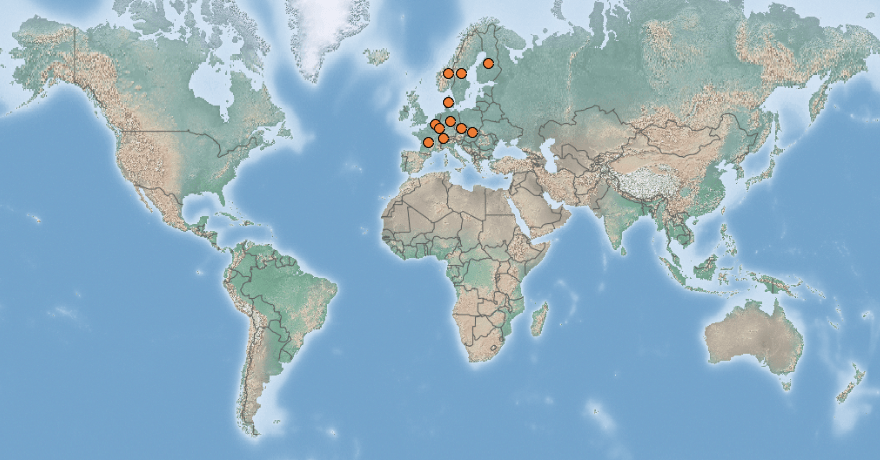
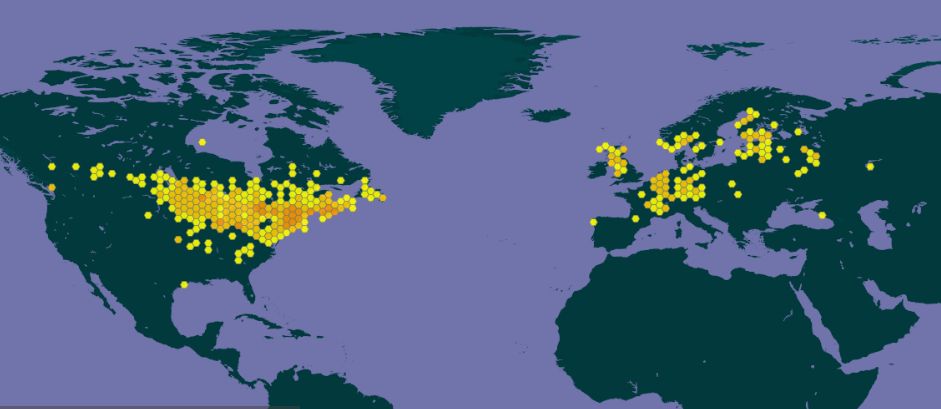
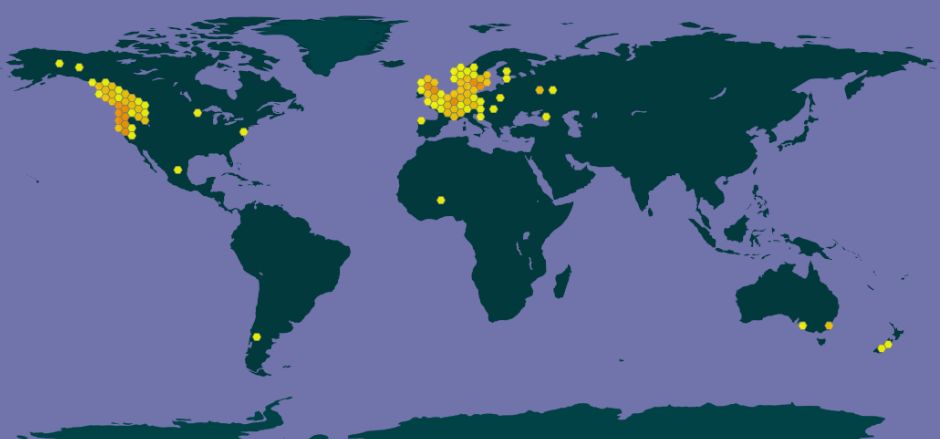
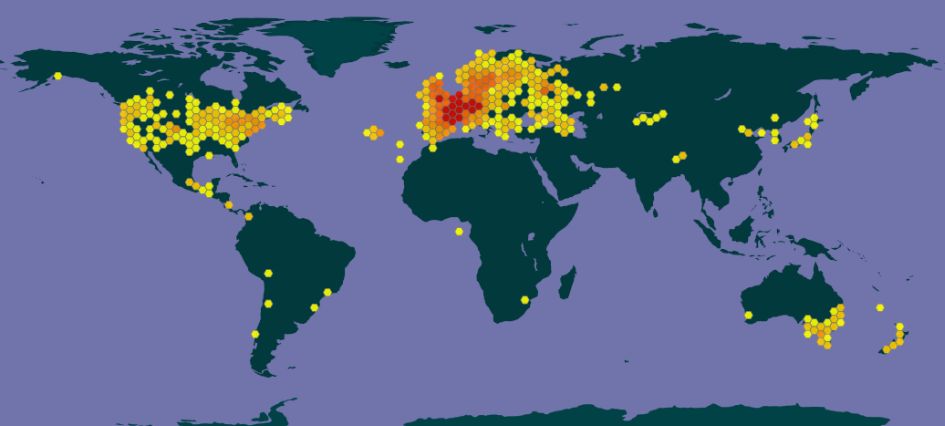
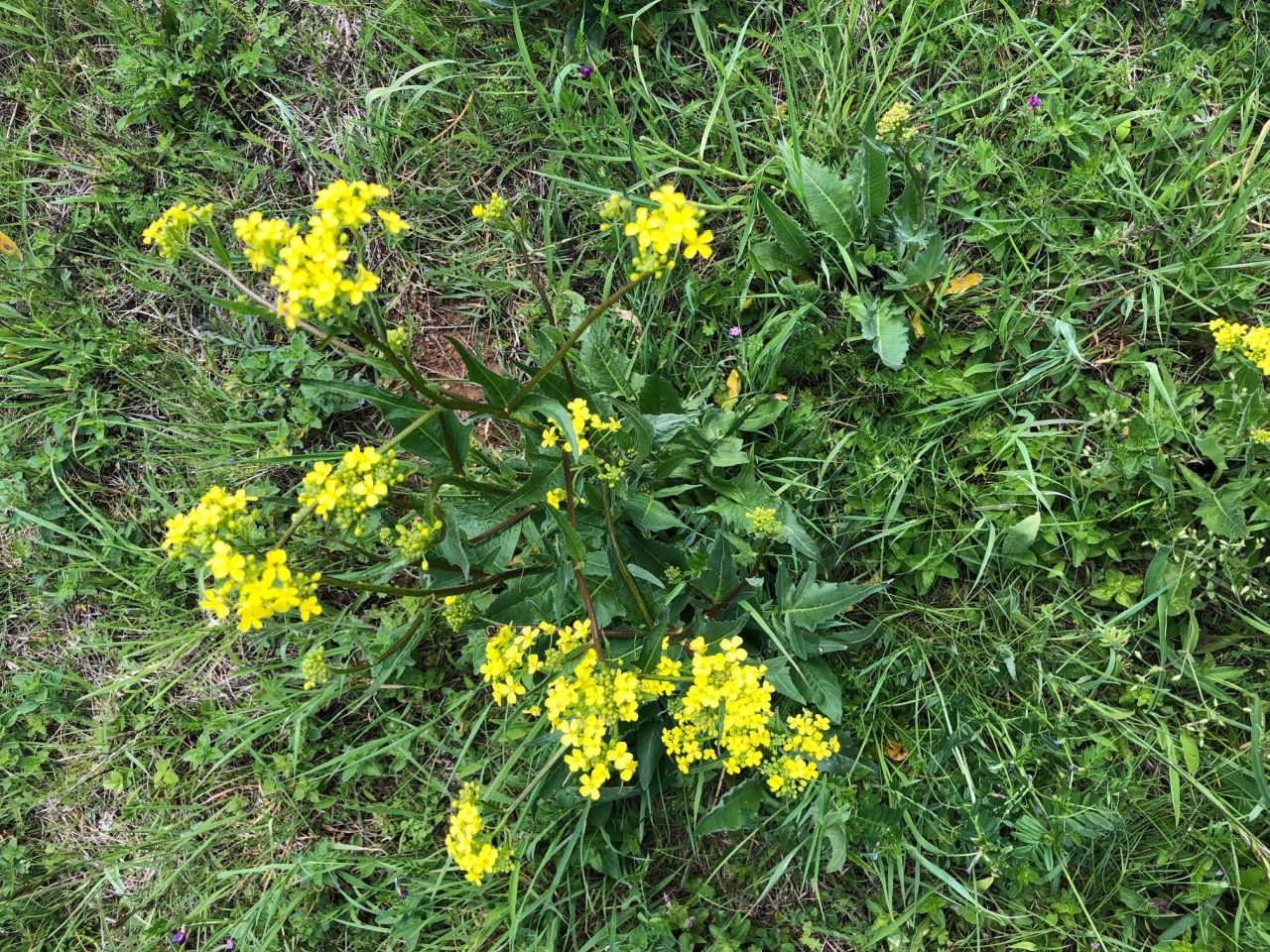
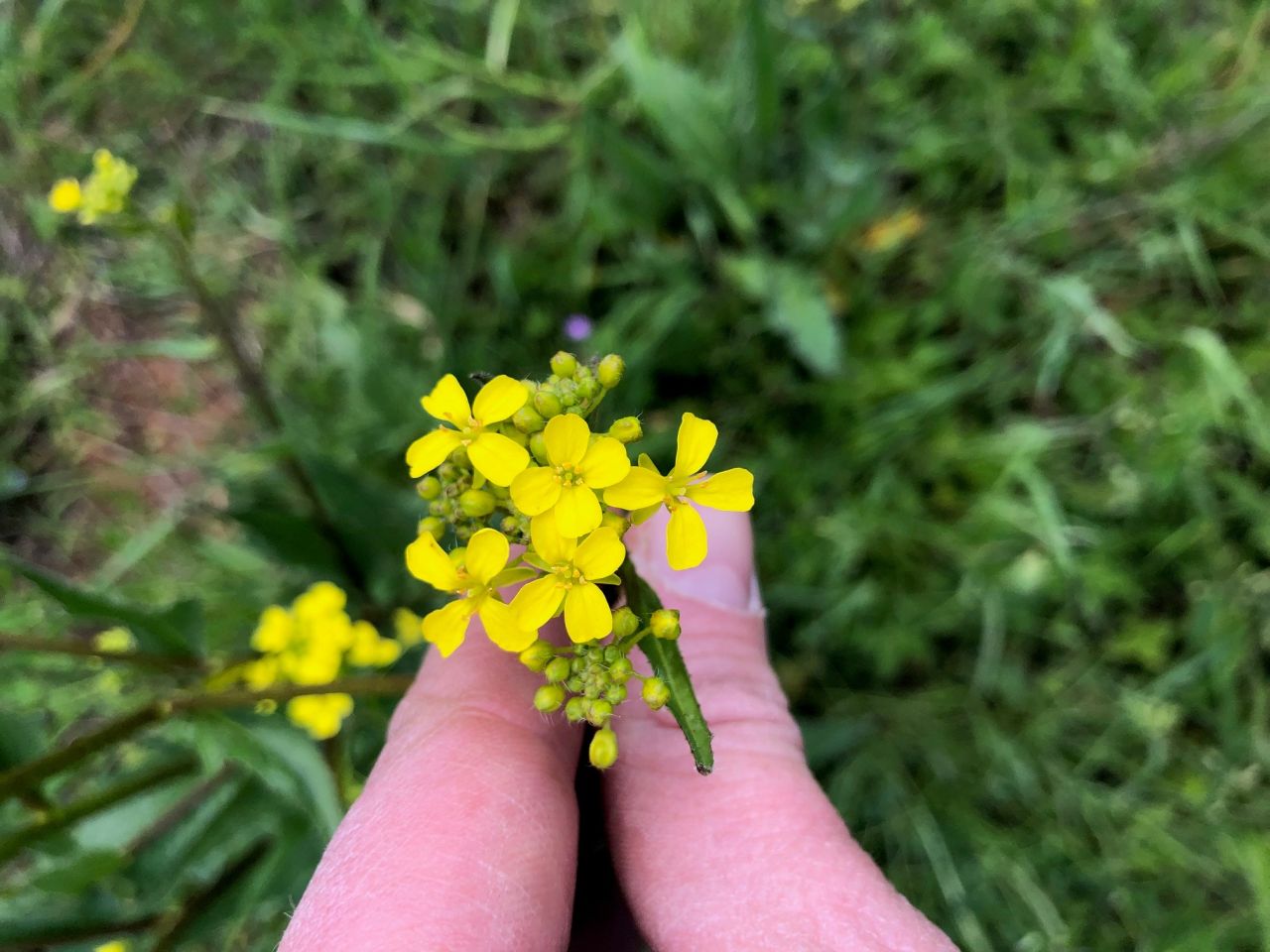
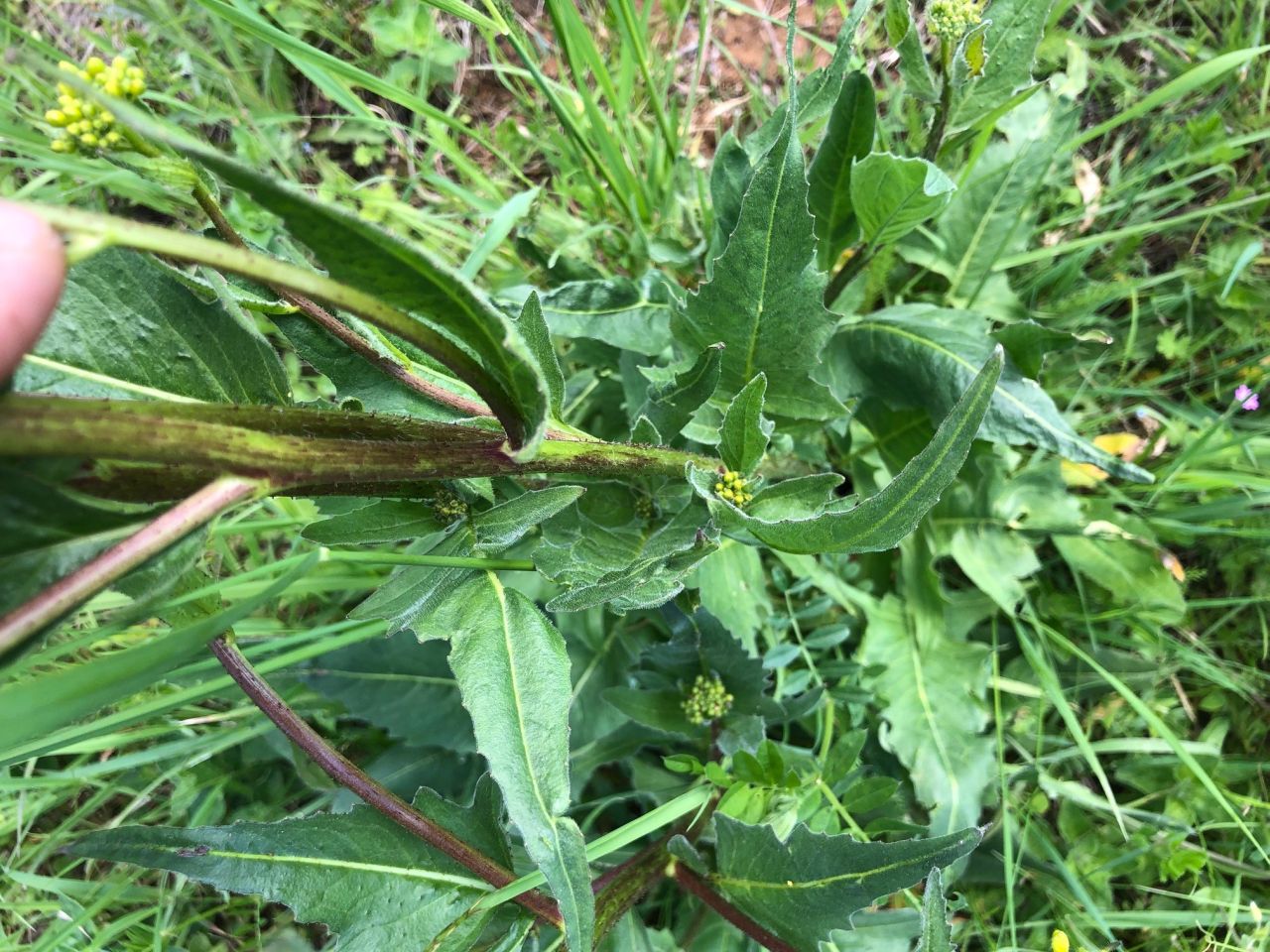
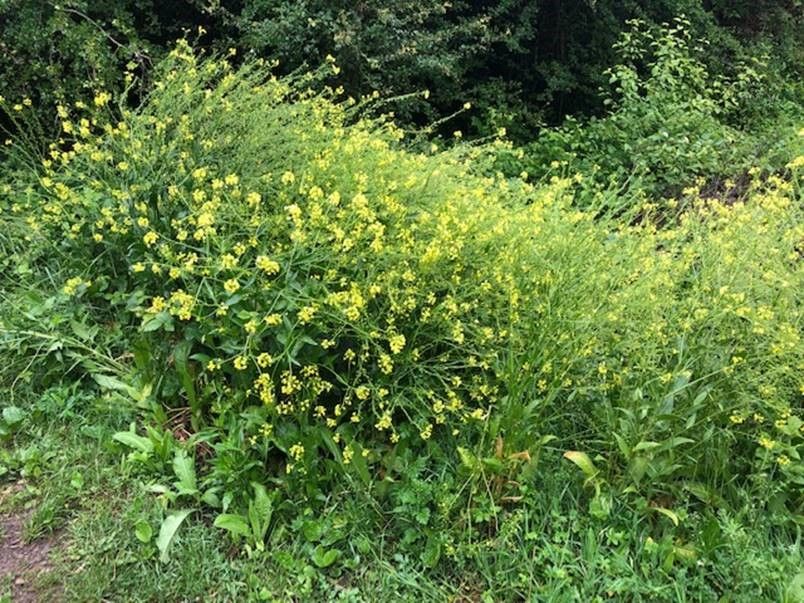
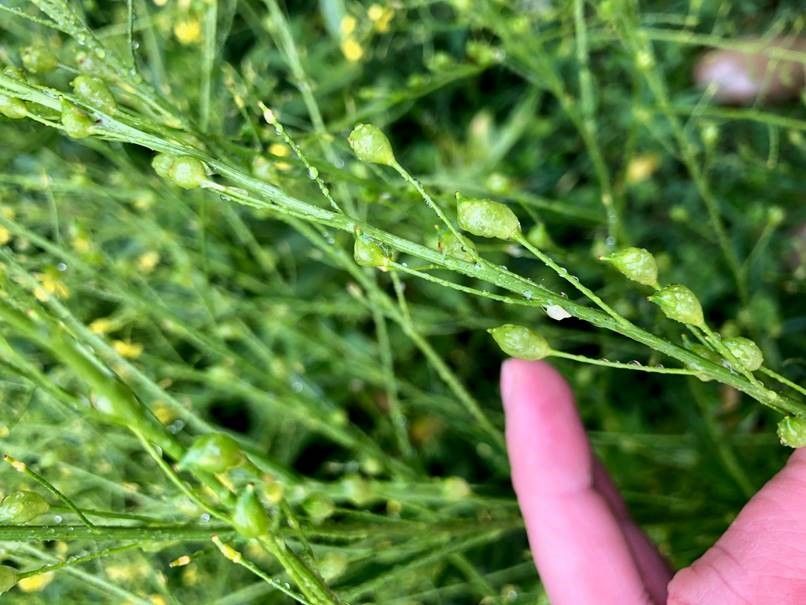
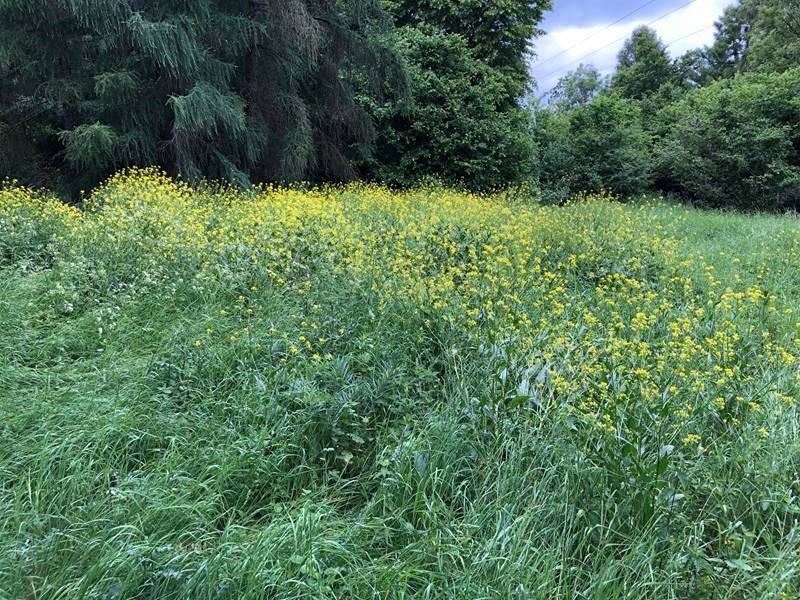
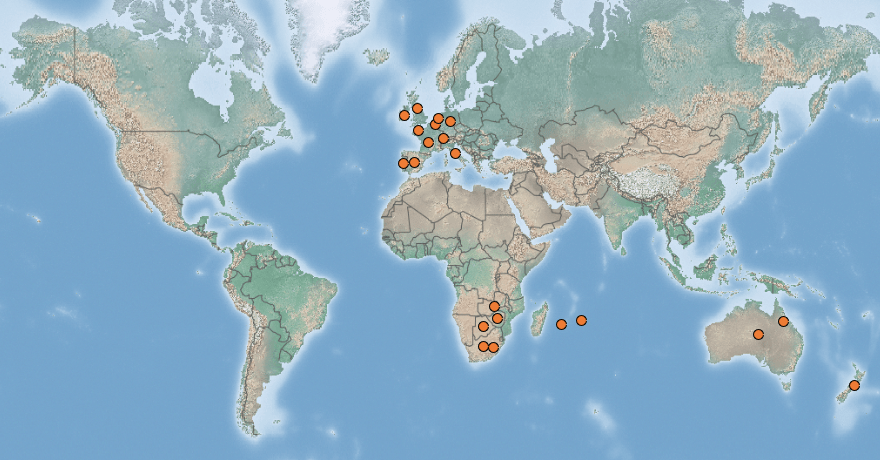
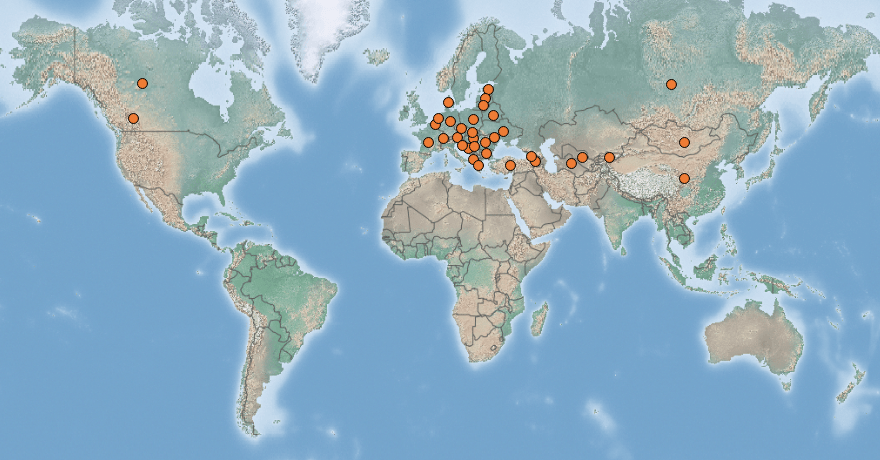
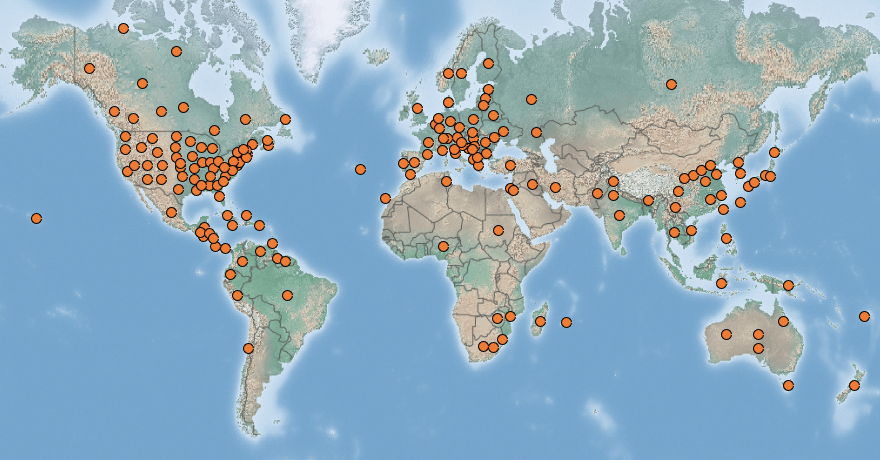
Epimedium alpinum is a rhizomatous perennial plant which spreads more rapidly than most other Epimedium species. The plant is native to southern Europe and is now present throughout the continent. Once established, it tolerates drought and heavy shade.

Status and distribution in Luxembourg

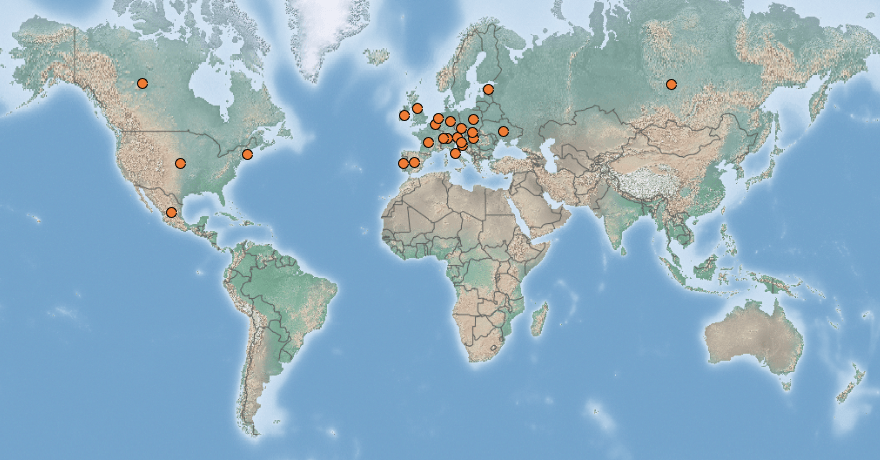
Records of Epimedium alpinum L. in Luxembourg. Data source: Recorder-Lux, iNaturalist & GBIF, 2026-09-21.

Lejeune (1824: 226) reports Tinant found the species in the Grünewald, we thus date the first record to <1825. Tinant (1836: 94) notes “This beautiful barberry grows in the coppice of the Grünewald, near the Roman Road. It is very rare.”1. Löhr (1844: 11) notes “At overgrown shady places only in Lxb. in the Grunewald, near the Roman road (Tin.) probably only run wild.”2 The first detailed documented observation of the species dates from 1826. It was found on 19th July 1826 near the river Sûre in the municipality of Bettendorf (Bronn & Courtois 1827). Fischer (1872: 14) found it escaping from the gardens in the bushes at Limpertsberg and in the fortifications of Luxembourg.3 Krombach (1875: 38) notes the species is “rarely grown in our gardens, found by Tinant in Grunenwald, but has not been observed since.”4 Nowadays, Epimedium alpinum is considered as very rare (RR) in the Luxembourgian part of the western Lorraine (Lambinon & Verloove 2012: 91).

In July 1910, Joseph Robert (1880-1918) found it again near Bettendorf, in the “Fohrberg” below the quarries; he could count about 30 well developed specimens, so he considered the species native, but very rare (Robert 1910 cit. in Reichling 1958: 95).

The four observations found in the Recorder-Lux database (1956, 1957, 1970) are from the Fouerbierg/Nidderbierg area north of Bettendorf (MNHNL, iNaturalist & GBIF 2019). The earliest one was a specimen collected by Jean-Jacques Kariger on 3 June 1956 north of Bettendorf, at the place known as Fohrberg, on the western end of the Niederberg, in a forest on shell limestone (Specimen № 24945, MNHNL 2000-).

The current status of the species is unknown, it may be extinct.

Epimedium alpinum is often grown as an ornamental plant in gardens. This explains its current existence in a more or less naturalised state in appropriate sites in various European countries outside its area. The location near Bettendorf has been maintained in this way for at least 130 years! (Reichling 1958: 95).

Risk assessment

ISEIA protocol
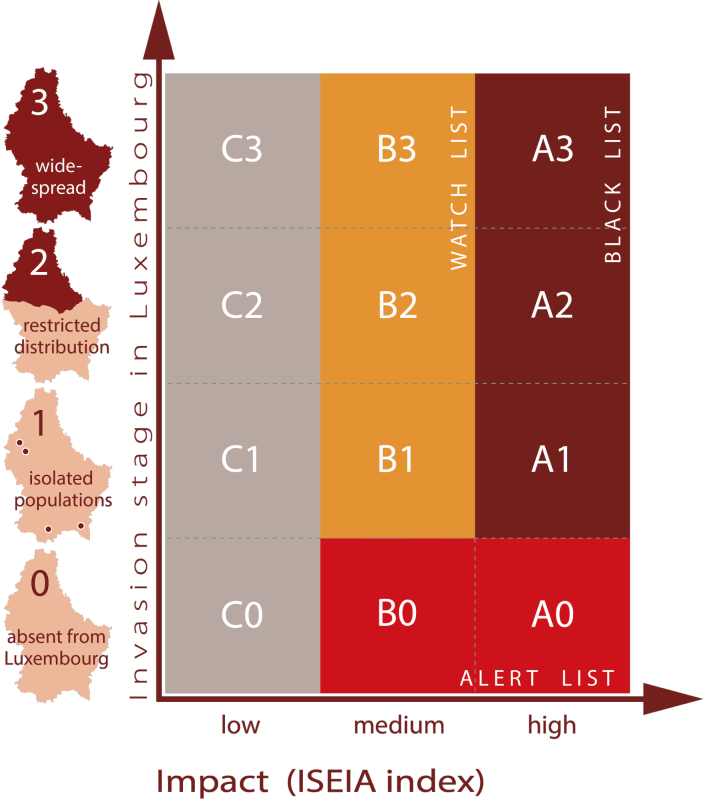
C1 (1+1+1+1) (Ries et al. 2013: 18).

Harmonia+ protocol

Overall risk score 0,03 = (Overall Invasion score 0,12 x Overall Impact score 0,10) (Ries et al. 2020).

0,12Invasion
0,10Impact
0,03Risk

Worldwide distribution

Bibliography

  • Bronn, M. & R. Courtois, 1827. Verslag van een plant- en landbouwkundig Reisje, gedaan in Julij 1826, langs de oevers de Maas, van Luik naar Dinant, in de Ardennes en het Groothertogdom Luxemburg. Bijdragen tot de natuurkundige Wetenschappen 2: 450–479. [google books]
  • CABI, 2019. Epimedium alpinum. In: Invasive Species Compendium. Wallingford, UK: CAB International. URL: www.cabi.org/isc [accessed 2020-02-28]
  • Fischer, E., 1872. Les plantes subspontanées et naturalisées de la flore du grand-duché de Luxembourg. Publications de l’Institut royal grand-ducal de Luxembourg, section des sciences naturelles et mathématiques XII: 1-115. Imprimerie V. Buck, Luxembourg.
  • Krombach, J.-H.-G., 1875. Flore du grand-duché de Luxembourg. Plantes phanérogames. 564 p. Luxembourg, Imprimerie Joris.
  • Lambinon J. & F. Verloove, 2012. Nouvelle flore de la Belgique, du grand-duché de Luxembourg, du Nord de la France et des régions voisines. Sixième édition. Avec la collaboration de L. Delvosalle, B. Toussaint, D. Geerinck, I. Hoste, F. Van Rossum, B. Cornier, R. Schumacker, A. Vanderpoorten et H. Vannerom. Jardin botanique national de Belgique, Meise. CXXXIX + 1195 pp. ISBN : 9789072619884.
  • Lejeune, A. L. S., 1824. Revue de la flore des environs de Spa. 264 p. Liège: imprimerie Duvivier.
  • Löhr, M. J., 1844. Taschenbuch der Flora von Trier und Luxemburg : mit Berücksichtigung der Nahe- und Glan-Gegenden. 319 S. Trier, Verlag C. Troschel.
  • MNHNL, 2000-. Epimedium alpinum L. in Recorder-Lux, database on the natural heritage of the Grand Duchy of Luxembourg. Musée national d’histoire naturelle, Luxembourg. URL: https://mdata.mnhn.lu [Accessed 2019-09-04]
  • MNHNL, iNaturalist & GBIF, 2019. Epimedium alpinum L. in MNHNL-mdata, online portal combining species observation from Recorder-Lux, iNaturalist and GBIF. National Museum of Natural History, Luxembourg. URL: https://mdata.mnhn.lu [Accessed 2019-09-06]
  • Reichling, L., 1958. Notes floristiques – Observations faites dans le grand-duché de Luxembourg en 1956. Bull. Soc. Nat. luxemb. 61: 63-123. [PDF 3355 KB]
  • Ries, C., Y. Krippel & M. Pfeiffenschneider, 2020. Risk assessment after the Harmonia+ protocol of invasive alien vascular plant species in Luxembourg. Bull. Soc. Nat. luxemb. 122: 197-205. [PDF 132 KB]
  • Ries, C., Y. Krippel, M. Pfeiffenschneider & S. Schneider, 2013. Environmental impact assessment and black, watch and alert list classification after the ISEIA Protocol of non-native vascular plant species in Luxembourg. Bull. Soc. Nat. luxemb. 114: 15-21. [PDF 652 KB]
  • Robert J., 1910. Beiträge zur Flora des Grossherzogtums Luxemburg. lnst. G.-D. Lux., Sect. Sc. natur., phvs., math., Arch. trimestr. n.s. V: 1-35. Luxembourg: Imprimerie de la Cour Victor-Buck.
  • Tinant, F. A., 1836. Flore luxembourgeoise, ou, Description des plantes phanérogames, recueillies et observées dans le grand-duché de Luxembourg, classées d’après le système sexuel de Linnée. 512 p. Luxembourg, J. P. Kuborn.

 Page content last updated on 2021-02-12. Last proofread by Caroline Grounds on 2019-11-18.

  1. Original text: “Cette belle berbéridée croît dans les taillis du Grünewald, du côté de la Chaussée romaine. Elle est très rare.” (Tinant 1836: 94).[]
  2. Original text: “An bewachsenen schattigen Stellen nur in Lxb. im Grunewald, bei der Römerstrasse (Tin.) wahrscheinlich nur verwildert” (Löhr 1844: 11).[]
  3. Original text: “Je l’ai trouvée échappée des jardins dans les buissons à Limpertsberg et dans les fortifications de Luxembourg” (Fischer 1872: 14).[]
  4. Original text: “… rarement cultivée dans nos jardins, trouvée par Tinant au Grunenwald, mais n’y ayant plus été observée depuis.” (Krombach 1875: 38)[]

Spiraea alba Du Roi

English Pale bridewort Status LU: established. 1st record: LU 1823, ITW 1949.
Lëtzebuergesch Wäisse Kluddertrausch Status Eur.: established. 1st record: ?
Français Spirée blanche RA: ISEIA: C1. Harmonia+: 0,16.
Deutsch Weißer Spierstrauch Wikipedia: Wikipedia - English - Pale bridewort | Wikispecies: Wikispecies - Spiraea alba
Nederlands Witte spirea Back to the list of neophytes

Brief description

Spiraea.alba2.-.lindsey

James Lindsey, CC BY-SA 2.5 Wikimedia Commons

Spiraea alba Du Roi is a shrub that prefers moist to wet conditions and grows on soil with abundant nutrients and organic material. It occurs mainly in riparian habitats such as river banks, wet meadows, swamps, ditches and bogs. This pioneer species needs full sunlight for optimal growth, flowering and fruiting, but may survive under the tree canopy. It reproduces mainly vegetatively and may be propagated via garden waste or waterflow.

The Pale Bridewort is a fast-growing rhizomatous species, propagating clonally. It forms stable and very dense shrub communities that can expand over large areas and displace native plant species. The dense cover of this plant prevents tree regeneration and inhibits the successional process towards a forest stage. This species is locally considered a weed in its native range. Old dry plant shoots are vulnerable to early ignition and may be the cause of fires (Branquart et al. 2010).

Status and distribution in Luxembourg

Records of Spiraea alba Du Roi in Luxembourg. Data source: Recorder-Lux, iNaturalist & GBIF, 2026-09-21.

Spiraea alba Du Roi was first mentioned for Luxembourg as introduced under its synonym S. undulata in 1823 in the park of Schrassig (Koltz 1875: 67).

The oldest MNHNL herbarium specimen of its variety Spiraea alba var. latifolia (Aiton) Dippel was collected under the synonym Spiraea latifolia (Aiton) Borkh. by Jos Witry on 26 July 1935 in Dalheim (Specimen № 52327, MNHNL 2000-).

The first documented record in the wild was reported on 1949-08-05 at Osterbour, naturalised by a pond, in the municipality of Larochette (Beck et al. 1952: 77; MNHNL 2000-).

Currently, 7 records of the Pale Bridewort are accessible through the MNHNL-mdata portal (MNHNL, iNaturalist & GBIF 2019).

This species originates from the eastern United States and is sometimes cultivated for ornamental purposes in parks. Subspontaneous or naturalised; banks of rivers and ponds, hedges (Lambinon & Verloove 2012: 326).

This species seems to have sometimes been confused in the wild with the horticultural hybrid Spiraea ×rosalba Dippel (Spiraea alba × salicifolia), with petals generally of a brighter pink, with shorter branches and stamens longer than petals (about as long as the latter in S. alba). The frequency and distribution of the two taxa should be studied in the wild, the degree of pollen fertility being perhaps a useful criterion for distinguishing them (Lambinon & Verloove 2012: 326).

Risk assessment

ISEIA protocol

C1 (1+1+3+2) (Ries et al. 2013: 19).

Harmonia+ protocol

Overall risk score 0,16 = (Overall Invasion score 0,34 x Overall Impact score 0,47) (Ries et al. 2020).

0,34Invasion
0,47Impact
0,16Risk

Worldwide distribution

Bibliography

  • Beck, E., Jungblut, F., Lefort, F.L., Reichling, L., Stumper, R., 1952. Herborisations faites au Grand-Duché de Luxembourg en 1951. Bull. Soc. Nat. luxemb. 56: 67-88. [PDF 1080 KB]
  • Branquart, E., S. Vanderhoeven, W. Van Landuyt, F. Van Rossum & F. Verloove, 2010. Harmonia database: Spiraea alba Du Roi. Harmonia version 1.2, Belgian Forum on Invasive Species. URL: http://ias.biodiversity.be [accessed on 2019-10-15]
  • GBIF, 2020. Spiraea alba Du Roi in GBIF Secretariat (2019). GBIF Backbone Taxonomy. Checklist dataset https://doi.org/10.15468/39omei [accessed 2020-03-04]
  • Koltz, J.-P.-J., 1875. Dendrologie luxembourgeoise. Catalogue des arbres, arbrisseaux et arbustes spontanés, subspontanés ou introduits dans la culture du Grand-Duché de Luxembourg. Imprimerie V. Buck, Luxembourg, 217 pp.
  • Lambinon J. & F. Verloove, 2012. Nouvelle flore de la Belgique, du grand-duché de Luxembourg, du Nord de la France et des régions voisines. Sixième édition. Avec la collaboration de L. Delvosalle, B. Toussaint, D. Geerinck, I. Hoste, F. Van Rossum, B. Cornier, R. Schumacker, A. Vanderpoorten et H. Vannerom. Jardin botanique national de Belgique, Meise. CXXXIX + 1195 pp. ISBN : 9789072619884.
  • MNHNL, 2000-. Spiraea alba Du Roi in Recorder-Lux, database on the natural heritage of the Grand Duchy of Luxembourg. Musée national d’histoire naturelle, Luxembourg. URL: https://mdata.mnhn.lu [Accessed 2019-10-15]
  • MNHNL, iNaturalist & GBIF, 2019. Spiraea alba Du Roi in MNHNL-mdata, online portal combining species observation from Recorder-Lux, iNaturalist and GBIF. National Museum of Natural History, Luxembourg. URL: https://mdata.mnhn.lu [Accessed 2019-10-15]
  • Ries, C. & Y. Krippel, 2021. First records of 56 invasive alien vascular plants in Luxembourg. Bulletin de la Société des naturalistes luxembourgeois 123: 115-127. [PDF 241 KB]
  • Ries, C., Y. Krippel & M. Pfeiffenschneider, 2020. Risk assessment after the Harmonia+ protocol of invasive alien vascular plant species in Luxembourg. Bull. Soc. Nat. luxemb. 122: 197-205. [PDF 132 KB]
  • Ries, C., Y. Krippel, M. Pfeiffenschneider & S. Schneider, 2013. Environmental impact assessment and black, watch and alert list classification after the ISEIA Protocol of non-native vascular plant species in Luxembourg. Bull. Soc. Nat. luxemb. 114: 15-21. [PDF 652 KB]

 Page content last updated on 2026-09-20. Last proofread by Caroline Grounds on 2019-11-21.

Spiraea douglasii Hook.

English Steeple-bush Status LU: established. 1st record: LU 1847, ITW 1954.
Lëtzebuergesch Douglas-Kluddertrausch Status Eur.: established. 1st record: ?
Français Spirée de Douglas RA: ISEIA: B0, Alert List. Harmonia+: 0,10.
Deutsch Douglas-Spierstrauch Wikipedia: Wikipedia - English - Steeple-bush | Wikispecies: Wikispecies - Spiraea douglasii 
Nederlands Douglasspirea Back to the list of neophytes

Brief description

USFWS spiraea douglasii (23722325702)

Public domain, Wikimedia Commons

Both in its native and invaded range, Spiraea douglasii Hook. grows best on loamy and sandy wet soils. It is tolerant to permanently water-logged soils (peat) and widely fluctuating water tables. It occurs mainly in riparian habitats such as swamps, shrub carrs, marshes and bogs. This pioneer species needs full sunlight for optimal growth, flowering and fruiting, but may survive under tree canopies. Contrary to other North American Spiraea species, Douglas’ spirea may produce fertile seeds under Belgian climatic conditions. They are disseminated at a slow rate by wind in the vicinity of parent shrubs and germinate in areas free of dense plant cover. This shrub has been increasingly observed in the wild in Belgium during the last decade.

Douglas’ spirea is a fast-growing rhizomatous shrub, propagating clonally. It easily forms dense monospecific thickets that can colonise large areas, displace other plant species and dominate communities in wetland areas (probably via allelopathic interactions). It can be invasive in its native range and rapidly colonise clearcut areas. It has been reported to be a serious danger to native plant communities in Belgium. Old dry plant shoots are vulnerable to early ignition and may be the cause of fires (Branquart et al. 2010).

Status and distribution in Luxembourg

Records of Spiraea douglasii Hook. in Luxembourg. Data source: Recorder-Lux, iNaturalist & GBIF, 2026-09-21.

Koltz (1875: 67): Native to California, Spiraea douglasii Hook. was introduced in 1847 (jardin des Dominicains). Requires a sheltered spot in fertile soil. Several hardier hybrids are grown which are:

  • Spiraea douglasi × callosa (Spiraea nobleana Hook.): Introduced in 1863; jardin des Dominicains.
  • Spiraea × pachystachys Hayne.: Introduced 1871; Sandweiler nurseries.
  • Spiraea paniculata Bill.: Introduced in 1847; jardin des Dominicains.

Marcel Etringer first documented Spiraea douglasii var. menziesii (under the name Spiraea salicifolia L.) in the wild on 1954-06-29 in a slag heap in Steinfort (Herb. LUX specimen № 50664; MNHNL 2000-).

The earliest herbarium specimen at the MNHNL was collected by Jos Witry in July 1935 in Rumelange (Specimen № 52329, MNHNL 2000-).

This species originates from western North America and is sometimes grown for ornamental purposes in parks. Subspontaneous or naturalised: old hedges, roadsides, groves, slopes (Lambinon & Verloove 2012: 326).

Risk assessment

ISEIA protocol

B0 (2+2+3+2) = Alert List (Ries et al. 2013: 19).

Harmonia+ protocol

Overall risk score 0,10 = (Overall Invasion score 0,18 x Overall Impact score 0,47) (Ries et al. 2020).

0,18Invasion
0,47Impact
0,10Risk

Worldwide distribution

Bibliography

  • Branquart, E., S. Vanderhoeven, W. Van Landuyt, F. Van Rossum, F. Verloove & A. Vervoort, 2010. Harmonia database: Spiraea douglasii Hook. Harmonia version 1.2, Belgian Forum on Invasive Species. URL: http://ias.biodiversity.be [accessed on 2019-10-15]
  • GBIF, 2020. Spiraea douglasii Hook. in GBIF Secretariat (2019). GBIF Backbone Taxonomy. Checklist dataset https://doi.org/10.15468/39omei [accessed 2020-03-04]
  • Lambinon J. & F. Verloove, 2012. Nouvelle flore de la Belgique, du grand-duché de Luxembourg, du Nord de la France et des régions voisines. Sixième édition. Avec la collaboration de L. Delvosalle, B. Toussaint, D. Geerinck, I. Hoste, F. Van Rossum, B. Cornier, R. Schumacker, A. Vanderpoorten et H. Vannerom. Jardin botanique national de Belgique, Meise. CXXXIX + 1195 pp. ISBN : 9789072619884.
  • MNHNL, 2000-. Spiraea douglasii Hook. in Recorder-Lux, database on the natural heritage of the Grand Duchy of Luxembourg. Musée national d’histoire naturelle, Luxembourg. URL: https://mdata.mnhn.lu [Accessed 2021-03-12]
  • MNHNL, iNaturalist & GBIF, 2019. Spiraea douglasii Hook. in MNHNL-mdata, online portal combining species observation from Recorder-Lux, iNaturalist and GBIF. National Museum of Natural History, Luxembourg. URL: https://mdata.mnhn.lu [Accessed 2019-10-15]
  • Ries, C. & Y. Krippel, 2021. First records of 56 invasive alien vascular plants in Luxembourg. Bulletin de la Société des naturalistes luxembourgeois 123: 115-127. [PDF 241 KB]
  • Ries, C., Y. Krippel & M. Pfeiffenschneider, 2020. Risk assessment after the Harmonia+ protocol of invasive alien vascular plant species in Luxembourg. Bull. Soc. Nat. luxemb. 122: 197-205. [PDF 132 KB]
  • Ries, C., Y. Krippel, M. Pfeiffenschneider & S. Schneider, 2013. Environmental impact assessment and black, watch and alert list classification after the ISEIA Protocol of non-native vascular plant species in Luxembourg. Bull. Soc. Nat. luxemb. 114: 15-21. [PDF 652 KB]

 Page content last updated on 2026-09-20. Last proofread by Caroline Grounds on 2019-11-21.

Syringa vulgaris L.

English Common lilac Status LU: established. 1st record: LU & ITW <1836.
Lëtzebuergesch Gewéinlechen Neelchesbam Status Eur.: established.
Français Lilas commun RA: ISEIA: C1. Harmonia+: 0,34.
Deutsch Gemeiner Flieder Wikipedia: Wikipedia - English - Common lilac Wikipedia - Français - Lilas commun Wikipedia - Deutsch - Gemeiner Flieder Wikipedia - Nederlands - Sering | Wikispecies: Wikispecies - Syringa vulgaris 
Nederlands Sering Back to the list of neophytes

Brief description

20150509Syringa vulgaris2

AnRo0002, CC0, Wikimedia Commons

The Common Lilac is widespread in southeastern Europe and the Near East. The original distribution ranges from central Albania to northern Romania. The species is frequently planted in numerous garden varieties and is often naturalised on rock slopes or railway embankments. It is a neophyte in some countries of Europe, Asia and North America. Light forests and bushes are preferred as habitats. The German Federal Agency for Nature Conservation considers the common lilac to be an invasive species and has placed it on the management list of the black list of invasive species, as it can displace native species (Wikipedia Contributors 2019).

Status and distribution in Luxembourg

Records of Syringa vulgaris L. in Luxembourg. Data source: Recorder-Lux, iNaturalist & GBIF, 2026-09-21.

The species, a very common garden shrub, was already reported in the wild in Luxembourg before 1836: according to Tinant (1836: 17) “This shrub […] is frequently found in the wild on the rocks of the Pétrus, Pulvermuhl, Bellevue etc.”1. Fischer (1872: 61) states the species, “frequently and commonly cultivated for ornamental purposes, is often found wild in hedges and on rocks near homes”. This is repeated by Krombach (1875: 219). To the known locations, Koltz (1873: 86) adds the ruins of the Grewchesberg between Greisch and Simmern.

The oldest herbarium specimen at the MNHNL was collected in May 1883 by Edmond Joseph Klein (1866-1942) from a cultivated shrub in Wiltz (Specimen № 16752, MNHNL 2000-). The next scientific record that we know of was made by Léopold Reichling on 8th July 1959 in Bierheck, Municipality of Steinsel (MNHNL 2000-). Currently, 59 records of Common Lilac are accessible through the MNHNL-mdata portal (MNHNL, iNaturalist & GBIF 2019).

Sometimes subspontaneous or naturalised (Lorr.): rock hedges, sunny slopes, wastelands (Lambinon & Verloove 2012: 537-538).

Other Syringa cultivars and taxa

  • Syringa persica is grown in groves and gardens, and is sometimes found subspontaneously in hedges and near homes (Fischer 1872: 61).
  • The lilacs are mainly grown from various cultivars of this species. Other ornamental Syringa species are also sometimes grown for ornamental purposes in parks and gardens (Lambinon & Verloove 2012: 537-538).

Risk assessment

ISEIA protocol

C1 (1+2+2+2) (Ries et al. 2013: 19).

Harmonia+ protocol

Overall risk score 0,34 = (Overall Invasion score 0,60 x Overall Impact score 0,57) (Ries et al. 2020).

0,60Invasion
0,57Impact
0,34Risk

Worldwide distribution

Bibliography

  • Fischer, E., 1872. Les plantes subspontanées et naturalisées de la flore du grand-duché de Luxembourg. Publications de l’Institut royal grand-ducal de Luxembourg, section des sciences naturelles et mathématiques XII: 1-115. Imprimerie V. Buck, Luxembourg.
  • GBIF, 2020. Syringa vulgaris L. in GBIF Secretariat (2019). GBIF Backbone Taxonomy. Checklist dataset https://doi.org/10.15468/39omei [accessed 2020-03-04]
  • Koltz, J.-P.-J., 1873. Prodrome de la flore du grand-duché de Luxembourg. Première partie. Plantes phanérogames. Imprimerie V. Buck, Luxembourg. 279 S.
  • Krombach, J.-H.-G., 1875. Flore du grand-duché de Luxembourg. Plantes phanérogames. 564 p. Luxembourg, Imprimerie Joris.
  • Lambinon J. & F. Verloove, 2012. Nouvelle flore de la Belgique, du grand-duché de Luxembourg, du Nord de la France et des régions voisines. Sixième édition. Avec la collaboration de L. Delvosalle, B. Toussaint, D. Geerinck, I. Hoste, F. Van Rossum, B. Cornier, R. Schumacker, A. Vanderpoorten et H. Vannerom. Jardin botanique national de Belgique, Meise. CXXXIX + 1195 pp. ISBN : 9789072619884.
  • MNHNL, 2000-. Syringa vulgaris in Recorder-Lux, database on the natural heritage of the Grand Duchy of Luxembourg. Musée national d’histoire naturelle, Luxembourg. URL: https://mdata.mnhn.lu [Accessed 2019-09-05]
  • MNHNL, iNaturalist & GBIF, 2019. Syringa vulgaris L. in MNHNL-mdata, online portal combining species observation from Recorder-Lux, iNaturalist and GBIF. National Museum of Natural History, Luxembourg. URL: https://mdata.mnhn.lu [Accessed 2019-09-06]
  • Ries, C. & Y. Krippel, 2021. First records of 56 invasive alien vascular plants in Luxembourg. Bulletin de la Société des naturalistes luxembourgeois 123: 115-127. [PDF 241 KB]
  • Ries, C., Y. Krippel & M. Pfeiffenschneider, 2020. Risk assessment after the Harmonia+ protocol of invasive alien vascular plant species in Luxembourg. Bull. Soc. Nat. luxemb. 122: 197-205. [PDF 132 KB]
  • Ries, C., Y. Krippel, M. Pfeiffenschneider & S. Schneider, 2013. Environmental impact assessment and black, watch and alert list classification after the ISEIA Protocol of non-native vascular plant species in Luxembourg. Bull. Soc. Nat. luxemb. 114: 15-21. [PDF 652 KB]
  • Tinant, F. A., 1836. Flore luxembourgeoise, ou, Description des plantes phanérogames, recueillies et observées dans le grand-duché de Luxembourg, classées d’après le système sexuel de Linnée. 512 p. Luxembourg, J. P. Kuborn.
  • Welter A., J.Turk & J. Trossen, 2008. Les arbres introduits au Luxembourg. Inventaire des essences arborescentes non indigènes de pleine terre présentes sur le territoire du Grand-Duché de Luxembourg. Ferrantia 53, Musée national d’histoire naturelle, Luxembourg, ISSN 1682-5519, 111 pp.
  • Wikipedia Contributors, 2019. Gemeiner Flieder. In: Wikipedia, Die freie Enzyklopädie. URL: https://de.wikipedia.org/w/index.php?title=Gemeiner_Flieder&oldid=188437593 [accessed 2020-03-04]

 Page content last updated on 2026-09-20. Last proofread by Caroline Grounds on 2019-11-21.

  1. Original text: “Cet arbrisseau […] se retrouve fréquemment sauvage sur les rochers de la Pétrus, Pulvermuhl, Bellevue etc.” (Tinant 1836: 17)[]

Aster lanceolatus Willd.

English Narrow-leaved Michaelmas-daisy Status LU: established. 1st record: LU 1934, ITW 1949.
Lëtzebuergesch Schmuelbliedreg Aster Status Eur. : established. 1st record: UK 1633.
Français Aster à feuilles lancéolées RA: ISEIA: C1. Harmonia+: 0,15
Deutsch Lanzettblättrige Aster Wikipedia: Wikipedia - English - Narrow-leaved Michaelmas-daisy Wikipedia - Français - Aster à feuilles lancéolées Wikipedia - Deutsch - Lanzettblättrige Aster | Wikispecies: Wikispecies - Aster lanceolatus / Symphyotrichum lanceolatum | CABI
Nederlands Smalle Aster Back to the list of neophytes

Brief description

Symphyotrichum lanceolatum flower (16)

Rob Foster, CC BY 4.0, via Wikimedia Commons

Aster lanceolatus Willd. thrives both in ruderal and riparian areas, especially on rich and moist to humid soils. Commonly planted in gardens, it then gets propagated through fly-tipping of green waste. Seed development depends on climatic conditions. Asters are rhizomatous species, and can propagate clonally. They easily form dense and wide monospecific colonies, displacing native wetland plants, and favouring the sedimentation and stabilization of riverbanks, which reduces the ability of rivers to meander and flood (Branquart et al. 2010).

Status and distribution in Luxembourg

Records of Aster lanceolatus Willd. in Luxembourg. Data source: Recorder-Lux, iNaturalist & GBIF, 2026-09-21.

In Luxembourg, Aster lanceolatus Willd. was first collected by Jos Witry on 24th August 1934 in Grevenmacher (Specimen № 52294, MNHNL 2000-b). It is not specified if it was cultivated or not.

The species was first recorded in the wild by François Léon Lefort (1917-1975) on 30 September 1949 by the river Sûre in Diekirch (Specimen № 22445, MNHNL 2000-b).

Currently, 15 records of the species are accessible through the MNHNL-mdata portal, most of them in the Moselle valley (MNHNL, iNaturalist & GBIF 2019).

According to Lambinon & Verloove (2012: 706), the species occurs as quite common to quite rare (AC-AR) around villages, vacant lots, wastelands, and river banks, as subspontaneous or naturalised.

Other Aster taxa

  1. Aster dumosus L. (Syn.: Symphyotrichum dumosum (L.) G. L. Nesom): the bushy aster is first reported by Tinant on the banks of the Moselle (Wirtgen 1842: 89; Lefort 1950: 41). A hybrid Aster dumosus x novi-belgii was collected by Paul Grzonka and Léopold Reichling on 29 September 1959 in Bech-Kleinmacher in the Moselle valley (MNHNL 2000-b).
  2. Aster novi-belgii L.: confused Michaelmas-daisy, first mentioned in 1872 in the wild in Luxembourg.
  3. Aster ×salignus: this hybrid between A. lanceolatus x A. novi-belgii is much confused with both its parents, particularly A. lanceolatus. The common michaelmas daisy was first mentioned by Yves Krippel in 2001 at Pällembierg (MNHNL 2000-b).

Risk assessment

ISEIA protocol

C1 (2+2+2+1) (Ries et al. 2013: 18).

Harmonia+ protocol

Overall risk score 0,15 = (Overall Invasion score 0,36 x Overall Impact score 0,40) (Ries et al. 2020).

0,36Invasion
0,40Impact
0,15Risk

Worldwide distribution

Bibliography

  • Branquart, E., S. Vanderhoeven, W. Van Landuyt, F. Van Rossum & F. Verloove, 2010. Harmonia database: Aster lanceolatus Willd. Harmonia version 1.2, Belgian Forum on Invasive Species. URL: http://ias.biodiversity.be [accessed on 2019-10-16]
  • CABI, 2020. Aster lanceolatus. In: Invasive Species Compendium. Wallingford, UK: CAB International. URL: www.cabi.org/isc [accessed 2020-02-28]
  • Lambinon J. & F. Verloove, 2012. Nouvelle flore de la Belgique, du grand-duché de Luxembourg, du Nord de la France et des régions voisines. Sixième édition. Avec la collaboration de L. Delvosalle, B. Toussaint, D. Geerinck, I. Hoste, F. Van Rossum, B. Cornier, R. Schumacker, A. Vanderpoorten et H. Vannerom. Jardin botanique national de Belgique, Meise. CXXXIX + 1195 pp. ISBN : 9789072619884.
  • Lefort, F. L., 1950. Contribution à l’histoire botanique du Luxembourg (av. 18 planches). Bull. Soc. Nat. luxemb. 54: 31-160. [PDF 6781 KB]
  • MNHNL, 2000-a. Aster novi-belgii L. in Recorder-Lux, database on the natural heritage of the Grand Duchy of Luxembourg. Musée national d’histoire naturelle, Luxembourg. URL: https://mdata.mnhn.lu [Accessed 2019-09-03]
  • MNHNL, 2000-b. Recorder-Lux, database on the natural heritage of the Grand Duchy of Luxembourg. Musée national d’histoire naturelle, Luxembourg. URL: https://mdata.mnhn.lu [Accessed 2019-10-24]
  • MNHNL, iNaturalist & GBIF, 2019. Aster lanceolatus Willd. in MNHNL-mdata, online portal combining species observation from Recorder-Lux, iNaturalist and GBIF. National Museum of Natural History, Luxembourg. URL: https://mdata.mnhn.lu [Accessed 2019-09-06]
  • Ries, C. & Y. Krippel, 2021. First records of 56 invasive alien vascular plants in Luxembourg. Bulletin de la Société des naturalistes luxembourgeois 123: 115-127. [PDF 241 KB]
  • Ries, C., Y. Krippel & M. Pfeiffenschneider, 2020. Risk assessment after the Harmonia+ protocol of invasive alien vascular plant species in Luxembourg. Bull. Soc. Nat. luxemb. 122: 197-205. [PDF 132 KB]
  • Ries, C., Y. Krippel, M. Pfeiffenschneider & S. Schneider, 2013. Environmental impact assessment and black, watch and alert list classification after the ISEIA Protocol of non-native vascular plant species in Luxembourg. Bull. Soc. Nat. luxemb. 114: 15-21. [PDF 652 KB]
  • Schmidt, G., 1993. Fiches de terrain, cartographie des biotopes de la commune de Remerschen. Fondation Oeko-Fonds, Luxembourg. Non published document.
  • Wirtgen, P., 1842. Prodromus der Flora der preussischen Rheinlande. Henry & Cohen, Bonn. 242 p.

 Page content last updated on 2026-09-18. Last proofread by Caroline Grounds on 2019-11-13.

Bunias orientalis L.

English Warty-cabbage Status LU: established. 1st record: LU & ITW 1874.
Lëtzebuergesch Orientalesch Zackescheekchen Status Eur.: established. 1st record: UK 1731.
Français Bunias d’Orient RA: ISEIA: C1. Harmonia+: 0,30
Deutsch Orientalisches Zackenschötchen Wikipedia: Wikipedia - English - Warty-cabbage Wikipedia - Français - Bunias d'Orient Wikipedia - Deutsch - Orientalisches Zackenschötchen | Wikispecies: Wikispecies - Bunias orientalis | CABI
Nederlands Grote hardvrucht Back to the list of neophytes

Brief description

Bunias orientalis L. is a fast growing perennial plant needing a lot of light. On nutrient-rich and disturbed soils, the species can build up dense populations quicker than potential competitors. Disturbances favour the species, which can also survive in closed vegetation stands unless it is shaded. The plant occurs mainly in ruderal habitats and on road embankments.

Status and distribution in Luxembourg

Records of Bunias orientalis L. in Luxembourg. Data source: Recorder-Lux, iNaturalist & GBIF, 2026-09-21.

Bunias orientalis L. was first documented in 1874 in Luxembourg. It was first found during a botanical stroll by Dr. Édouard Aschman in June 1874 in an alfalfa field on the upper part of Clausen towards Fetschenhof (Fischer 1886: 58; Koltz 1877: 8).

If we consider the previous record as being found in cultivated conditions, the species was first recorded in the wild by Jean Feltgen (1833-1904) in 1885 on a railway dam in Lorentzweiler (Obs. key: DSS00439000014NR, MNHNL 2000-).

Another early finding was on 1949-05-25 in the Municipality of Mersch (Beck et al. 1950).

Since then more than 50 occurrences have been reported, mainly in the south and the central parts of Luxembourg (MNHNL, iNaturalist & GBIF 2021, MNHNL 2000-). The species seems to expand in the south of Luxembourg into dry grassland habitats with new records at Haut des Saulnes (Rodange), at Roudebierg (Dudelange) and Giele Botter (Niedercorn / Pétange) (Email by Jan Herr, 2019-06-12).

The melliferous species is quite common to quite rare (AC-AR) in the Lorraine environment (Lambinon & Verloove 2012: 256).

Risk assessment

ISEIA protocol

C1 (1+2+1+1) (Ries et al. 2013: 18).

Harmonia+ protocol

Overall risk score 0,30 = (Overall Invasion score 0,67 x Overall Impact score 0,44) (Ries et al. 2020).

0,67Invasion
0,44Impact
0,30Risk

Worldwide distribution

Bibliography

  • Beck, E., Jungblut, F., Lefort, F.L., Reichling, L., Stumper, R., 1950. Herborisations faites dans le Grand-Duché de Luxembourg en 1949 (av. 2 fig. et 7 planches). Bull. Soc. Nat. luxemb. 54: 161-208. [PDF 1745 KB]
  • CABI, 2009. Bunias orientalis [original text by Agnese Priede]. In: Invasive Species Compendium. Wallingford, UK: CAB International. URL: www.cabi.org/isc [accessed 2020-02-28]
  • Fischer, M.-E., 1886. Plantes Phanérogames Nouvelle ou Rares de la Flore luxembourgeoise. Recueil des mémoires et des travaux publiés par la Société de botanique du grand-duché de Luxembourg 11: 50-68. [PDF 12 MB]
  • Koltz, J.-P.-J., 1877. Compte-rendu des travaux de la Société botanique pour l’exercice 1874, présenté à l’assemblée générale du 27 février 1875. Recueil des mémoires et des travaux publiés par la Société de Botanique du Grand-Duché de Luxembourg 2-3 : 7-9.
  • Lambinon J. & F. Verloove, 2012. Nouvelle flore de la Belgique, du grand-duché de Luxembourg, du Nord de la France et des régions voisines. Sixième édition. Avec la collaboration de L. Delvosalle, B. Toussaint, D. Geerinck, I. Hoste, F. Van Rossum, B. Cornier, R. Schumacker, A. Vanderpoorten et H. Vannerom. Jardin botanique national de Belgique, Meise. CXXXIX + 1195 pp. ISBN : 9789072619884.
  • MNHNL, 2000-. Bunias orientalis L. in Recorder-Lux, database on the natural heritage of the Grand Duchy of Luxembourg. Musée national d’histoire naturelle, Luxembourg. URL: https://mdata.mnhn.lu [Accessed 2019-09-05]
  • MNHNL, iNaturalist & GBIF, 2019. Bunias orientalis L. in MNHNL-mdata, online portal combining species observation from Recorder-Lux, iNaturalist and GBIF. National Museum of Natural History, Luxembourg. URL: https://mdata.mnhn.lu [Accessed 2019-09-06]
  • Ries, C. & Y. Krippel, 2021. First records of 56 invasive alien vascular plants in Luxembourg. Bulletin de la Société des naturalistes luxembourgeois 123: 115-127. [PDF 241 KB]
  • Ries, C., Y. Krippel & M. Pfeiffenschneider, 2020. Risk assessment after the Harmonia+ protocol of invasive alien vascular plant species in Luxembourg. Bull. Soc. Nat. luxemb. 122: 197-205. [PDF 132 KB]
  • Ries, C., Y. Krippel, M. Pfeiffenschneider & S. Schneider, 2013. Environmental impact assessment and black, watch and alert list classification after the ISEIA Protocol of non-native vascular plant species in Luxembourg. Bull. Soc. Nat. luxemb. 114: 15-21. [PDF 652 KB]

 Page content last updated on 2021-04-14. Last proofread by Caroline Grounds on 2019-11-14.

Lagarosiphon major Ridl. Moss ex Wager

English Curly waterweed Status LU: present. 1st record: 2024
Lëtzebuergesch Gekréngelt Waasserpescht Status Eur.: established. 1st record: UK 1944.1 IAS of EU concern (2016).
Français Elodée crépue RA: ISEIA: A1, Alert List. Harmonia+: 0,39.
Deutsch Wechselblatt-Wasserpest Wikipedia: Wikipedia - English - Curly waterweed Français Wikipedia - Deutsch - Wechselblatt-Wasserpest | Wikispecies: Wikispecies - Lagarosiphon major | CABI
Nederlands Verspreidbladige waterpest Back to the list of neophytes

Brief description

Lagarosiphon major. Howardian, 1992 (30491279833)

Dr Mary Gillham Archive Project, CC BY 2.0, via Wikimedia Commons

Lagarosiphon major Ridl. Moss ex Wager, Curly Waterweed, preferentially develops in clear, still or slow-flowing water systems. It can live in a wide range of trophic conditions providing that a silty or sandy bottom rich in nutrients is available. It prefers well-lit environments. The plant makes dense monospecific populations which often colonise whole water bodies, restrict water movement, cut off light, produce anoxic conditions and trap sediments in the system. The species has been reported to outcompete native aquatic plants and to affect associated populations of aquatic invertebrates and vertebrates. Dense beds provide a poor habitat for aquatic animals and are not consumed by fish. They interfere with recreational activities and increase the risk of adjacent land flooding (Branquart et al. 2013).

IAS of Union concern

In 2016, Lagarosiphon major Ridl. Moss ex Wager was added to the list of invasive alien species of Union concern (Anonymous 2016) which implies that member states shall take all necessary steps to prevent it’s unintentional introduction or spread.

Status and distribution in Luxembourg

Records of Lagarosiphon major Ridl. Moss ex Wager in Luxembourg. Data source: Recorder-Lux, iNaturalist & GBIF, 2026-09-21.

The first documented observation of Lagarosiphon major Ridl. Moss ex Wager in Luxembourg was made in 2024 by Max Oly. The species was found on 26 August in a pond in the park of Munsbach Castle. Here are the observer’s comments. The population is located in a rather small and approx. 1 metre deep foil pond at the castle. The vegetation is quite natural with cattails, sedges and milfoil. The two invasive species (L. major and Crassula helmsii) have probably been deliberately introduced into the pond. Lagarosiphon is submersed and occupies a large part of the water body.

Risk assessment

ISEIA protocol

A1 (2+3+3+3) = Alert List (Ries et al. 2013: 18).

Harmonia+ protocol

Overall risk score 0,39 = (Overall Invasion score 0,60 x Overall Impact score 0,65) (Ries et al. 2020).

0,60Invasion
0,65Impact
0,39Risk

Worldwide distribution

Bibliography

  • Anonymous, 2016. Commission implementing regulation (EU) 2016/1141 of 13 July 2016 adopting a list of invasive alien species of Union concern pursuant to Regulation (EU) No 1143/2014 of the European Parliament and of the Council. Official Journal of the European Union L 189: 4-5.
  • Branquart, E., I. Stiers, L. Triest, S. Vanderhoeven, W. Van Landuyt, F. Van Rossum & F. Verloove, 2013. Harmonia database: Lagarosiphon major Ridl. Moss ex Wager. Harmonia version 1.2, Belgian Forum on Invasive Species. URL: http://ias.biodiversity.be [accessed on 2019-11-21]
  • CABI, 2021. Lagarosiphon major. In: Invasive Species Compendium. Wallingford, UK: CAB International. URL: www.cabi.org/isc [accessed 2021-03-04]
  • MNHNL, iNaturalist & GBIF, 2020. Lagarosiphon major in MNHNL-mdata, online portal combining species observation from Recorder-Lux, iNaturalist and GBIF. National Museum of Natural History, Luxembourg. URL: https://mdata.mnhn.lu [Accessed 2020-03-02]
  • Ries, C., Y. Krippel & M. Pfeiffenschneider, 2020. Risk assessment after the Harmonia+ protocol of invasive alien vascular plant species in Luxembourg. Bull. Soc. Nat. luxemb. 122: 197-205. [PDF 132 KB]
  • Ries, C., Y. Krippel, M. Pfeiffenschneider & S. Schneider, 2013. Environmental impact assessment and black, watch and alert list classification after the ISEIA Protocol of non-native vascular plant species in Luxembourg. Bull. Soc. Nat. luxemb. 114: 15-21. [PDF 652 KB]

 Page content last updated on 2026-09-19. Last proofread by Caroline Grounds on 2019-11-19.

  1. Cf. CABI 2021.[]

Carassius gibelio (Bloch, 1782)

English Prussian carp Status LU: established. 1st record: ~1825
Lëtzebuergesch Grousse koppesche Kaarp1 Status Eur.: established.
Français Carassin argenté RA: ISEIA: C1. Harmonia+: n/a.
Deutsch Giebel Wikipedia: Wikipedia - English - Prussian carp Wikipedia - Français - Carassin argenté Wikipedia - Deutsch - Giebel Wikipedia - Nederlands - Giebel | Wikispecies: Wikispecies - Carassius gibelio | CABI
Nederlands Giebel Back to the list of vertebrates

Brief description

Carassius gibelio 2008 G1Carassius gibelio (Bloch, 1782) has potential to cause economic and environmental damage by causing quantitative changes in community structure in becoming the dominant species and shifts in food chains, and by altering the physical and chemical properties of habitats. A major biological trait responsible for invasiveness in C. gibelio is its mode of reproduction. Invading populations are often triploid and composed of almost exclusively females that exhibit apomictic (gynogenetic) reproduction, using the sperm of other species to activate (but not fertilize) their own eggs. C. gibelio have been introduced intentionally for the purposes of food production and unintentionally due to the similarity in appearance between C. gibelio and native Carassius spp. (CABI, 2019).

Status and distribution in Luxembourg

Records of Carassius gibelio Bloch, 1782 in Luxembourg. Data source: Recorder-Lux, iNaturalist & GBIF, 2026-09-21.

Carassius gibelio (Bloch, 1782) was probably introduced in Luxembourg in the period 1820 – 1830 (De La Fontaine 1872). During river inventories in 2005, 392 individuals were caught in the rivers Alzette, Lower Sauer and Moselle, which was three times as many as were caught during a similar survey in 1996/1997 but with catches occurring in fewer rivers (Administration de la gestion de l’eau 2010).

The Prussian carp is a thermophilic fish species living in eutrophic still and slow-running waters, often with submerged aquatic vegetation. It is a prolific species which is believed to be responsible for the decline of native fish, invertebrate and plant populations in different areas. Furthermore, it is notorious for increasing water turbidity because of its habit of stirring up bottom sediments during feeding.

Risk assessment

ISEIA protocol

C1 (2+2+1+1) (Ries et al. 2014: 199).

Harmonia+ protocol

Not assessed yet.

Worldwide distribution

Bibliography

  • Administration de la gestion de l’eau, 2010. Les poissons au Luxembourg, Cartographie des poissons, lamproies et écrevisses du grand-duché de Luxembourg, 213 pp.
  • CABI, 2019. Carassius gibelio (Bloch, 1782). In: Invasive Species Compendium. Wallingford, UK: CAB International. URL: www.cabi.org/isc [accessed 2020-04-22]
  • De la Fontaine, A. (1872): Faune du Pays du Luxembourg. – Poissons Publ. Inst. Roy. Gr.-D. Luxb. 8: 1-88.
  • Klees, H., 1981. Luxemburger Tiernamen. Beiträge zur luxemburgischen Sprach- und Volkskunde XIV. Institut grand-ducal, Section de linguistique, de folklore et de toponymie. 2. Aufl. 131 S. Imprimerie Pierre Linden, Luxembourg.
  • MNHNL, iNaturalist & GBIF, 2020. Carassius gibelio (Bloch, 1782) in MNHNL-mdata, online portal combining species observation from Recorder-Lux, iNaturalist and GBIF. National Museum of Natural History, Luxembourg. URL: https://mdata.mnhn.lu [accessed 2020-04-22]
  • Ries, C., M. Pfeiffenschneider, Engel, E., J.-C. Heidt & M. Lauff, 2014. Environmental impact assessment and black, watch and alert list classification after the ISEIA Protocol of vertebrates in Luxembourg. Bull. Soc. Nat. luxemb. 115: 195-201. [PDF 247 KB]

 Page content last updated on 2020-04-28.

  1. Cf. Klees 1981: 26.[]

Conyza canadensis (L.) Cronquist

English Canadian fleabane Status LU: established. 1st record: LU & ITW 1822.
Lëtzebuergesch Kanadesch Beruffkraut Status Eur.: established. 1st record: Eur. 1600s.
Français Vergerette du Canada RA: ISEIA: C3. Harmonia+: 0,24
Deutsch Kanadisches Berufkraut Wikipedia: Wikipedia - English - Canadian fleabane Wikipedia - Français - Vergerette du Canada Wikipedia - Deutsch - Kanadisches Berufkraut Wikipedia - Nederlands - Canadese fijnstraal | Wikispecies: Wikispecies - Conyza canadensis | CABI
Nederlands Canadese fijnstraal Back to the list of neophytes

Brief description

Erigeron canadensis from Britain

Meteorquake, CC BY 4.0, via Wikimedia Commons

Conyza canadensis (L.) Cronquist is considered a weed and is associated mostly with perennial crops, fallows and field borders. It also occurs on roadsides and appears as an early successional species on recently disturbed land. This North American species has a high spreading capacity due to its ability to adapt to different environments combined with high reproductive potential and high seed mobility.

Status and distribution in Luxembourg

Records of Conyza canadensis (L.) Cronquist in Luxembourg. Data source: Recorder-Lux, iNaturalist & GBIF, 2026-09-21.

In Luxembourg, Conyza canadensis (L.) Cronquist was first reported in 1822 from a wall in Rollingen, municipality of Mersch (Krombach 1874: 344). In 1836, it was mentioned under its synonym Erigeron canadensis as an annual herbaceous plant which flowers in June-July and colonises dry and sandy environments (Tinant 1836: 424). In 1873, Koltz describes the species as common, but missing in large spaces. Found in rubble, old walls, roadsides, fallow fields around Luxembourg City. Rare in the Ardennes (Koltz 1873: 129). Between 1900-1909 huge populations were observed on the banks of the river Sauer in Diekirch (Robert 2010: 15).

The species was first documented in 1883 in Mersch by Jean Feltgen (1833-1904) (Specimen № 13971 MNHNL 2000-). The next observation was made by Léopold Reichling on 8th August 1952 in Manzenbaach, Municipality of Larochette. Since then, more than 310 observations have been recorded, especially in the central area of Luxembourg, while the north of the country is populated much more sparsely (MNHNL, iNaturalist & GBIF 2019).

According to Lambinon & Verloove (2012), the species is generally common to quite common in the environment, apart from the Ardennes and the Eifel, where it is rare (Lambinon & Verloove 2012: 709). × Conyzigeron huelsenii (Vatke) Rauschert, an intergeneric hybrid between Erigeron acris and Conyza canadensis, is very rarely observed (Lambinon & Verloove 2012: 707).

Risk assessment

ISEIA protocol

C3 (3+2+2+1) (Ries et al. 2013: 18).

Harmonia+ protocol

Overall risk score 0,24 = (Overall Invasion score 0,74 x Overall Impact score 0,31) (Ries et al. 2020).

0,74Invasion
0,31Impact
0,24Risk

Worldwide distribution

Bibliography

  • CABI, 2019. Conyza canadensis. In: Invasive Species Compendium. Wallingford, UK: CAB International. URL: www.cabi.org/isc [accessed 2020-02-28]
  • Krombach, J.-H.-G., 1875. Flore du grand-duché de Luxembourg. Plantes phanérogames. 564 p. Luxembourg, Imprimerie Joris.
  • Lambinon J. & F. Verloove, 2012. Nouvelle flore de la Belgique, du grand-duché de Luxembourg, du Nord de la France et des régions voisines. Sixième édition. Avec la collaboration de L. Delvosalle, B. Toussaint, D. Geerinck, I. Hoste, F. Van Rossum, B. Cornier, R. Schumacker, A. Vanderpoorten et H. Vannerom. Jardin botanique national de Belgique, Meise. CXXXIX + 1195 pp. ISBN : 9789072619884.
  • MNHNL, 2000-. Conyza canadensis (L.) Cronquist in Recorder-Lux, database on the natural heritage of the Grand Duchy of Luxembourg. Musée national d’histoire naturelle, Luxembourg. URL: https://mdata.mnhn.lu [Accessed 2019-09-05]
  • MNHNL, iNaturalist & GBIF, 2019. Conyza canadensis (L.) Cronquist in MNHNL-mdata, online portal combining species observation from Recorder-Lux, iNaturalist and GBIF. National Museum of Natural History, Luxembourg. URL: https://mdata.mnhn.lu [Accessed 2019-09-06]
  • Ries, C. & Y. Krippel, 2021. First records of 56 invasive alien vascular plants in Luxembourg. Bulletin de la Société des naturalistes luxembourgeois 123: 115-127. [PDF 241 KB]
  • Ries, C., Y. Krippel, M. Pfeiffenschneider & S. Schneider, 2013. Environmental impact assessment and black, watch and alert list classification after the ISEIA Protocol of non-native vascular plant species in Luxembourg. Bull. Soc. Nat. luxemb. 114: 15-21. [PDF 652 KB]
  • Ries, C., Y. Krippel & M. Pfeiffenschneider, 2020 [submitted]. Risk assessment after the Harmonia+ protocol of invasive alien vascular plant species in Luxembourg. Bulletin de la Société des naturalistes luxembourgeois.
  • Robert J., 1910. Beiträge zur Flora des Grossherzogtums Luxemburg. lnst. G.-D. Lux., Sect. Sc. natur., phvs., math., Arch. trimestr. n.s. V: 1-35. Luxembourg: Imprimerie de la Cour Victor-Buck.
  • Tinant, F. A., 1836. Flore luxembourgeoise, ou, Description des plantes phanérogames, recueillies et observées dans le grand-duché de Luxembourg, classées d’après le système sexuel de Linnée. 512 p. Luxembourg, J. P. Kuborn.

 Page content last updated on 2026-09-18. Last proofread by Caroline Grounds on 2019-11-14.

Cornus sericea L.

English Red-osier dogwood Status LU: established. 1st record: LU 1823, ITW 1950.
Lëtzebuergesch Seideg Haartrutt Status Eur.: established. 1st record: LU 1823.
Français Cornouiller soyeux RA: ISEIA: B1, Watch list. Harmonia+: 0,30
Deutsch Seidiger Hartriegel Wikipedia: Wikipedia - English - Red-osier dogwood Wikipedia - Français - Cornouiller soyeux Wikipedia - Deutsch - Seidiger Hartriegel | Wikispecies: Wikispecies - Cornus sericea | CABI
Nederlands Canadese kornoeilje Back to the list of neophytes

Brief description

Cornus sericea 1208027

Dave Powell, USDA Forest Service, Bugwood.org, Public domain, via Wikimedia Commons

Cornus sericea L. is mostly found on moist to humid eutrophic soils, where it can live with the roots submerged in water for most of the growing season. It thrives in early successional stages of riparian swamps and woodlands, but also in the understorey of open forests, along forest margins, in meadows and ruderal habitats. The plant is able to tolerate extremely cold temperatures. It is autosterile and pollinated by insects. Seeds, that are primarily dispersed by birds, have a double dormancy that needs both cold stratification and passage through bird guts to germinate. As it is commonly used as an ornamental plant and grown in gardens and public green areas, humans also contribute to the dispersion of this shrub. It is increasingly observed in the wild [in Belgium], most of the time obviously as an escape from cultivation.

In open conditions, Cornus sericea has a very high growth rate and produces abundant flowering. It can quickly cover high surfaces and make a dense canopy, which reduces the development of native vegetation, strongly decreases plant species richness, reduces tree seedling establishment and inhibits succession development. Density can exceed 100 000 stems per hectare. Under a closed canopy, the plant doesn’t produce flowers but emits long and horizontal axes that root and give rise to many stocks. This allows it to achieve great lateral exploration and to migrate to a more favourable area or to wait until opening occurs. It is considered as a weed in the floodplains and in forest openings of its area of origin (Branquart et al. 2011).

Status and distribution in Luxembourg

Records of Cornus sericea L. in Luxembourg. Data source: Recorder-Lux, iNaturalist & GBIF, 2026-09-21.

Cornus sericea L. was first mentioned for Luxembourg under its synonym Cornus stolonifera Michx. as introduced in 1823 in the Schrassig Park (Koltz 1875: 94). It was first documented in Luxembourg as its subspecies Cornus sericea ssp. sericea under its synonym Cornus stolonifera Michx. by Jean Feltgen in July 1887 in the park of Kockelscheuer, municipality of Luxembourg (Herbier specimen № 10659, MNHNL 2000-).

The next record of Cornus sericea L. is a herbarium specimen collected by Jos Witry on 1950-06-01 on/near a railway in Rumelange (Herbarium Specimen № 51729, MNHNL 2000-).

Currently, 6 records of the red-osier dogwood in Luxembourg are accessible through the MNHNL-mdata portal (MNHNL, iNaturalist & GBIF 2019).

This species originates from North America and is naturalised in Europe (mainly central). Grown for ornamental purposes in parks and along roads. Subspontaneous or naturalised here and there: old parks, groves, fresh thickets (Lambinon & Verloove 2012: 441).

Other Cornus taxa

A related species, Cornus alba L. [Syn.: Swida alba (L.) Opiz; Thelycrania alba (L.) Pojark.], originally from Siberia, is also grown for ornamental purposes. It is distinguished by its generally smaller leaves (leaf blade 4-11 cm long), erect and general non-rooting shoots and especially by the fruit stones: longer than broad, and narrow at the base, whereas they are about as long as broad and truncated-rounded at the base in C. sericea. C. alba has sometimes been mentioned in the subspontaneous state, but perhaps by confusion with C. sericea. Variants with leaf blades mixed with green and yellowish or whitish, which are not easily attached to either of these species, are frequently observed (Lambinon & Verloove 2012: 441).

Risk assessment

ISEIA protocol

B1 (2+3+3+2) = Watch list, reassessed on 2019-10-25 by C. Ries & Y. Krippel. First assessed as C0 (1+1+1+1) (Ries et al. 2013: 18).

Harmonia+ protocol

Overall risk score 0,30 = (Overall Invasion score 0,50 x Overall Impact score 0,60) (Ries et al. 2020).

0,50Invasion
0,60Impact
0,30Risk

Worldwide distribution

CABI 2009: https://www.cabi.org/isc/datasheet/16312#toDistributionMaps

Bibliography

  • Branquart, E., S. Vanderhoeven, W. Van Landuyt, F. Van Rossum & F. Verloove, 2011. Harmonia database: Cornus sericea L. Harmonia version 1.2, Belgian Forum on Invasive Species. URL: http://ias.biodiversity.be [accessed on 2019-10-15]
  • CABI, 2009. Cornus sericea L. [original text by Beth Middleton]. In: Invasive Species Compendium. Wallingford, UK: CAB International. URL: www.cabi.org/isc [accessed 2019-11-22]
  • Koltz, J.-P.-J., 1875. Dendrologie luxembourgeoise. Catalogue des arbres, arbrisseaux et arbustes spontanés, subspontanés ou introduits dans la culture du Grand-Duché de Luxembourg. Imprimerie V. Buck, Luxembourg, 217 pp.
  • Lambinon J. & F. Verloove, 2012. Nouvelle flore de la Belgique, du grand-duché de Luxembourg, du Nord de la France et des régions voisines. Sixième édition. Avec la collaboration de L. Delvosalle, B. Toussaint, D. Geerinck, I. Hoste, F. Van Rossum, B. Cornier, R. Schumacker, A. Vanderpoorten et H. Vannerom. Jardin botanique national de Belgique, Meise. CXXXIX + 1195 pp. ISBN : 9789072619884.
  • MNHNL, 2000-. Cornus sericea L. in Recorder-Lux, database on the natural heritage of the Grand Duchy of Luxembourg. Musée national d’histoire naturelle, Luxembourg. URL: https://mdata.mnhn.lu [Accessed 2019-10-15]
  • MNHNL, iNaturalist & GBIF, 2019. Cornus sericea L. in MNHNL-mdata, online portal combining species observation from Recorder-Lux, iNaturalist and GBIF. National Museum of Natural History, Luxembourg. URL: https://mdata.mnhn.lu [Accessed 2019-10-15]
  • Ries, C. & Y. Krippel, 2021. First records of 56 invasive alien vascular plants in Luxembourg. Bulletin de la Société des naturalistes luxembourgeois 123: 115-127. [PDF 241 KB]
  • Ries, C., Y. Krippel & M. Pfeiffenschneider, 2020. Risk assessment after the Harmonia+ protocol of invasive alien vascular plant species in Luxembourg. Bull. Soc. Nat. luxemb. 122: 197-205. [PDF 132 KB]
  • Ries, C., Y. Krippel, M. Pfeiffenschneider & S. Schneider, 2013. Environmental impact assessment and black, watch and alert list classification after the ISEIA Protocol of non-native vascular plant species in Luxembourg. Bull. Soc. Nat. luxemb. 114: 15-21. [PDF 652 KB]

 Page content last updated on 2026-09-18. Last proofread by Caroline Grounds on 2019-11-14.