Elodea nuttallii (Planch.) H. St. John

English Nuttall’s Waterweed Status LU: established. 1st record: LU & ITW 1975.
Lëtzebuergesch Schmuelbliedereg Waasserpescht Status Eur.: established. 1st record: BE 1939. IAS of EU concern (2017).
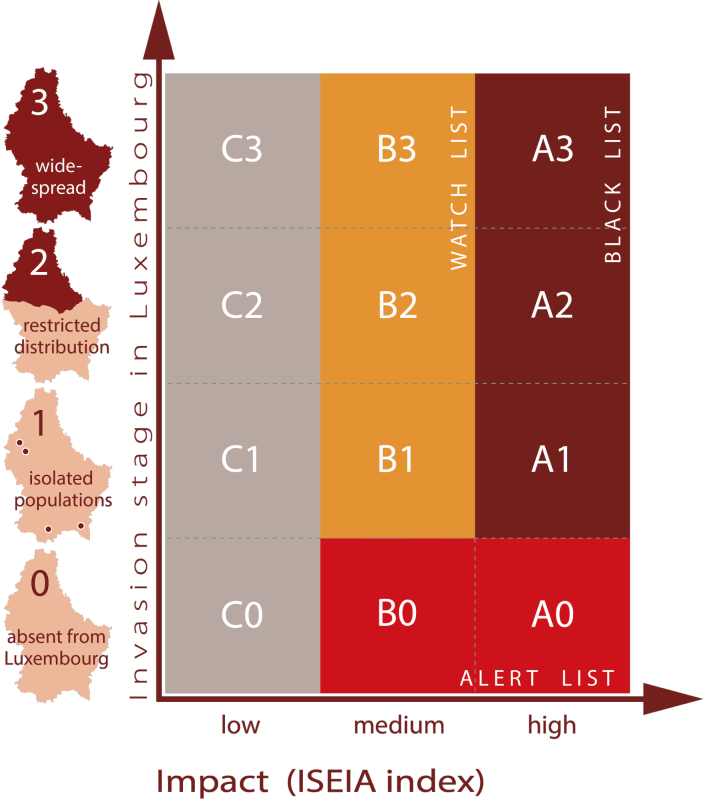
Français Elodée de Nuttall RA: ISEIA: A3, Black List. Harmonia+: 0,42
Deutsch Schmalblättrige Wasserpest Wikipedia: Wikipedia - English - Nuttall's Waterweed Wikipedia - Français - Elodée de Nuttall Wikipedia - Deutsch - Schmalblättrige Wasserpest | Wikispecies: Wikispecies - Elodea nuttallii | CABI
Nederlands Smalle waterpest Back to the list of neophytes

Brief description

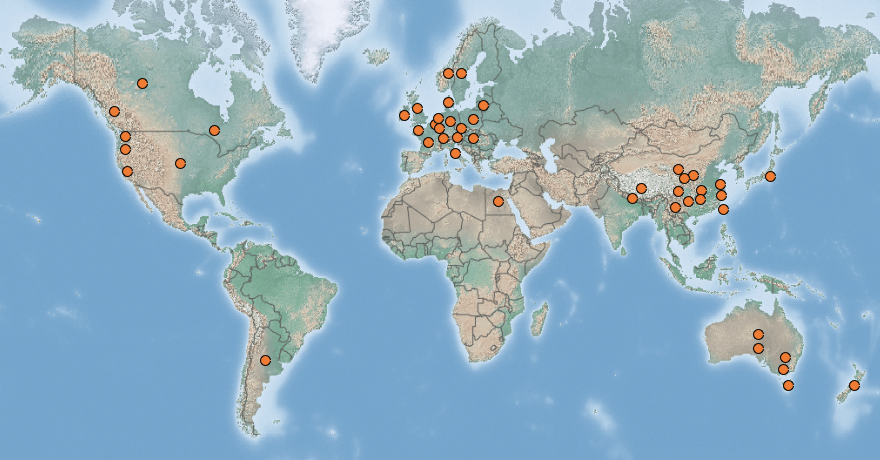
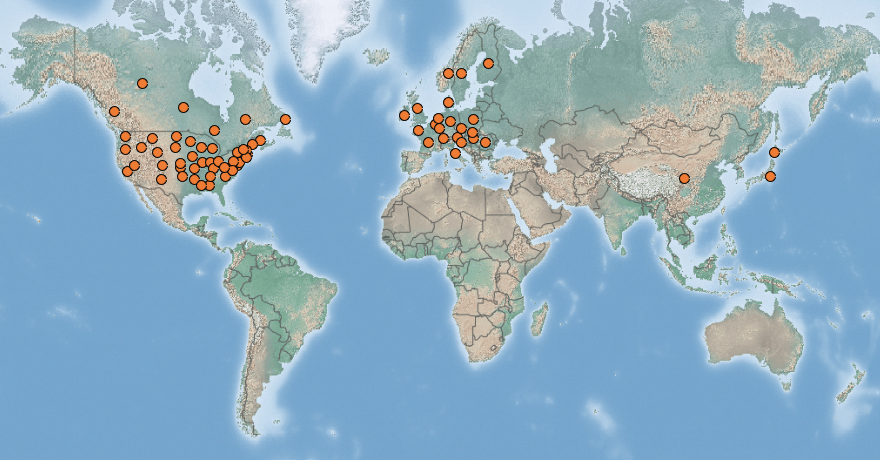
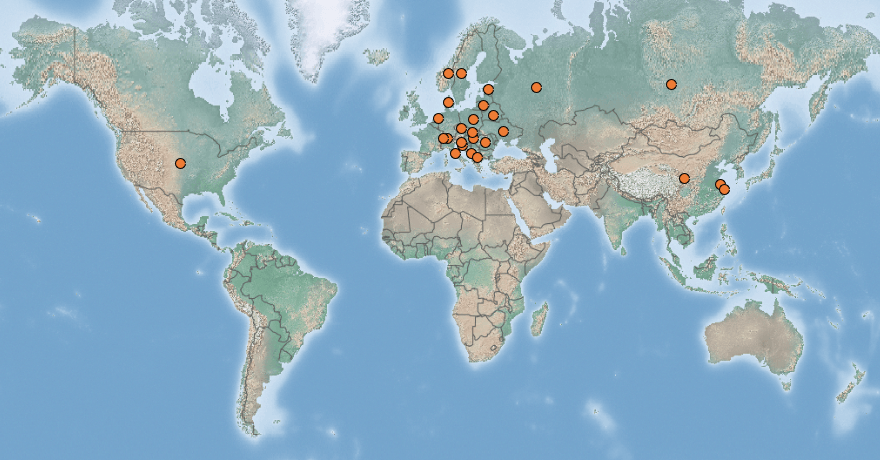
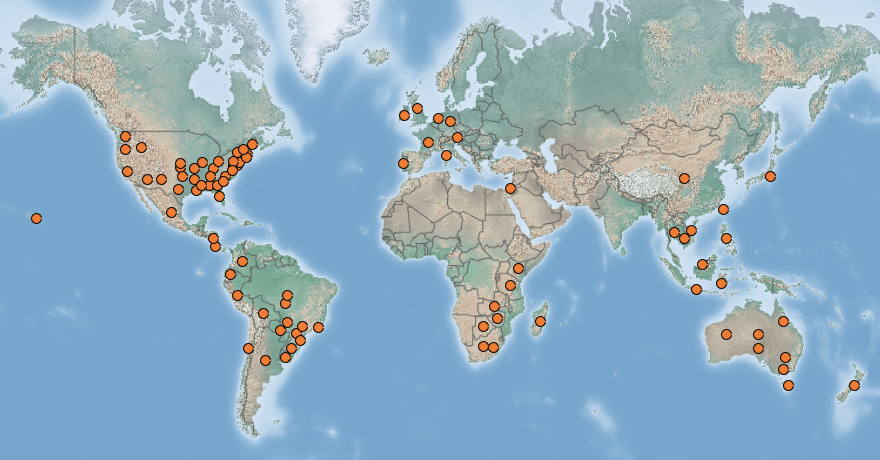
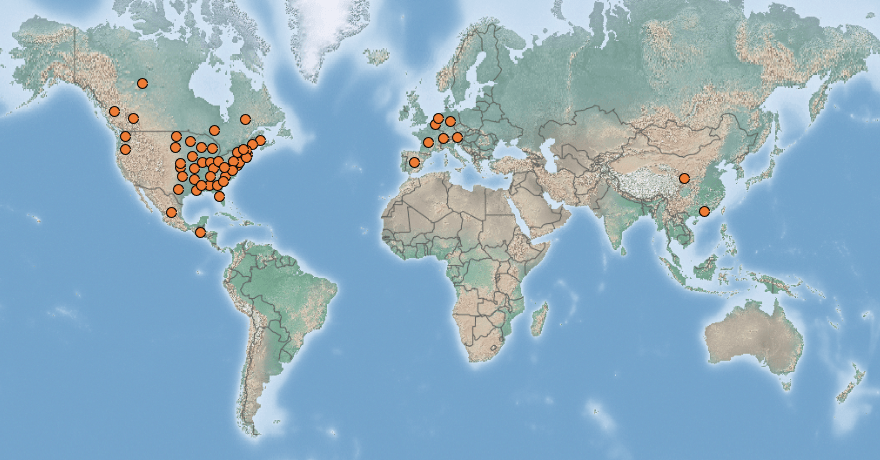
Elodea nuttallii (Planch.) H. St. John is an aquatic plant that thrives in various types of freshwater habitats, from still to slow-flowing systems and from very shallow to deep waters. It is very tolerant to water pollution and prefers warm eutrophic and calcareous waters; it is often found in species-poor macrophyte communities. This submerged perennial makes dense monospecific populations which often colonise whole water bodies, restrict water movement, cut off light, produce anoxic conditions and trap sediments in the system. Due to its quick nutrient uptake and very high growth rate, the species has been reported to outcompete several native aquatic plants (Branquart et al. 2019).

IAS of Union concern

In 2017, Elodea nuttallii (Planch.) H. St. John was added to the list of invasive alien species of Union concern (Anonymous 2017) which implies that member states shall take all necessary steps to prevent it’s unintentional introduction or spread.

Status and distribution in Luxembourg

Records of Elodea nuttallii (Planch.) H. St. John in Luxembourg. Data source: Recorder-Lux, iNaturalist & GBIF, 2021-07-23.

Elodea nuttallii (Planch.) H. St. John has been first documented by Paul Verheggen in the Upper Sûre lake near Boulaide in 1975 (Parent 1983 cit. in Diederich 1984: 39) 1.

65 records of the species are listed in the MNHNL-mdata online portal (MNHNL, iNaturalist & GBIF 2019). In Luxembourg, it is less common than Elodea canadensis and seems confined to the Gutland.

The species, observed since 1941 in the Netherlands, was harvested in 1939 in northern Belgium, but was only identified later (around 1967). It tends to locally supplant Elodea canadensis Michx. (Lambinon & Verloove 2012: 790).

Management

Action plan

Finalised Action Plan for Elodea nuttallii (Pfeiffenschneider & Hoppe 2020).

Risk assessment

ISEIA protocol

A3 (3+3+3+3) = Black List (Ries et al. 2013: 18).

Harmonia+ protocol

Overall risk score 0,42 = (Overall Invasion score 0,71 x Overall Impact score 0,60) (Ries et al. 2020).

0,71Invasion
0,60Impact
0,42Risk

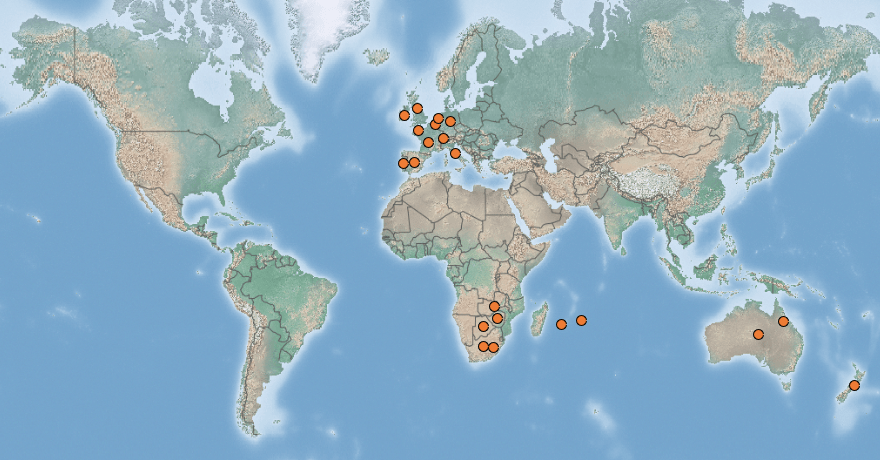
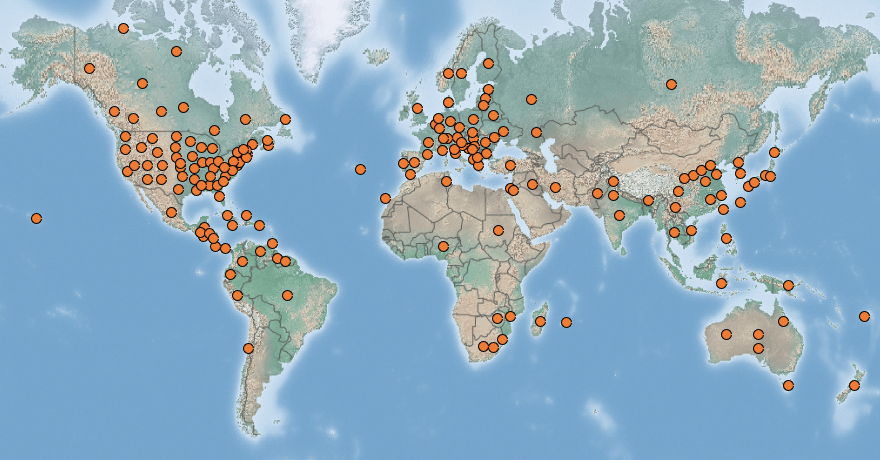
Worldwide distribution

Fact sheet

PDF fact sheet of the Nature and Forestry Administration: FR | DE

Bibliography

  • Anonymous, 2017. Commission implementing regulation (EU) 2017/1263 of 12 July 2017 updating the list of invasive alien species of Union concern established by Implementing Regulation (EU) 2016/1141 pursuant to Regulation (EU) No 1143/2014 of the European Parliament and of the Council. Official Journal of the European Union L 182: 37-39 (13.7.2017).
  • CABI, 2019. Elodea nuttallii. In: Invasive Species Compendium. Wallingford, UK: CAB International. URL: www.cabi.org/isc [accessed 2020-02-28]
  • Branquart, E., I. Stiers, L. Triest, S. Vanderhoeven, W. Van Landuyt, F. Van Rossum, F. Verloove, 2019. Harmonia database: Elodea nuttallii (Planch.) H. St. John. Harmonia version 1.2, Belgian Forum on Invasive Species. URL: http://ias.biodiversity.be [accessed on 2019-10-09]
  • Diederich, P., 1984. Les monocotylédones aquatiques (excl. Potamogeton s.l.) du Grand-Duché de Luxembourg. Dumortiera 29-30: 34-41. [PDF 5 MB].
  • Lambinon J. & F. Verloove, 2012. Nouvelle flore de la Belgique, du grand-duché de Luxembourg, du Nord de la France et des régions voisines. Sixième édition. Avec la collaboration de L. Delvosalle, B. Toussaint, D. Geerinck, I. Hoste, F. Van Rossum, B. Cornier, R. Schumacker, A. Vanderpoorten et H. Vannerom. Jardin botanique national de Belgique, Meise. CXXXIX + 1195 pp. ISBN : 9789072619884.
  • MNHNL, 2000-. Elodea nuttallii (Planch.) H. St. John in Recorder-Lux, database on the natural heritage of the Grand Duchy of Luxembourg. Musée national d’histoire naturelle, Luxembourg. URL: https://mdata.mnhn.lu [Accessed 2019-09-05]
  • MNHNL, iNaturalist & GBIF, 2019. Elodea nuttallii (Planch.) H. St. John in MNHNL-mdata, online portal combining species observation from Recorder-Lux, iNaturalist and GBIF. National Museum of Natural History, Luxembourg. URL: https://mdata.mnhn.lu [Accessed 2019-09-06]
  • Parent, G. H., 1983. Données floristiques inédites tirées de l’herbier du docteur Paul Verheggen. Dumortiera 25 : 12-21.
  • Pfeiffenschneider, M. & F. Hoppe, 2020. Plan d’action pour espèces exotiques envahissantes au GrandDuché de Luxembourg : Elodéede Nuttall, Elodea nuttallii (Planch.) H. St. John. Version 23/09/2020. Administration de la nature et des forêts, Luxembourg. 22pp.
  • Ries, C. & Y. Krippel, 2021 [Unpublished manuscript]. First records of 56 invasive alien vascular plants in Luxembourg. MNHNL & Naturpark Öewersauer.
  • Ries, C., Y. Krippel & M. Pfeiffenschneider, 2020. Risk assessment after the Harmonia+ protocol of invasive alien vascular plant species in Luxembourg. Bull. Soc. Nat. luxemb. 122: 197-205. [PDF 132 KB]
  • Ries, C., Y. Krippel, M. Pfeiffenschneider & S. Schneider, 2013. Environmental impact assessment and black, watch and alert list classification after the ISEIA Protocol of non-native vascular plant species in Luxembourg. Bull. Soc. Nat. luxemb. 114: 15-21. [PDF 652 KB]

 Page content last updated on 2021-06-28. Last proofread by Caroline Grounds on 2019-11-17.

Erigeron annuus (L.) Pers.

English Tall fleabane Status LU: established. 1st record: LU & ITW <1836.
Lëtzebuergesch Jäerlecht Beuffkraut Status Eur.: established. 1st record: DK 1810.
Français Vergerette annuelle RA: ISEIA: C1. Harmonia+: 0,03
Deutsch Feinstrahl Wikipedia: Wikipedia - English - Tall fleabane Wikipedia - Français - Vergerette annuelle Wikipedia - Deutsch - Feinstrahl Wikipedia - Nederlands - Zomerfijnstraal | Wikispecies: Wikispecies - Erigeron annuus | CABI
Nederlands Zomerfijnstraal Back to the list of neophytes

Brief description

Daisy Fleabane (1292154577)Erigeron annuus (L.) Pers. is a North American plant that often populates ruderal sites. Because of its ability to form dense stands, the species can become problematic from a nature conservation point of view, if it enters established natural plant communities.

Erigeron annuus is a highly variable species, in which American studies have distinguished several infraspecific taxa, generally with a more or less limited geographical distribution. Their application to naturalised populations in Europe has led to their being reported as two or even three distinct subspecies. In the environment two subspecies have often been distinguished: Erigeron annuus subsp. annuus and Erigeron annuus subsp. septentrionalis (Lambinon & Verloove 2012: 707-708).

Status and distribution in Luxembourg

Records of Erigeron annuus (L.) Pers. in Luxembourg. Data source: Recorder-Lux, iNaturalist & GBIF, 2021-07-23.

Tinant (1836: 428) indicates Erigeron annuus (L.) Pers. under its synonym Aster annuus L. on “the gravels of the banks of the Moselle near Remich”. Erigeron annuus was sampled on the edge of the Moselle river near Remich before 1842 (Holandre 1842: 336). 1 The first edition of this flora from 1829 does not mention the species (Holandre 1829: 450). According to Lefort (1949: 46), Holandre’s “Flore de la Moselle” mentions Erigeron annuus near Schengen. It seems that all these refer to original material and observations of Tinant dating before 1836. An explanation of the confusion between Remich and Schengen as location may be read in the “Flore de Lorraine” by Grodron (1857: 387) who mentions Aster annuus L. at the “Banks of the Moselle near Remich, a little beyond the French border” 2, which suggests the location of the finding by Tinant might have been closer to Schengen than to Remich. In 1873, Koltz lists the species under its synonyms Stenactis alba [in the text] and Aster stenactis [in the index] and confirms that it occurs on roadsides, in hedges, lawns, and at forest edges. “Remich. T. près Schengen (Hollandre)” (Koltz 1873: 129).

The next documented observation of the species in Luxembourg dates from 1953. Marcel Etringer collected a specimen of the species on a slag heap in Dommeldange on 15th September 1953 (Specimen № 48214, MNHNL 2000-). Nowadays Erigeron annuus is quite common to quite rare in the Lorraine district (AC-AR) and very rare (RR) or non-existent in the Ardennes district (Lambinon & Verloove 2012: 707).

There are 94 observations in the Recorder-Lux database (MNHNL, iNaturalist & GBIF 2019).

Risk assessment

ISEIA protocol

C1 (2+2+1+1) (Ries et al. 2013: 18).

Harmonia+ protocol

Overall risk score 0,03 = (Overall Invasion score 0,28 x Overall Impact score 0,13) (Ries et al. 2020).

0,28Invasion
0,13Impact
0,03Risk

Worldwide distribution

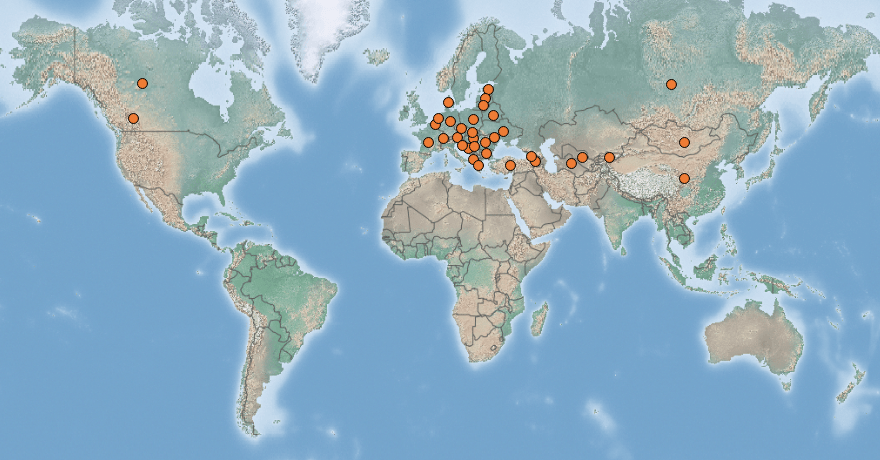
Bibliography

  • CABI, 2019. Erigeron annuus. In: Invasive Species Compendium. Wallingford, UK: CAB International. URL: www.cabi.org/isc [accessed 2020-03-02]
  • Gordon, A., 1857. Flore de Lorraine. 504 p. 2e édition, tome 1. Nancy, Metz & Paris.
  • Holandre, J.-J.-J., 1829. Flore de la Moselle, ou, Manuel d’herborisation, précédé d’un aperçu géologique sur le département et d’élémens abrégés de botanique. Tome 1. 712 p. Metz : Mme Thiel, libraire-éditeur.
  • Holandre, J.-J.-J., 1842. Nouvelle flore de la Moselle, ou Manuel d’herborisation dans les environs de Metz principalement, et les autres parties du département. Tome 1 et 2, 948 p. Metz : Verronnais. Paris : Roret.
  • Koltz, J.-P.-J., 1873. Prodrome de la flore du grand-duché de Luxembourg. Première partie. Plantes phanérogames. Imprimerie V. Buck, Luxembourg. 279 S.
  • Lambinon J. & F. Verloove, 2012. Nouvelle flore de la Belgique, du grand-duché de Luxembourg, du Nord de la France et des régions voisines. Sixième édition. Avec la collaboration de L. Delvosalle, B. Toussaint, D. Geerinck, I. Hoste, F. Van Rossum, B. Cornier, R. Schumacker, A. Vanderpoorten et H. Vannerom. Jardin botanique national de Belgique, Meise. CXXXIX + 1195 pp. ISBN : 9789072619884.
  • Lefort, F. L., 1950. Contribution à l’histoire botanique du Luxembourg (av. 18 planches). Bull. Soc. Nat. luxemb. 54: 31-160. [PDF 6781 KB]
  • MNHNL, 2000-. Erigeron annuus (L.) Pers. in Recorder-Lux, database on the natural heritage of the Grand Duchy of Luxembourg. Musée national d’histoire naturelle, Luxembourg. URL: https://mdata.mnhn.lu [Accessed 2018-01-18]
  • MNHNL, iNaturalist & GBIF, 2019. Erigeron annuus (L.) Pers. in MNHNL-mdata, online portal combining species observation from Recorder-Lux, iNaturalist and GBIF. National Museum of Natural History, Luxembourg. URL: https://mdata.mnhn.lu [Accessed 2019-09-06]
  • Ries, C. & Y. Krippel, 2021 [Unpublished manuscript]. First records of 56 invasive alien vascular plants in Luxembourg. MNHNL & Naturpark Öewersauer.
  • Ries, C., Y. Krippel & M. Pfeiffenschneider, 2020. Risk assessment after the Harmonia+ protocol of invasive alien vascular plant species in Luxembourg. Bull. Soc. Nat. luxemb. 122: 197-205. [PDF 132 KB]
  • Ries, C., Y. Krippel, M. Pfeiffenschneider & S. Schneider, 2013. Environmental impact assessment and black, watch and alert list classification after the ISEIA Protocol of non-native vascular plant species in Luxembourg. Bull. Soc. Nat. luxemb. 114: 15-21. [PDF 652 KB]

 Page content last updated on 2021-03-03. Last proofread by Caroline Grounds on 2019-11-18.

Egeria densa Planch.

English Large-flowered waterweed Status LU: established. 1st record: LU & ITW 2016.
Lëtzebuergesch Dichtbliedreg Waasserpescht Status Eur.: established. 1st record: unkn.
Français Égérie dense RA: ISEIA: A1 – Black List. Harmonia+: 0,32
Deutsch Dichtblättrige Wasserpest Wikipedia: Wikipedia - English - Large-flowered waterweed Wikipedia - Deutsch - Dichtblättrige Wasserpest Wikipedia - Nederlands - Egeria (plant) | Wikispecies: Wikispecies - Egeria densa | CABI
Nederlands Egeria (plant) Back to the list of neophytes

Brief description

Egeria densa Planch. is a South American aquatic plant with a very wide ecological amplitude. It thrives in a variety of freshwater habitats: while it prefers flowing systems it may also be found in still waters. The species is not light-demanding and is able to develop in deep and turbid waters. The submerged perennial makes dense monospecific populations which often colonise whole water bodies, restrict water movement, cut off light, produce anoxic conditions and trap sediments in the system. The large-flowered water weed has been reported to outcompete native aquatic plants and to adversely affect fish communities (Branquart et al. 2013).

Status and distribution in Luxembourg

Records of Egeria densa Planch. in Luxembourg. Data source: Recorder-Lux, iNaturalist & GBIF, 2021-07-23.

Egeria densa Planch. was observed twice in 2016 in the Eisch valley East of Hobscheid (mdata.mnhn.lu) and in 2019 in Luxembourg City (MNHNL, iNaturalist & GBIF 2019).

Risk assessment

ISEIA protocol

A1 (2+3+3+3) = Black List. Updated on 22 June 2018 by Christian Ries and Manou Pfeiffenschneider. Former assessment: A0 (2+3+3+3) = Alert List (Ries et al. 2013: 18).

Harmonia+ protocol

Overall risk score 0,32 = (Overall Invasion score 0,53 x Overall Impact score 0,62) (Ries et al. 2020).

0,53Invasion
0,62Impact
0,32Risk

Worldwide distribution

Bibliography

  • Branquart, E., I. Stiers, L. Triest, S. Vanderhoeven, W. Van Landuyt, F. Van Rossum & F. Verloove, 2013. Harmonia database: . Harmonia version 1.2, Belgian Forum on Invasive Species. URL: http://ias.biodiversity.be [accessed on 2020-02-28]
  • CABI, 2019. Egeria densa. In: Invasive Species Compendium. Wallingford, UK: CAB International. URL: www.cabi.org/isc [accessed 2020-02-28]
  • MNHNL, iNaturalist & GBIF, 2019. Egeria densa in MNHNL-mdata, online portal combining species observation from Recorder-Lux, iNaturalist and GBIF. National Museum of Natural History, Luxembourg. URL: https://mdata.mnhn.lu [Accessed 2020-02-28]
  • Ries, C. & Y. Krippel, 2021 [Unpublished manuscript]. First records of 56 invasive alien vascular plants in Luxembourg. MNHNL & Naturpark Öewersauer.
  • Ries, C., Y. Krippel & M. Pfeiffenschneider, 2020. Risk assessment after the Harmonia+ protocol of invasive alien vascular plant species in Luxembourg. Bull. Soc. Nat. luxemb. 122: 197-205. [PDF 132 KB]
  • Ries, C., Y. Krippel, M. Pfeiffenschneider & S. Schneider, 2013. Environmental impact assessment and black, watch and alert list classification after the ISEIA Protocol of non-native vascular plant species in Luxembourg. Bull. Soc. Nat. luxemb. 114: 15-21. [PDF 652 KB]

 Page content last updated on 2021-03-03. Last proofread by Caroline Grounds on 2019-11-14.

Myriophyllum aquaticum (Vell.) Verdc.

English Parrot’s-feather Status LU: established. 1st record: LU & ITW ~1990.
Lëtzebuergesch Brasilien-Waassergras Status Eur.: established. 1st record: unkn. IAS of EU concern (2016).
Français Myriophylle du Brésil RA: ISEIA: B1, Watch List. Harmonia+: 0,51.
Deutsch Brasilianisches Tausendblatt Wikipedia: Wikipedia - English - Parrot's-feather Wikipedia - Français - Myriophylle du Brésil Wikipedia - Deutsch - Brasilianisches Tausendblatt | Wikispecies: Wikispecies - Myriophyllum_aquaticum | CABI
Nederlands Parelvederkruid Back to the list of neophytes

Brief description

Starr 070515-7059 Myriophyllum aquaticumMyriophyllum aquaticum (Vell.) Verdc. is an invasive submerged/emergent aquatic weed characteristic of sub-tropical to warm-temperate regions, but found as far north as the UK. The species thrives in well-lit ponds, ditches, canals and slow-running streams. It is most often found in eutrophic water bodies and is able to grow as a terrestrial plant when ponds dry out, making it well-adapted to medium water level fluctuations (Branquart et al. 2013).

IAS of Union concern

In 2016, Myriophyllum aquaticum (Vell.) Verdc. was added to the list of invasive alien species of Union concern (Anonymous 2016) which implies that member states shall take all necessary steps to prevent it’s unintentional introduction or spread.

Status and distribution in Luxembourg

Records of Myriophyllum aquaticum (Vell.) Verdc. in Luxembourg. Data source: Recorder-Lux, iNaturalist & GBIF, 2021-07-23.

Myriophyllum aquaticum (Vell.) Verdc. was first documented by Roland Proess in his Herbarium in June 2000 at Freschewisen near Roeser, a dead branch stream of the Alzette river. According to Proess, this large population in a pond has existed for at least 10 years (Colling & Krippel 2003: 16). Parrot’s-feather’s first record for Luxembourg can thus approximately be dated to ~1990. Another observation by Mikka Mootz on 1 April 2019 in a nearby pond in Houwisen confirms the presence of the species in the same area.

In 2019, extensive patches were discovered in the Thilleweier pond in a forest environment (Dudelange). A third site was detected in 2020 near Saeul (Krippel et al. 2020: 42).

Currently 2 records are accessible through the MNHNL-mdata portal (MNHNL, iNaturalist & GBIF 2020).

This eastern North American species is very rare, subspontaneous or naturalised [in the Luxembourg environment]. In Europe, only female flowers have been reported, which are necessarily sterile in the absence of male flowers. Apparently, however, the plants observed in the wild are only known in the vegetative state. This species became naturalised here during the 1990s. Its expansion seems to be continuing (Lambinon & Verloove 2012: 422-423).

Risk assessment

ISEIA protocol

B1 (2+2+3+3) = Watch List (Ries et al. 2013: 18).

Harmonia+ protocol

Overall risk score 0,51 = (Overall Invasion score 0,68 x Overall Impact score 0,75) (Ries et al. 2020).

0,68Invasion
0,75Impact
0,51Risk

Worldwide distribution

Bibliography

  • Anonymous, 2016. Commission implementing regulation (EU) 2016/1141 of 13 July 2016 adopting a list of invasive alien species of Union concern pursuant to Regulation (EU) No 1143/2014 of the European Parliament and of the Council. Official Journal of the European Union L 189: 4-5.
  • Branquart, E., L. Triest, S. Vanderhoeven, W. Van Landuyt, F. Van Rossum & F. Verloove, 2013. Harmonia database: Myriophyllum aquaticum (Vell.) Verdc. Harmonia version 1.2, Belgian Forum on Invasive Species. URL: http://ias.biodiversity.be [accessed on 2019-10-14]
  • CABI, 2019. Myriophyllum aquaticum. In: Invasive Species Compendium. Wallingford, UK: CAB International. URL: www.cabi.org/isc [accessed 2020-03-02]
  • Colling, G. & Y. Krippel, 2003. Notes floristiques. Observations faites au Luxembourg (2000-2001). Bull. Soc. Nat. luxemb. 103: 3-23. [PDF 342 KB]
  • Krippel, Y., T. Helminger & G. Colling, 2020. Notes floristiques. Observations faites au Luxembourg (2018-2019). Bulletin Soc. Nat. luxemb. 122 : 29-55. [PDF 132 KB]
  • Lambinon J. & F. Verloove, 2012. Nouvelle flore de la Belgique, du grand-duché de Luxembourg, du Nord de la France et des régions voisines. Sixième édition. Avec la collaboration de L. Delvosalle, B. Toussaint, D. Geerinck, I. Hoste, F. Van Rossum, B. Cornier, R. Schumacker, A. Vanderpoorten et H. Vannerom. Jardin botanique national de Belgique, Meise. CXXXIX + 1195 pp. ISBN : 9789072619884.
  • MNHNL, 2000-. Myriophyllum aquaticum (Vell.) Verdc. in Recorder-Lux, database on the natural heritage of the Grand Duchy of Luxembourg. Musée national d’histoire naturelle, Luxembourg. URL: https://mdata.mnhn.lu [Accessed 2019-10-14]
  • MNHNL, iNaturalist & GBIF, 2020. Myriophyllum aquaticum (Vell.) Verdc. in MNHNL-mdata, online portal combining species observation from Recorder-Lux, iNaturalist and GBIF. National Museum of Natural History, Luxembourg. URL: https://mdata.mnhn.lu [Accessed 2019-10-14]
  • Ries, C. & Y. Krippel, 2021 [Unpublished manuscript]. First records of 56 invasive alien vascular plants in Luxembourg. MNHNL & Naturpark Öewersauer.
  • Ries, C., Y. Krippel & M. Pfeiffenschneider, 2020. Risk assessment after the Harmonia+ protocol of invasive alien vascular plant species in Luxembourg. Bull. Soc. Nat. luxemb. 122: 197-205. [PDF 132 KB]
  • Ries, C., Y. Krippel, M. Pfeiffenschneider & S. Schneider, 2013. Environmental impact assessment and black, watch and alert list classification after the ISEIA Protocol of non-native vascular plant species in Luxembourg. Bull. Soc. Nat. luxemb. 114: 15-21. [PDF 652 KB]

 Page content last updated on 2021-03-04. Last proofread by Caroline Grounds on 2019-11-20.

Myriophyllum heterophyllum Michx.

English Various-leaved water-milfoil Status LU: absent. 1st record: n/a.
Lëtzebuergesch Wiesselblat-Waassergras Status Eur.: established. 1st record: DE 1960s. 1 IAS of EU concern (2017).
Français Myriophylle hétérophylle RA: ISEIA: B0, Alert List. Harmonia+: 0,47.
Deutsch Verschiedenblättriges Tausendblatt Wikipedia: Wikipedia - Français - Myriophylle hétérophylle Wikipedia - Deutsch - Verschiedenblättriges Tausendblatt | Wikispecies: Wikispecies - Myriophyllum heterophyllum | CABI
Nederlands Ongelijkbladig vederkruid Back to the list of neophytes

Brief description

Myriophyllum heterophyllum 5457876Myriophyllum heterophyllum Michx. grows in well-lit ponds, ditches, canals and slow-running streams. It is found growing under a wide range of chemical conditions, but tends to prefer acidic waters. Variable watermilfoil is able produce very dense populations and high biomass. It is highly competitive and may lead to the exclusion of other submerged water plants. The dense mats it produces reduce sunlight and can restrict water movement; when decomposing, they alter water quality and reduce available oxygen. The low oxygen conditions can kill fish and harm other aquatic organisms. The plant can also cause boating and swimming hazards (Baus et al. 2013).

IAS of Union concern

In 2017, Myriophyllum heterophyllum Michx. was added to the list of invasive alien species of Union concern (Anonymous 2017) which implies that member states shall take all necessary steps to prevent it’s unintentional introduction or spread.

Status and distribution in Luxembourg

Myriophyllum heterophyllum Michx. has not yet been observed in Luxembourg (MNHNL, iNaturalist & GBIF 2020).

Risk assessment

ISEIA protocol

B0 (2+3+2+3) = Alert List (Ries et al. 2013: 18).

Harmonia+ protocol

Overall risk score 0,47 = (Overall Invasion score 0,63 x Overall Impact score 0,75) (Ries et al. 2020).

0,63Invasion
0,75Impact
0,47Risk

Worldwide distribution

Bibliography

  • Anonymous, 2017. Commission implementing regulation (EU) 2017/1263 of 12 July 2017 updating the list of invasive alien species of Union concern established by Implementing Regulation (EU) 2016/1141 pursuant to Regulation (EU) No 1143/2014 of the European Parliament and of the Council. Official Journal of the European Union L 182: 37-39 (13.7.2017).
  • Baus E., Branquart, E., I. Stiers, L. Triest, S. Vanderhoeven, W. Van Landuyt, F. Van Rossum & F. Verloove, 2013. Harmonia database: Myriophyllum heterophyllum Michx.. Harmonia version 1.2, Belgian Forum on Invasive Species. URL: http://ias.biodiversity.be [accessed on 2019-11-21]
  • CABI, 2021. Myriophyllum heterophyllum. In: Invasive Species Compendium. Wallingford, UK: CAB International. URL: www.cabi.org/isc [accessed 2021-03-04]
  • MNHNL, iNaturalist & GBIF, 2020. Myriophyllum heterophyllum in MNHNL-mdata, online portal combining species observation from Recorder-Lux, iNaturalist and GBIF. National Museum of Natural History, Luxembourg. URL: https://mdata.mnhn.lu [Accessed 2020-03-02]
  • Ries, C., Y. Krippel & M. Pfeiffenschneider, 2020. Risk assessment after the Harmonia+ protocol of invasive alien vascular plant species in Luxembourg. Bull. Soc. Nat. luxemb. 122: 197-205. [PDF 132 KB]
  • Ries, C., Y. Krippel, M. Pfeiffenschneider & S. Schneider, 2013. Environmental impact assessment and black, watch and alert list classification after the ISEIA Protocol of non-native vascular plant species in Luxembourg. Bull. Soc. Nat. luxemb. 114: 15-21. [PDF 652 KB]

 Page content last updated on 2021-03-04. Last proofread by Caroline Grounds on 2019-11-20.

Castor canadensis Kuhl, 1820

English North American beaver, Canadian beaver Status LU: casual. 1st record: 2000.
Lëtzebuergesch Kanadësche Biwer 1 Status Eur.: established.
Français Castor du Canada RA: ISEIA: B1, Watch List. Harmonia+: n/a.
Deutsch Kanadischer Biber Wikipedia: Wikipedia - English - North American beaver Wikipedia - Français - Castor du Canada Wikipedia - Deutsch - Kanadischer Biber Wikipedia - Nederlands - Canadese bever | Wikispecies: Wikispecies - Castor canadensis | CABI
Nederlands Canadese bever Back to the list of vertebrates

Brief description

Bevers

Canadian beavers in captivity, Mierlo, Netherlands, October 2005

Like Castor fiber Linnaeus, 1758, Castor canadensis Kuhl, 1820 lives in riparian zones, rivers and lakes, usually included in a forest matrix providing food and building material. Lodges may be completely surrounded by water or built on the banks of streams and lakes. The Canadian beaver has a greater ecological flexibility – it survives better under severe climatic conditions and adapts more easily to substitute foods than its Eurasian counterpart. The Canadian beaver is likely to outcompete the native the Eurasian beaver due to higher reproductive output. It is a more active builder of dams and lodges and regulates hydrological regimes of water bodies better than C. fiber. The two species do not hybridise due to a difference in chromosome numbers. The fact that these are two different species was only confirmed by genetic studies in 1973 (Schley & Herr 2019: 138).

Status and distribution in Luxembourg

Records of Castor canadensis Kuhl, 1820 in Luxembourg. Data source: Recorder-Lux, iNaturalist & GBIF, 2021-07-23.

Castor canadensis Kuhl, 1820 was first documented in 2000 in Drauffelt (Pir & Schley 2015: 443): “A beaver that appeared in Luxembourg in 2000 (Schley et al. 2001) was crushed by a train in 2002 and subsequently identified as a Canadian beaver (Schley & Herr, unpublished data).”

The species was next reported by Alexander Kristiansen on 29 November 2018 near the Sûre, upstream from Wallendorf-Pont (MNHNL 2000-).

Pir & Schley (2015: 443) report the current situation: “Genetic analyses carried out by the ANF have shown that Luxembourg is facing colonisation by the Canadian beaver from a population in Rhineland-Palatinate (Schley et al. 2009). The latter was able to develop from individuals escaping from a zoo near Pronsfeld (D) (Michaux et al. 2012).”

Actions are taken to eliminate the Canadian beaver, in order to limit its negative impacts on the fragile population of Castor fiber in Luxembourg.

The distribution map is not complete because records still have to be entered into the Recorder-Lux database (MNHNL, iNaturalist & GBIF 2019).

Risk assessment

ISEIA protocol

B1 (3+3+2+1) = Watch List (Ries et al. 2014: 199).

Harmonia+ protocol

Not assessed yet.

Worldwide distribution

Bibliography

    • CABI, 2009. Castor canadensis Kuhl, 1820 [original text by Viki Aldridge]. In: Invasive Species Compendium. Wallingford, UK: CAB International. URL: www.cabi.org/isc [accessed 2019-11-26]
    • Dewas M, Herr J, Schley L, Angst C, Manet B, et al. (2011) Recovery and status of native and introduced beavers Castor fiber and Castor canadensis in France and neighboring countries. Mammal Review 42: 144–165. [DOI]
    • Herr, J., L. Schley, C. Gonner, A. Arendt, G. Biver, A. Bombardella, M. Dostert, A. Frantz, B. Goebel, S. Hermes, Y. Mersch, N. Negretti, C. Origer, M. Peters, P. Reis, C. Schortgen, F. Steffes, N. Welschbillig & M. Weydert, 2018. Aktions- und Managementplan für den Umgang mit Bibern in Luxemburg. Technischer Bericht der Naturverwaltung betreffend Wildtiermanagement und Jagd, 6 (Spezialnummer): 1-40.
    • Michaux, J., C. Frosch, B. Manet, J. Herr, M. Eugène, L. Dalbeck, R. Denné, M.-L. Schwoerer, S. Venske, F. Rosell, P. Hurel, N. Chevallier & L. Schley, 2012. Genetic analysis of beavers (Castor sp.) in the greater region of Belgium, Luxembourg, northern France and Western Germany. In: Book of Abstracts of the 6th International Beaver Symposium (éds Bjedov L., G. Schwab & M. Grubešić), 17-20 September 2012, Ivanić-Grad, Croatia: 110.
    • MNHNL, 2000-. Castor canadensis Kuhl, 1820 in Recorder-Lux, database on the natural heritage of the Grand Duchy of Luxembourg. Musée national d’histoire naturelle, Luxembourg. URL: https://mdata.mnhn.lu [Accessed 2019-10-24]
    • MNHNL, iNaturalist & GBIF, 2019. Castor canadensis Kuhl, 1820 in MNHNL-mdata, online portal combining species observation from Recorder-Lux, iNaturalist and GBIF. National Museum of Natural History, Luxembourg. URL: https://mdata.mnhn.lu [Accessed 2019-10-24]
    • Pir, J.B. & L. Schley, 2015. Développement des connaissances sur la répartition et l’écologie des mammifères au Luxembourg entre 1990 et 2015. Bull. Soc. Nat. luxemb. 116: 437-455.
    • Ries, C., M. Pfeiffenschneider, Engel, E., J.-C. Heidt & M. Lauff, 2014. Environmental impact assessment and black, watch and alert list classification after the ISEIA Protocol of vertebrates in Luxembourg. Bull. Soc. Nat. luxemb. 115: 195-201. [PDF 247 KB]
    • Schley, L., C. Sinner, S. Venske & A. Stern, 2004. Biber in Luxemburg. Administration des eaux et forêts, Luxembourg, 20 pp.
    • Schley, L. & J. Herr, 2019. Säugetiere Luxemburgs. Hrsg.: natur&ëmwelt a.s.b.l., Ministère du développement durable et des infrastructures, Administration de la nature et des forêts. 219 S. ISBN 978-2-9199511-0-9 [French edition: Les mammifères du Luxembourg, ISBN 978-2-9199511-2-3]
    • Schley, L., J. Herr, L. Dalbeck, R. Denné, B. Manet, M.-L. Schwoerer, S.Venske & J. Michaux, 2009. Evidence for the presence of the North American beaver Castor canadensis in Western Europe. In: Programme, Abstracts, Participants of the 5th International Beaver Symposium, 20-23 September 2009, Dubingiai, Lithuania: 58.
    • Schley, L., L. Dalbeck, R. Denné, B. Manet, M.-L. Schwoerer, S. Venske & J. Herr, 2012. Management and eradication of the North American beaver Castor canadensis in Western Europe. In: Book of Abstracts of the 6th International Beaver Symposium (éds Bjedov L., G. Schwab & M. Grubešić), 17-20 September 2012, Ivanić-Grad, Croatia: 31.
    • Schley, L., L. Schmitz & C. Schanck, 2001. First record of the beaver Castor fiber in Luxembourg since at least the 19th century. Lutra 44: 41-42.
    • Wörterbuchkommission (Hrsg.), 1987. Luxemburger Wörterbuch. 5 Bd. Im Auftrag der Grossherzoglichen Luxemburgischen Regierung. Linden, Luxemburg.

 Page content last updated on 2021-04-13. Last proofread by Caroline Grounds on 2019-11-27.

Senecio inaequidens DC.

English Narrow-leaved ragwort Status LU: established. 1st record: LU & ITW 1988.
Lëtzebuergesch Schmuelt Kräizkräitchen Status Eur.: established. 1st record: DE 1889. 1
Français Séneçon du Cap RA: ISEIA: B2, Watch List. Harmonia+: 0,29.
Deutsch Schmalblättriges Greiskraut Wikipedia: Wikipedia - English - Narrow-leaved ragwort Wikipedia - Français - Séneçon du Cap Wikipedia - Deutsch - Schmalblättriges Greiskraut Wikipedia - Nederlands - Bezemkruiskruid | Wikispecies: Wikispecies - Senecio inaequidens | CABI
Nederlands Bezemkruiskruid Back to the list of neophytes

Brief description

Senecio inaequidens

Kristian Peters @ Wikimedia Commons

Senecio inaequidens DC. mainly thrives in ruderal and disturbed areas. It may also be found in rock outcrops, open grasslands and sand dunes. Minute achenes (3 mm) are mainly dispersed by wind, but also by water and animals, travelling long distances. Senecio inaequidens does not demonstrably pose a threat to indigenous species or plant communities at present in western Europe. The plant is toxic for livestock (Branquart et al. 2010).

As a plant of the southern hemisphere, it tends to flower particularly in autumn (springtime in its region of origin) and it is only the first serious frosts that make its beautiful light-yellow flower heads disappear, carried on stems lined with linear leaves (Reichling 1990: 67).

Status and distribution in Luxembourg

Records of Senecio inaequidens DC. in Luxembourg. Data source: Recorder-Lux, iNaturalist & GBIF, 2021-07-23.

Senecio inaequidens DC. was first observed in Luxembourg in the wild by Ed Melchior on 1988-07-31 on a slag heap in Differdange (Reichling 1990: 67; MNHNL 2000-). This record was published with the following annotations by Léopold Reichling: “A South African species, new to our country. It has become naturalised in some regions of southern and western Europe, closer to home, particularly in Belgium (especially the Liège region) (e.g. Van Rompaey & Delvosalle, 1979, map 1040: Delvosalle & al. 1979 and in the NW of Germany (e. g. Kuhbier, 1977). Given the momentum with which it often invades newly conquered lands, it can be expected to spread to the slag heaps and quarry bottoms of the Mining Basin. As a plant of the southern hemisphere, it tends to flower mainly in the autumn (springtime in its native land) and it is only the first serious frosts that make its beautiful light-yellow flower heads disappear, carried on stems lined with linear leaves with an embracing base” (Reichling 1990: 67; see here for the cited references).

In 2008 and 2009, isolated plants were observed in the northern part of Luxembourg (Esch/Sûre, Harlange). In 2012, only 14 observations were documented in the Recorder-Lux database (MNHNL 2000-). In 2014 a survey of the species along highways increased the number of records (Frankenberg & Gräser 2014). Currently, 164 records are accessible through the MNHNL-mdata portal (MNHNL, iNaturalist & GBIF 2021).

But while the first populations of the plant were documented in industrial areas in the south of Luxembourg, it took the species only a few years to spread to Luxembourg City as well as to the German and Belgian borders, using the motorway network as a dispersal route. A study from 2014 showed that by then the species had populated almost the entire motorway network of Luxembourg (Frankenberg & Gräser 2014).

The species is already widespread in the south of the country, mainly along the main roads, but it is also expanding in the central and northern parts of the country and is increasingly being observed at stations far from any roadside (Krippel et al. 2020: 47).

The species continues to expand its range and will probably have negative impacts on biodiversity as soon as it spreads from motorways and roads into grassland, pastures and rock ecosystems.

This species, native to South Africa, is naturalised in southern and western Europe. Common to rare, with strong expansion in the wild. Roadsides, railway ballast, wastelands, slag heaps, quarry screes, lawns. Originally, this species was mainly naturalised in the eastern Mosan area (Vesdre valley and Meuse valley around Liège) and in the surroundings of Calais. It then spread (especially from the 1980s onwards), often proving to be a very invasive weed. It is now found in a large part of the region, where it is still growing (Lambinon & Verloove 2012: 739).

Risk assessment

ISEIA protocol

B2 (3+2+2+3) = Watch List (Ries et al. 2013: 19).

Harmonia+ protocol

Overall risk score 0,29 = (Overall Invasion score 0,76 x Overall Impact score 0,38) (Ries et al. 2020).

0,76Invasion
0,38Impact
0,29Risk

Worldwide distribution

Bibliography

  • Branquart, E., S. Vanderhoeven, W. Van Landuyt, F. Van Rossum & F. Verloove, 2010. Harmonia database: Senecio inaequidens DC. Harmonia version 1.2, Belgian Forum on Invasive Species. URL: http://ias.biodiversity.be [accessed on 2019-10-15]
  • CABI, 2019. Senecio inaequidens. In: Invasive Species Compendium. Wallingford, UK: CAB International. URL: www.cabi.org/isc [accessed 2020-03-04]
  • Colling, G. et L. Reichling, 1996. Notes floristiques 1994-1995. Bull. Soc. Nat. luxemb. 97: 25-38. [PDF 596 KB]
  • Colling , G. & Y. Krippel, 2001. Notes floristiques. Observations faites au Luxembourg (1998-1999). Bull. Soc. Nat. luxemb. 101: 33-48. [PDF 331 Kb]
  • Frankenberg, T. & P. Gräser, 2014. Vorkommen des Schmalblättrigen Greiskrauts (Senecio inaequidens DC.) in Luxemburg, Erfassung der aktuellen Verbreitung der Art entlang der Autobahnen und Autobahnzubringer. Unveröff. Studie des Büros EFOR-ERSA im Auftrag Nationalmuseums für Naturgeschichte, Oktober 2014. 6 S. + Anhang [PDF-Bericht, PDF-Übersichtskarte].
  • Krippel, Y. & G. Colling, 2008. Notes floristiques. Observations faites au Luxembourg (2006-2007). Bull. Soc. Nat. luxemb. 109: 59-76. [PDF 549 KB]
  • Krippel, Y. & G. Colling, 2010. Notes floristiques. Observations faites au Luxembourg (2008- 2009). Bull. Soc. Nat. luxemb. 111: 11-32. [PDF 209 KB]
  • Krippel, Y. & G. Colling, 2012. Notes floristiques. Observations faites au Luxembourg (2010-2011). Bull. Soc. Nat. luxemb. 113: 67-82. [PDF 579 KB]
  • Krippel, Y. & G. Colling, 2014. Notes floristiques. Observations faites au Luxembourg (2012-2013). Bull. Soc. Nat. luxemb. 115: 109-124. [PDF 893 KB]
  • Krippel, Y., T. Helminger & G. Colling, 2020. Notes floristiques. Observations faites au Luxembourg (2018-2019). Bulletin Soc. Nat. luxemb. 122 : 29-55. [PDF 132 KB]
  • Lambinon J. & F. Verloove, 2012. Nouvelle flore de la Belgique, du grand-duché de Luxembourg, du Nord de la France et des régions voisines. Sixième édition. Avec la collaboration de L. Delvosalle, B. Toussaint, D. Geerinck, I. Hoste, F. Van Rossum, B. Cornier, R. Schumacker, A. Vanderpoorten et H. Vannerom. Jardin botanique national de Belgique, Meise. CXXXIX + 1195 pp. ISBN : 9789072619884.
  • MNHNL, 2000-. Senecio inaequidens DC. in Recorder-Lux, database on the natural heritage of the Grand Duchy of Luxembourg. Musée national d’histoire naturelle, Luxembourg. URL: https://mdata.mnhn.lu [Accessed 2019-10-15]
  • MNHNL, iNaturalist & GBIF, 2021. Senecio inaequidens DC. in MNHNL-mdata, online portal combining species observation from Recorder-Lux, iNaturalist and GBIF. National Museum of Natural History, Luxembourg. URL: https://mdata.mnhn.lu [Accessed 2019-10-15]
  • Reichling, L., 1990. Observations floristiques au Luxembourg 1980-1989. Bull. Soc. Nat. luxemb. 90: 55-70. [PDF 808 KB]
  • Ries, C. & Y. Krippel, 2021 [Unpublished manuscript]. First records of 56 invasive alien vascular plants in Luxembourg. MNHNL & Naturpark Öewersauer.
  • Ries, C., Y. Krippel & M. Pfeiffenschneider, 2020. Risk assessment after the Harmonia+ protocol of invasive alien vascular plant species in Luxembourg. Bull. Soc. Nat. luxemb. 122: 197-205. [PDF 132 KB]
  • Ries, C., Y. Krippel, M. Pfeiffenschneider & S. Schneider, 2013. Environmental impact assessment and black, watch and alert list classification after the ISEIA Protocol of non-native vascular plant species in Luxembourg. Bull. Soc. Nat. luxemb. 114: 15-21. [PDF 652 KB]

 Page content last updated on 2021-03-11. Last proofread by Caroline Grounds on 2019-11-21.

Elodea canadensis Michx.

English Canadian waterweed, pondweed Status LU: established. 1st record: LU & ITW ~1875
Lëtzebuergesch Kanadesch Waasserpescht Status Eur.: established. 1st record: IE 1836.
Français Élodée du Canada RA: ISEIA: A3 – Black List. Harmonia+: 0,46
Deutsch Kanadische Wasserpest Wikipedia: Wikipedia - English - Canadian waterweed Wikipedia - Français - Élodée du Canada Wikipedia - Deutsch - Kanadische Wasserpest Wikipedia - Nederlands - Brede waterpest | Wikispecies: Wikispecies - Elodea canadensis | CABI
Nederlands Brede waterpest Back to the list of neophytes

Brief description

Elodea canadensis Michx. is an aquatic plant native to North America that thrives in a variety of freshwater habitats, from still to slow-flowing systems and from very shallow to deep waters. It is most frequent in clear, nutrient-rich and alkaline waters. Elodea aggressively invaded the waterways of Europe in the 19th Century (Branquart et al. 2010).

Status and distribution in Luxembourg

Records of Elodea canadensis Michx. in Luxembourg. Data source: Recorder-Lux, iNaturalist & GBIF, 2021-07-23.

Elodea canadensis Michx. was introduced around 1875 to the Grand Duchy of Luxembourg in 2 ponds between Itzig, Contern and Scheidhof (Fischer 1882: 122). In the following years, it was found in Imbringen (1883), Meysembourg (1886), Schrassig (1902), Diekirch (1906), Birelergrund (1908) and Bissen (1909). It has become quite common in our regions and can be observed in both standing and river waters (Diederich 1984: 38).

The oldest herbarium specimen in the Museum was collected in 1883 by Jean Feltgen (1833-1904) in standing water in the meadows of Imbringen (Specimen № 629a MNHNL 2000-).

Until 1909 the species had not been observed in the Ardennes (Oesling) (Robert 1910: 15).

By now the Canadian waterweed is widely spread throughout the country, 172 records of the species are listed in the MNHNL-mdata online portal (MNHNL, iNaturalist & GBIF 2019).

The North American plant Elodea canadensis was introduced to Europe around 1835 and quickly invaded the fresh waters of much of the continent. However, this expansion seems to have stopped or even reversed today, and is tending to be replaced by Elodea nuttallii (Planch.) H. St. John (Lambinon & Verloove 2012: 790, 791).

Risk assessment

ISEIA protocol

A3 (3+3+3+3) = Black List (Ries et al. 2013: 18).

Harmonia+ protocol

Overall risk score 0,46 = (Overall Invasion score 0,77 x Overall Impact score 0,60) (Ries et al. 2020).

0,77Invasion
0,60Impact
0,46Risk

Worldwide distribution

Bibliography

  • Branquart, E., I. Stiers, L. Triest, S. Vanderhoeven, W. Van Landuyt, F. Van Rossum, F. Verloove, 2010. Harmonia database: Elodea canadensis Michx.. Harmonia version 1.2, Belgian Forum on Invasive Species. URL: http://ias.biodiversity.be [accessed on 2019-10-09]
  • CABI, 2019. Elodea canadensis. In: Invasive Species Compendium. Wallingford, UK: CAB International. URL: www.cabi.org/isc [accessed 2020-02-28]
  • Diederich, P., 1984. Les monocotylédones aquatiques (excl. Potamogeton s.l.) du Grand-Duché de Luxembourg. Dumortiera 29-30: 34-41. [PDF 5 MB].
  • Fischer, M.-E., 1882. Plantes phanérogames nouvelles ou rares de la flore luxembourgeoise. Recueil des mémoires et des travaux publiés par la Société de botanique du grand-duché de Luxembourg 6-8: 116-124.
  • Lambinon J. & F. Verloove, 2012. Nouvelle flore de la Belgique, du grand-duché de Luxembourg, du Nord de la France et des régions voisines. Sixième édition. Avec la collaboration de L. Delvosalle, B. Toussaint, D. Geerinck, I. Hoste, F. Van Rossum, B. Cornier, R. Schumacker, A. Vanderpoorten et H. Vannerom. Jardin botanique national de Belgique, Meise. CXXXIX + 1195 pp. ISBN : 9789072619884.
  • MNHNL, 2000-. Elodea canadensis Michx. in Recorder-Lux, database on the natural heritage of the Grand Duchy of Luxembourg. Musée national d’histoire naturelle, Luxembourg. URL: https://mdata.mnhn.lu [Accessed 2019-09-05]
  • MNHNL, iNaturalist & GBIF, 2019. Elodea canadensis Michx. in MNHNL-mdata, online portal combining species observation from Recorder-Lux, iNaturalist and GBIF. National Museum of Natural History, Luxembourg. URL: https://mdata.mnhn.lu [Accessed 2019-09-06]
  • Ries, C. & Y. Krippel, 2021 [Unpublished manuscript]. First records of 56 invasive alien vascular plants in Luxembourg. MNHNL & Naturpark Öewersauer.
  • Ries, C., Y. Krippel & M. Pfeiffenschneider, 2020. Risk assessment after the Harmonia+ protocol of invasive alien vascular plant species in Luxembourg. Bull. Soc. Nat. luxemb. 122: 197-205. [PDF 132 KB]
  • Ries, C., Y. Krippel, M. Pfeiffenschneider & S. Schneider, 2013. Environmental impact assessment and black, watch and alert list classification after the ISEIA Protocol of non-native vascular plant species in Luxembourg. Bull. Soc. Nat. luxemb. 114: 15-21. [PDF 652 KB]
  • Robert J., 1910. Beiträge zur Flora des Grossherzogtums Luxemburg. lnst. G.-D. Lux., Sect. Sc. natur., phvs., math., Arch. trimestr. n.s. V: 1-35. Luxembourg: Imprimerie de la Cour Victor-Buck.

 Page content last updated on 2021-03-03. Last proofread by Caroline Grounds on 2019-11-14.

Hydrocotyle ranunculoides L.f.

English Floating pennywort Status LU: absent. 1st record: n/a.
Lëtzebuergesch Grousse Waassernuebel Status Eur.: established. 1st record: NL, BE, UK 1980s. IAS of EU concern (2016)
Français Hydrocotyle fausse renoncule RA: ISEIA: A0, Alert List. Harmonia+: 0,38.
Deutsch Großer Wassernabel Wikipedia: Wikipedia - English - Floating pennywort Wikipedia - Français - Hydrocotyle fausse renoncule Wikipedia - Nederlands - Grote waternavel Wikispecies: Wikispecies - Hydrocotyle ranunculoides | CABI
Nederlands Grote waternavel Back to the list of neophytes

Brief description

Hydrocotyle ranunculoides L.f. is an aquatic plant that thrives in slow-flowing water bodies, particularly in ditches, canals, lakes and ponds. It prefers eutrophic waters, but it can also colonise marshes and mesotrophic water bodies. The species forms dense interwoven mats of vegetation which can quickly cover the entire water surface. Due to its vigorous growth, this plant causes loss of light and reduction in dissolved oxygen content in the water. As a consequence, the native submerged and water-edge plant species can be outcompeted, and ecosystem functions can be altered (Branquart et al. 2013).

IAS of Union concern

In 2016, Hydrocotyle ranunculoides L.f. was added to the list of invasive alien species of Union concern (Anonymous 2016) which implies that member states shall take all necessary steps to prevent it’s unintentional introduction or spread.

Status and distribution in Luxembourg

Hydrocotyle ranunculoides L.f. has not yet been observed in Luxembourg.

Risk assessment

ISEIA protocol

A0 (2+3+3+3) = Alert List (Ries et al. 2013: 18).

Harmonia+ protocol

Overall risk score 0,38 = (Overall Invasion score 0,65 x Overall Impact score 0,58) (Ries et al. 2020).

0,65Invasion
0,58Impact
0,38Risk

Worldwide distribution

Ressources

Verloove & Heyneman (2021) have published an identification key allowing to identify the species of Hydrocotyle currently found in Belgium.

Bibliography

  • Anonymous, 2016. Commission implementing regulation (EU) 2016/1141 of 13 July 2016 adopting a list of invasive alien species of Union concern pursuant to Regulation (EU) No 1143/2014 of the European Parliament and of the Council. Official Journal of the European Union L 189: 4-5.
  • Branquart, E., I. Stiers, L. Triest, S. Vanderhoeven, W. Van Landuyt, F. Van Rossum & F. Verloove, 2013. Harmonia database: Hydrocotyle ranunculoides L. f.. Harmonia version 1.2, Belgian Forum on Invasive Species. URL: http://ias.biodiversity.be [accessed on 2019-11-21]
  • CABI, 2019. Hydrocotyle ranunculoides. In: Invasive Species Compendium. Wallingford, UK: CAB International. URL: www.cabi.org/isc [accessed 2020-03-02]
  • Ries, C., Y. Krippel & M. Pfeiffenschneider, 2020. Risk assessment after the Harmonia+ protocol of invasive alien vascular plant species in Luxembourg. Bull. Soc. Nat. luxemb. 122: 197-205. [PDF 132 KB]
  • Ries, C., Y. Krippel, M. Pfeiffenschneider & S. Schneider, 2013. Environmental impact assessment and black, watch and alert list classification after the ISEIA Protocol of non-native vascular plant species in Luxembourg. Bull. Soc. Nat. luxemb. 114: 15-21. [PDF 652 KB]
  • Verloove, F. & G. Heyneman, 2021. A note on some alien species of Hydrocotyle (Araliaceae) in Belgium. Dumortiera 117: 26-29. [PDF]

 Page content last updated on 2021-03-28. Last proofread by Caroline Grounds on 2019-11-18.

Mimulus guttatus DC.

English Monkeyflower Status LU: established. 1st record: LU & ITW 1998.
Lëtzebuergesch Getëppelt Mimekraut Status Eur.: established. 1st record: unkn.
Français Mimule tacheté RA: ISEIA: C1. Harmonia+: 0,16.
Deutsch Gelbe Gauklerblume Wikipedia: Wikipedia - English - Monkeyflower Wikipedia - Français - Mimule tacheté Wikipedia - Deutsch - Gelbe Gauklerblume Wikipedia - Nederlands - Gele maskerbloem | Wikispecies: Wikispecies - Mimulus guttatus | CABI
Nederlands Gele maskerbloem Back to the list of neophytes

Brief description

Mimulus guttatus 5649Mimulus guttatus DC. (Syn.:  Erythranthe guttata (Fisch. DC.) G.L.Nesom) typically grows in disturbed areas around river banks and is rarely found in the adjacent marshes and wet meadows. This plant species colonises gaps within the established vegetation. It can form large patches where tree cover is low and vegetation is dominated by light-demanding, ruderal and small-sized plant species, especially in the upper reaches of streams (Baus et al. 2010).

Status and distribution in Luxembourg

Records of Mimulus guttatus DC. in Luxembourg. Data source: Recorder-Lux, iNaturalist & GBIF, 2021-07-23.

The western North American Mimulus guttatus DC. was first documented in Luxembourg by Gérard Schmid on 1998-09-01 near the mill on the right bank of the river Attert in the municipality of Useldange (Colling & Krippel 2001: 42).

In 2019, about 15 plants were discovered near Reimberg in the ruts left by the construction machines of a water pipeline (Krippel et al. 2020: 41).

A large population was found on 10th July 2020 around an artificial garden pond in Simmerschmelz. According to the garden owner, the species was not planted, it suddenly appeared several years ago.

Population of Mimulus guttatus around a pond in Simmerschmelz. Photo: 10 July 2020 by C. Ries.

15 records are accessible through the MNHNL-mdata portal (MNHNL, iNaturalist & GBIF 2020).

Rare to very rare, naturalised; expanding, at least locally, in the wild. Sometimes cultivated for ornamental purposes along watercourses (Lambinon & Verloove 2012: 634).

Risk assessment

ISEIA protocol

C1 (1+2+1+1) (Ries et al. 2013: 18).

Harmonia+ protocol

Overall risk score 0,16 = (Overall Invasion score 0,71 x Overall Impact score 0,23) (Ries et al. 2020).

0,71Invasion
0,23Impact
0,16Risk

Worldwide distribution

Bibliography

  • Baus, E., E. Branquart, S. Vanderhoeven, W. Van Landuyt, F. Van Rossum & F. Verloove 2010. Harmonia database: Mimulus guttatus DC.. Harmonia version 1.2, Belgian Forum on Invasive Species. URL: http://ias.biodiversity.be [accessed on 2019-10-14]
  • CABI, 2019. Mimulus guttatus. In: Invasive Species Compendium. Wallingford, UK: CAB International. URL: www.cabi.org/isc [accessed 2020-03-02]
  • Colling , G. & Y. Krippel, 2001. Notes floristiques. Observations faites au Luxembourg (1998-1999). Bull. Soc. Nat. luxemb. 101: 33-48. [PDF 331 Kb]
  • Krippel, Y., T. Helminger & G. Colling, 2020. Notes floristiques. Observations faites au Luxembourg (2018-2019). Bulletin Soc. Nat. luxemb. 122 : 29-55. [PDF 132 KB]
  • Lambinon J. & F. Verloove, 2012. Nouvelle flore de la Belgique, du grand-duché de Luxembourg, du Nord de la France et des régions voisines. Sixième édition. Avec la collaboration de L. Delvosalle, B. Toussaint, D. Geerinck, I. Hoste, F. Van Rossum, B. Cornier, R. Schumacker, A. Vanderpoorten et H. Vannerom. Jardin botanique national de Belgique, Meise. CXXXIX + 1195 pp. ISBN : 9789072619884.
  • MNHNL, 2000-. Mimulus guttatus DC. in Recorder-Lux, database on the natural heritage of the Grand Duchy of Luxembourg. Musée national d’histoire naturelle, Luxembourg. URL: https://mdata.mnhn.lu [Accessed 2019-10-14]
  • MNHNL, iNaturalist & GBIF, 2020. Mimulus guttatus DC. in MNHNL-mdata, online portal combining species observation from Recorder-Lux, iNaturalist and GBIF. National Museum of Natural History, Luxembourg. URL: https://mdata.mnhn.lu [Accessed 2020-07-20]
  • Ries, C. & Y. Krippel, 2021 [Unpublished manuscript]. First records of 56 invasive alien vascular plants in Luxembourg. MNHNL & Naturpark Öewersauer.
  • Ries, C., Y. Krippel & M. Pfeiffenschneider, 2020. Risk assessment after the Harmonia+ protocol of invasive alien vascular plant species in Luxembourg. Bull. Soc. Nat. luxemb. 122: 197-205. [PDF 132 KB]
  • Ries, C., Y. Krippel, M. Pfeiffenschneider & S. Schneider, 2013. Environmental impact assessment and black, watch and alert list classification after the ISEIA Protocol of non-native vascular plant species in Luxembourg. Bull. Soc. Nat. luxemb. 114: 15-21. [PDF 652 KB]

 Page content last updated on 2021-03-04. Last proofread by Caroline Grounds on 2019-11-20.