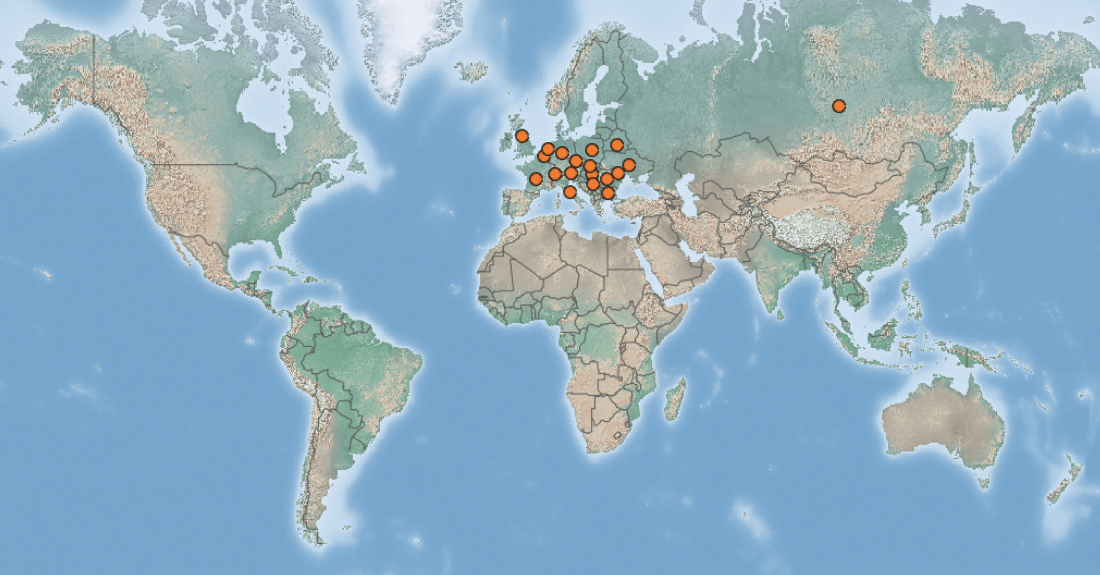
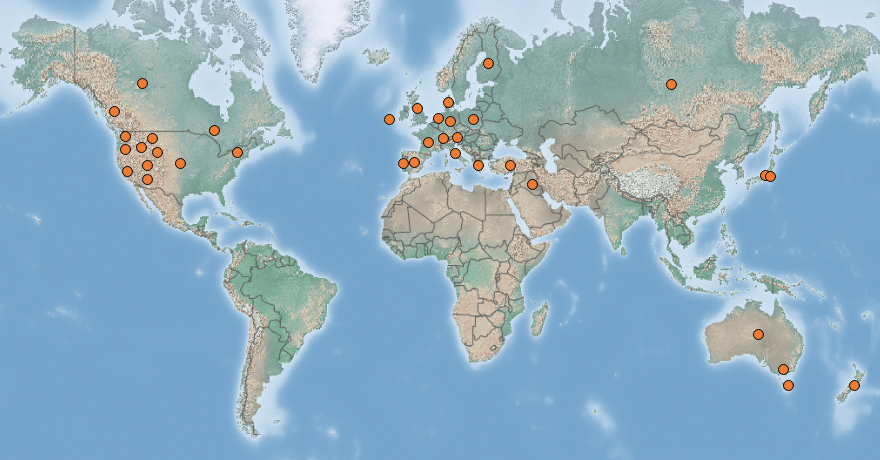
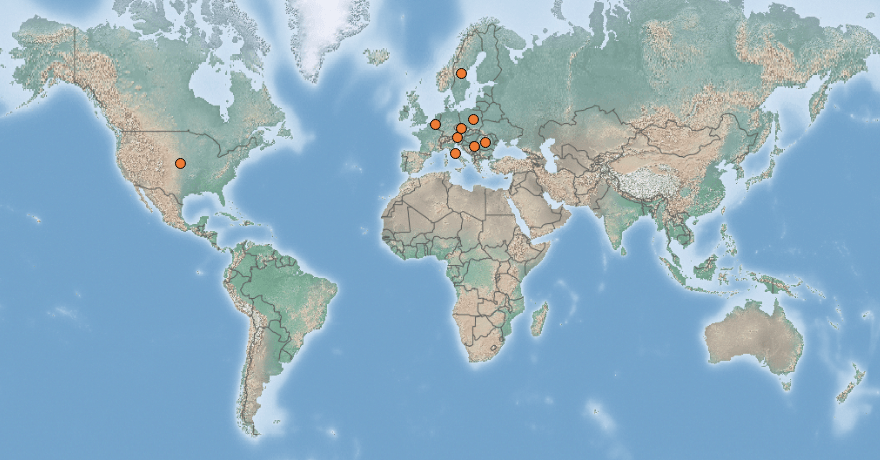
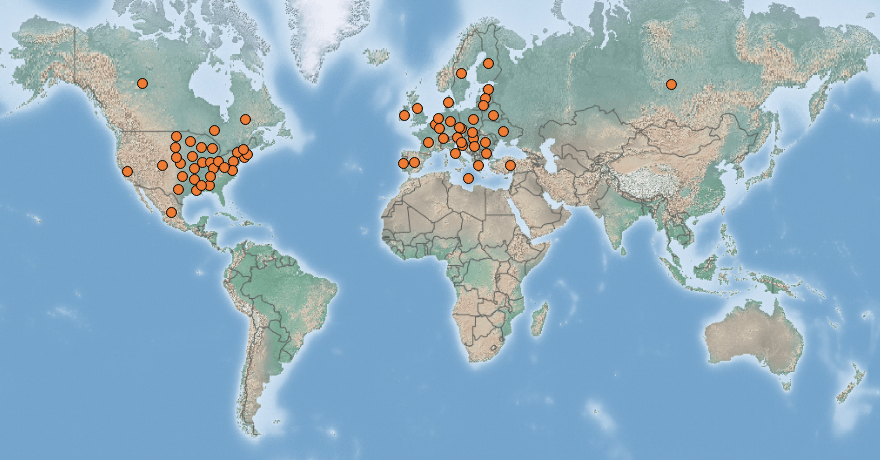
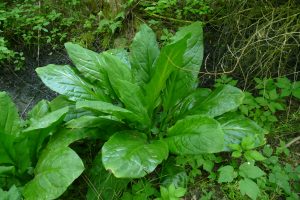
 The first observation of Lysichiton americanus in Luxembourg has been documented by C. Wolff via iNaturalist on 31st May 2022 and was confirmed by M. Oly on 2nd June in the Mamer valley close to Kopstal.
Page content last updated on 2022-06-07.
The first observation of Lysichiton americanus in Luxembourg has been documented by C. Wolff via iNaturalist on 31st May 2022 and was confirmed by M. Oly on 2nd June in the Mamer valley close to Kopstal.
Page content last updated on 2022-06-07.
On 28th January 2021, André Bauler and Max Hahn, Members of the Chamber of Deputies, addressed a parliamentary question to the Minister of the Environment regarding invasive alien species.
Page content last updated on 2025-10-11. Last proofread by Caroline Grounds on 2019-12-19.
 |
n/a | Status LU: established. 1st record: ? |
 |
n/a | Status Eur.: established. 1st record: ~2000 (NL). |
 |
n/a | RA: ISEIA: C2. Harmonia+: n/a. |
 |
Namenloser Rückenkanker | Wikipedia:   | Wikispecies: n/a (2020) | Wikispecies: n/a (2020) |
|
n/a | Back to the list of invertebrates |
Contents
 Since probably 2000, a completely unknown harvestman started its quick expansion through Central Europe. The species could be classified in the genus Leiobunum, but is different from other European species. It has been named provisionally as Leiobunum sp. (sensu Wijnhoven et al. 2007). It is assumed that it arrived with ships from overseas, probably reaching the Netherlands first. It is still unknown exactly where it came from (Wijnhoven et al. 2007).
The area of origin is unknown to date, since about 2000 the species has probably spread from the Netherlands into Western Germany on both sides of the Rhine valley to Switzerland and Vorarlberg (Wijnhoven et al. 2007), in the meantime also to Schleswig-Holstein (Staudt 2012).
Habitat: Primarily possibly a rock dweller, in Europe in habitats of anthropogenic origin: industrial wastelands, ruins and house walls (Wijnhoven et al. 2007). Leiobunum sp. generally tend to cluster together during the day. This behaviour is even more pronounced in the species in question. Mass aggregations of several hundreds of individuals have been observed. Many observations show that in spite of its high reproduction rate this “new” Leiobunum sp. seems to coexist well with indigenous species and integrates in the native fauna without great damage. But surely great colonies of the species compete for food with other similar predators.
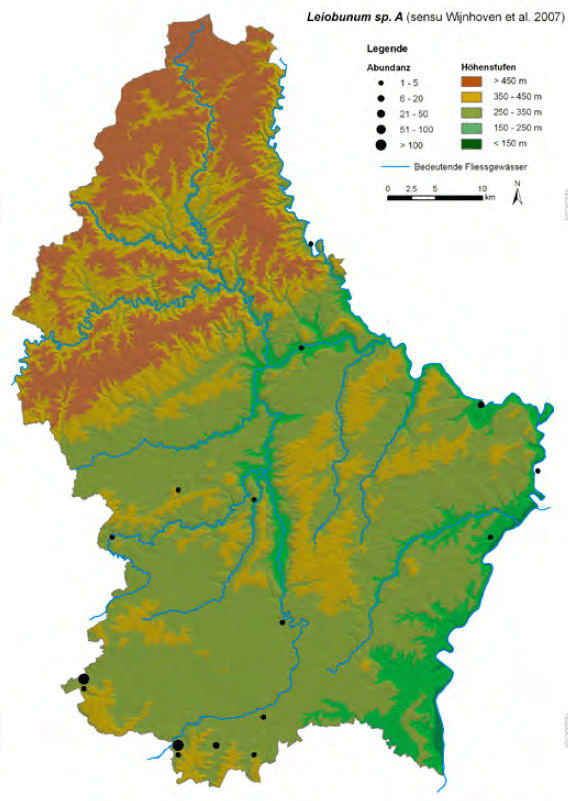
Distribution map of Leiobunum sp. in Luxembourg. Source: Muster & Meyer 2014: 80.
No records of Leiobunum sp. (sensu Wijnhoven et al. 2007) are present in the MNHNL-mdata portal (MNHNL, iNaturalist & GBIF, 2020).
Already widespread in the Gutland, Leiobunum sp. still largely absent in the Ösling (Muster & Meyer 2014: 79). In Luxembourg exclusively synanthropic, larger aggregations have so far only been observed on industrial ruins in the Minette area, in small numbers of individuals in many places on average house walls.
Remarks (Muster & Meyer 2014: 82): Due to the occurrence of mass aggregations with > 1000 specimens the species became the focus of media and sensation-hungry public after 2007. Suddenly, weavers were the focus of exhibitions, local publications, radio and television broadcasts. Wijnhoven et al. (2007) also warned urgently of an imminent invasion of unprecedented proportions and possible dramatic effects on the native opilionid fauna. A few years after this initial uncertainty, the situation is now much more relaxed. Despite the now widespread distribution in Luxembourg, no mass increases could be registered. Only in the former Goodyear test site near Esch-sur-Alzette and at industrial ruins near Rodange larger colonies of 100-200 specimens were sighted. Otherwise only smaller groups of maximum 10 specimens were observed, often only single specimens. It was noticeable that often only one dwelling house per small village was inhabited, while other similar houses remained unoccupied. In this context, observations from the Ruhr area seem interesting, according to which the animals show a preference for calcareous surfaces rich in structure (Toss 2010). The effects on other weaver’s apprentice species are also likely to be less severe than originally assumed. Leiobunum rotundum is often found at or even within aggregations of the Nameless Spine Anchor, while they even seem to evade Dicranopalpus ramosus (Wijnhoven 2011).
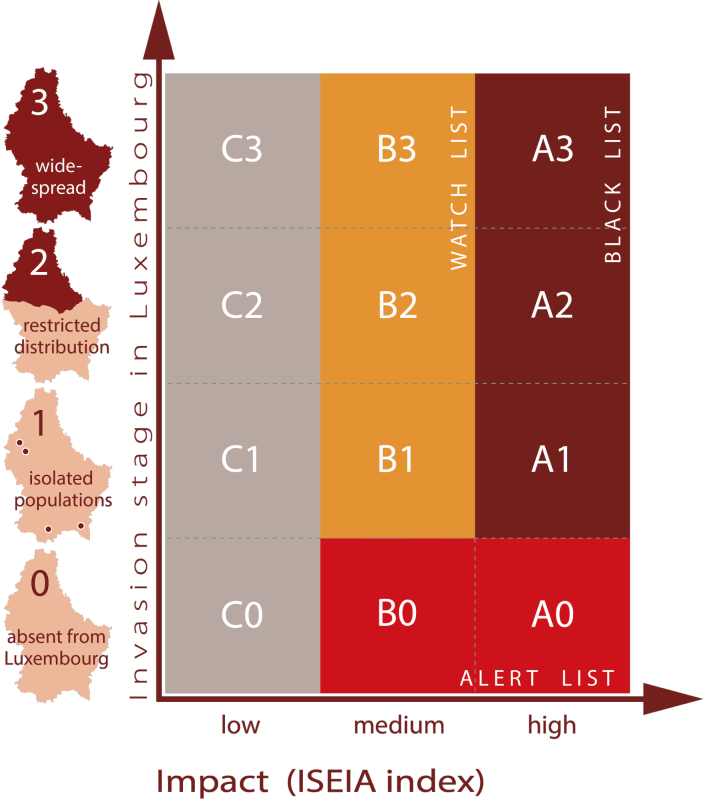
C2 (2+2+2+1) (Ries et al. 2017: 68).
Not assessed yet.
Page content last updated on 2020-03-05. Last proofread by Caroline Grounds on 2019-12-10.
|
Killer shrimp | Status LU: present. 1st record: 2006. |
|
Killercrevette | Status Eur.: established. |
|
Crevette tueuse | RA: ISEIA: A1, Black List. Harmonia+: 0,50 |
|
Großer Höckerflohkrebs | Wikipedia:  | Wikispecies: n/a (2020) | Wikispecies: n/a (2020) |
|
Pontokaspische Vlokreeft | Back to the list of invertebrates |
Contents
.jpg) Dikerogammarus villosus (Sowinsky, 1894) is a freshwater amphipod originating from the Ponto-Caspian region. Its range expansion began in the late twentieth century and was associated with re-opening of the shipping canal between the Danube River and Main River (Vaate et al., 2002). Large body size, extremely voracious predatory behaviour, high fecundity and wide environmental tolerance make this amphipod a very successful invader of European waters. Invasion of D. villosus often results in significant local reduction or even extinction of native amphipods and other macroinvertebrates on which it preys (CABI 2019).
Dikerogammarus villosus (Sowinsky, 1894) is a freshwater amphipod originating from the Ponto-Caspian region. Its range expansion began in the late twentieth century and was associated with re-opening of the shipping canal between the Danube River and Main River (Vaate et al., 2002). Large body size, extremely voracious predatory behaviour, high fecundity and wide environmental tolerance make this amphipod a very successful invader of European waters. Invasion of D. villosus often results in significant local reduction or even extinction of native amphipods and other macroinvertebrates on which it preys (CABI 2019).
D. villosus is included on the list of the 100 most invasive exotic species of Europe (Devin & Beisel 2009).
Dikerogammarus villosus (Sowinsky, 1894) was first recorded in 2006: several specimen collected on 2006-05-12 in the river Moselle near Stadtbredimus were discovered in the Museums collections in July 2021 (Weigand in litt.). Another observation was made on 2018-06-20 in the river Sure near Wasserbillig / Langsur (MNHNL, iNaturalist & GBIF 2021). Accordingly, the Killer shrimp has been moved from the Alert List (Ries et al. 2017: 68) to the Black List.
Following the discovery of the Killer shrimp in July 2021 in the Museums collections (Weigand in litt.), the species was reassessed on 2021-07-29 to A1 (3+2+3+3) = Black List by C. Ries. Initial assessment: A0 (3+2+3+3) = Alert List (Ries et al. 2017: 68).
 InvasionImpactRisk
Page content last updated on 2024-03-06. Last proofread by Caroline Grounds on 2019-12-10.
|
New Zealand mud snail | Status LU: established. 1st record: 1996. |
|
Neiséilännesch Zwergdeckelschleek | Status Eur.: established. |
|
Hydrobie des antipodes | RA: ISEIA: A3, Black List. Harmonia+: n/a. |
|
Neuseeländische Zwergdeckelschnecke | Wikipedia: | Wikispecies: n/a (2020) | CABI |
|
Jenkins’ waterhoren | Back to the list of invertebrates |
Contents
 Potamopyrgus antipodarum (Gray, 1843) is an aquatic snail native to New Zealand. It has been introduced to Europe, North America, Australia, Iraq, Turkey and Japan. In several ecosystems it is considered invasive because it becomes highly abundant, impacting the structure and function of the invaded ecosystems. Females are parthenogenetic, meaning they can reproduce without males, so a population can be founded by a single female. Most the non-native populations are female. There can be up to six generations per year, with an average number of 230 offspring per adult per year. P. antipodarum can also tolerate desiccation for several days, which allows for rapid spread (such as by birds and fishing tools) throughout different aquatic ecosystems. In several countries, including Spain, USA and Australia, it is considered as an invasive species (CABI 2019).
Records of Potamopyrgus antipodarum (Gray, 1843) in Luxembourg. Data source: Recorder-Lux, iNaturalist & GBIF, 2026-05-26.
Currently, 52 records of the New Zealand mud snail are accessible through the MNHNL-mdata portal (MNHNL, iNaturalist & GBIF 2019).
A3 (3+2+3+3) = Black List (Ries et al. 2017: 68).
Not assessed yet.
Page content last updated on 2020-04-21.
|
Chinese pond mussel | Status LU: absent. |
|
Chinesesch Weiermuschel | Status Eur.: established. |
|
Anodonte chinois | RA: ISEIA: C0. Harmonia+: n/a. |
|
Chinesische Teichmuschel | Wikipedia: | Wikispecies: n/a (2020) | CABI |
|
n/a | Back to the list of invertebrates |
Contents
 Sinanodonta woodiana (Lea, 1834) is a species of freshwater mussel, an aquatic bivalve mollusk in the family Unionidae, the river mussels. The Chinese pond mussel can reach sizes of up to 30 cm and an age of 12–14 years. Yet, they can reproduce in their first year while only 3–4 cm in size. This large freshwater mussel is a habitat generalist with high silt tolerance. It is established worldwide despite having, like all unionid mussels, an obligatory parasitic stage (glochidium), which must encyst on host fish. The species is a broad host generalist, which can complete its development on all fish species tested, both coinvasive and native. The presence of S. woodiana can seriously influence indigenous unionid populations. Sinanodonta woodiana’s great success is attributed to importation and commercialization of Asian carp, its native host. S. woodiana was introduced in Tuscany both inadvertently, and for artificial pearl production. The species is also sold in garden centers as biofiltration for artificial ponds (CABI 2019).
Sinanodonta woodiana (Lea, 1834) has not yet been observed in Luxembourg (MNHNL, iNaturalist & GBIF 2020).
A flyer about invasive mussels has been published by natur&ëmwelt.
C0 (2+1+2+1) (Ries et al. 2017: 68).
Not assessed yet.
Page content last updated on 2024-09-09.
|
Zebra mussel | Status LU: established. 1st record: <1892. |
|
Zebramuschel | Status Eur.: established. |
|
Moule zébrée | RA: ISEIA: A2, Black List. Harmonia+: n/a. |
|
Zebramuschel | Wikipedia: | Wikispecies: n/a | CABI |
|
Driehoeksmossel | Back to the list of invertebrates |
Contents
_0265_(39449820624).jpg) To date, D. polymorpha has been the most aggressive freshwater invader worldwide. Dreissenids are the only freshwater bivalves that attach to hard substrates in high densities and have a planktonic larval stage. This life history facilitates their abilities as invaders, and allows them to become enormously abundant when introduced into a new water body. Once introduced their populations can grow rapidly, and the total biomass of a population can exceed 10 times that of all other native benthic invertebrates. D. polymorpha is native to the drainage basins of the Black, Caspian and Aral Seas. During the nineteenth century its range has expanded westward to most of western Europe, the UK, and North America, where it is found in the Great Lakes and all major river drainages east of the Rocky Mountains and causes multiple economic impacts on fisheries, aquaculture, water attractions and aquatic transport (CABI 2019).
To date, D. polymorpha has been the most aggressive freshwater invader worldwide. Dreissenids are the only freshwater bivalves that attach to hard substrates in high densities and have a planktonic larval stage. This life history facilitates their abilities as invaders, and allows them to become enormously abundant when introduced into a new water body. Once introduced their populations can grow rapidly, and the total biomass of a population can exceed 10 times that of all other native benthic invertebrates. D. polymorpha is native to the drainage basins of the Black, Caspian and Aral Seas. During the nineteenth century its range has expanded westward to most of western Europe, the UK, and North America, where it is found in the Great Lakes and all major river drainages east of the Rocky Mountains and causes multiple economic impacts on fisheries, aquaculture, water attractions and aquatic transport (CABI 2019).
Records of Dreissena polymorpha (Pallas, 1771) in Luxembourg. Data source: Recorder-Lux, iNaturalist & GBIF, 2026-05-26.
An identification sheet of the species has been published by the MECDD in French and German. A flyer about invasive mussels has been published by natur&ëmwelt.
A2 (3+3+3+3) = Black List (Ries et al. 2017: 68).
Not assessed yet.
Page content last updated on 2024-09-09.
|
Chinese mitten crab | Status LU: casual. 1st record: 1978. |
|
Chinesesch Wollhandkrabb | Status Eur.: established. IAS of EU concern (2016). |
|
Crabe chinois | RA: ISEIA: C0. Harmonia+: n/a. |
|
Chinesische Wollhandkrabbe | Wikipedia: | Wikispecies:  | IUCNGISD | CABI | IUCNGISD | CABI |
|
Chinese wolhandkrab | Back to the list of invertebrates |
Contents

Male specimen of Eriocheir sinensis. Photo by Christian Fischer, 2007-10-06, North-western Brandenburg, Germany. commons.wikimedia.org
In 2016, Eriocheir sinensis H. Milne-Edwards, 1853 was added to the list of invasive alien species of Union concern (Anonymous 2016) which implies that member states shall take all necessary steps to prevent it’s unintentional introduction or spread.
Records of Eriocheir sinensis H. Milne-Edwards, 1853 in Luxembourg. Data source: Recorder-Lux, iNaturalist & GBIF, 2026-05-26.
Eriocheir sinensis H. Milne-Edwards, 1853 was first documented in Luxembourg in 1978 by Claude Meisch who found one individual in a pond of the Haff Réimech nature conservation reserve, municipality of Schengen (Meisch 1978): “It can be regarded as relatively common in the Moselle valley. A single specimen was found in the pond area. It must be regarded as an aberration, since the ponds do not correspond to its normal location”.
Field research by Dhur and Massard in the years 1992-1993 did not find Eriocheir sinensis in the ecosystem of the border Moselle (Dhur & Massard 1995): “It seems likely that currently the species, even if its presence seems confirmed for the period before 1960, no longer populates the waters of the Luxembourg Moselle. A call to fishermen in 1994 (Massard 1994)1 for them to report a possible presence of Eriocheir did not produce any results. In fact, after its expansion phase, Eriocheir has become considerably scarcer over the past forty years in most of the colonised areas of northern France and the Benelux (Vigneux et al. 1993). No E. sinensis stations are indicated in Lorraine by Vigneux et al. (1993), neither for the period before 1960 nor for the one after.”
On 4 March 2020, two adult crabs of the species Eriocheir sinensis (1 male and 1 female) were found by an inhabitant of the ‘Petite rue du Moulin’ in Esch-sur-Alzette.The crabs were brought to the National Museum of Natural History.

Two adult Eriocheir sinensis (1 male and 1 female) found in Esch-sur-Alzette. Photo: 4 March 2020, Déierenasyl Gaasperech.
C0 (2+1+2+2) (Ries et al. 2017: 68).
Not assessed yet.

CABI 2014: https://www.cabi.org/isc/datasheet/84120#toDistributionMaps
Page content last updated on 2020-03-12. Last proofread by Caroline Grounds on 2019-12-10.
|
Buffalo treehopper | Status LU: established. 1st record: 2002. |
|
Büffel-Zikad | Status Eur.: established. |
|
Cicadelle bison | RA: ISEIA: C2. Harmonia+: n/a. |
|
Büffelzikade | Wikipedia: | Wikispecies: n/a (2020) |
|
Buffelcicade | Back to the list of invertebrates |
Contents
 Stictocephala bisonia Kopp & Yonke, 1977 is a species of treehopper belonging to the subfamily Membracinae. It is also sometimes classified as Ceresa bisonia. This species is native to North America, but now it is widespread throughout southern Europe and it is also present in the Near East and in North Africa. Both adult and immature buffalo treehoppers feed upon sap using specialized mouthparts suited for this purpose. Black locust, clover, elm, goldenrod, and willow are among their favorite food sources. It is also an occasional pest of fruit trees and is harmful to young orchard trees, especially apple trees. It has become an invasive species in some parts of Europe (Wikipedia contributors 2020).
Records of Stictocephala bisonia Kopp & Yonke, 1977 in Luxembourg. Data source: Recorder-Lux, iNaturalist & GBIF, 2026-05-26.
Stictocephala bisonia Kopp & Yonke, 1977 was first documented by Robert Biedermann on 15th September 2002 near Remerschen, municipality of Schengen (MNHNL 2000-).
Currently, 61 records of the buffalo treehopper in Luxembourg are accessible through the MNHNL-mdata portal, most of them in the Gutland, the southern half of the country (MNHNL, iNaturalist & GBIF 2021).
C2 (2+1+1+1) (Ries et al. 2017: 69).
Not assessed yet.
Page content last updated on 2021-12-13.
|
Andromeda lace bug | Status LU: casual. 1st record: 2019. |
|
Andromeda-Netzwanz | Status Eur.: established. |
|
n/a | RA: ISEIA: C1. Harmonia+: n/a. |
|
Andromeda-Netzwanze | Wikipedia:  | Wikispecies: n/a (2020) | Wikispecies: n/a (2020) |
|
Rotsheidenetwants | Back to the list of invertebrates |
Contents
,_Mook,_the_Netherlands_-_2.jpg) Stephanitis takeyai Drake & Maa, 1955 is a pest insect on plants of the genus Pieris, especially Pieris japonica, the Japanese andromeda. It originated in Japan with its host plant but has since been introduced to other areas of the globe. The andromeda lace bug is about 3 millimeters in length. It has a characteristic rounded pronotum, lacy black and white wings, and shiny gold highlighting. The bug produces mottling on the leaves of the plant, and heavy infestations can cause the leaves to drop in large numbers, stunting the plant’s growth. Both nymph and adult forms damage the leaves by piercing them to suck the juices, and leave dark frass on the undersides of the leaves. Damage is worst on plants that grow in full sun (Wikipedia contributors 2018).
Stephanitis takeyai Drake & Maa, 1955 is a pest insect on plants of the genus Pieris, especially Pieris japonica, the Japanese andromeda. It originated in Japan with its host plant but has since been introduced to other areas of the globe. The andromeda lace bug is about 3 millimeters in length. It has a characteristic rounded pronotum, lacy black and white wings, and shiny gold highlighting. The bug produces mottling on the leaves of the plant, and heavy infestations can cause the leaves to drop in large numbers, stunting the plant’s growth. Both nymph and adult forms damage the leaves by piercing them to suck the juices, and leave dark frass on the undersides of the leaves. Damage is worst on plants that grow in full sun (Wikipedia contributors 2018).
“Stephanitis takeyai is an invasive Tingidae native to Japan. It was introduced to Europe in 1994 through the plant trade in the Netherlands with its feeder plant Pieris japonica (Aukema 1996). It reached Germany in 2002 (Baufeld 2002), Belgium in 2003 (Aukema et al. 2005) and France in 2004 (Streito 2006)” (Schneider 2020).
Stephanitis takeyai Drake & Maa, 1955 was first found on 24th June 2019 in the kitchen of a private house in Roeser. The often open door of this kitchen communicates with a garden in which grows Pieris japonica (the Japanese andromeda), the host plant of the Andromeda lace bug (Schneider 2020: 100).
Following its discovery in Luxembourg in 2019, the species has been reassessed on 14th September 2020 to C1 (3+1+1+1) by Christian Ries. Assessment before the appearance of the species in Luxembourg: C1 (3+1+1+1) (Ries et al. 2017: 69).
InvasionImpactRiskPage content last updated on 2024-03-06.