 |
Status LU: present | |
 |
Status Eur.: established. | |
 |
RA: ISEIA: n/a. Harmonia+: n/a. | |
 |
Granataugen-Flohkrebs | Wikipedia: / | Wikispecies:/ |
 |
Back to the list of invertebrates |
Report the species
→ Report Chaetogammarus ischnus to the National Museum of Natural History.
Brief description
Chaetogammarus ischnus (Stebbing, 1899) is a fresh and brackish water gammarid amphipod native to the Black and Caspian Sea basins and the surrounding inflowing rivers. It is a small, slender species with a body length of up to 12 mm. It is introduced in parts of Europe and North America. The species tolerates a wide temperature range, from near-freezing to above 30°C. It ranges widely into freshwater, but is sensitive to water of low ionic content (conductivity). In its introduced range, E. ischnus is abundant on rocky and cobble shores, but especially favors clumps of Zebra and Quagga Mussel shells. It is not strongly associated with vegetation. In living specimens, the eyes are bright red, the antennae are orange, and the body is translucent and reddish. The antennae are long and hairy. Its preferred habitats are the lower reaches of larger rivers and streams, canals, and lakes. The species competes with native amphipods for habitat and food. There are no known significant negative impacts on other species groups. Chaetogammarus ischnus occurs sporadically in Germany but is often found in high densities on rock embankments in waterways (e.g., the Rhine and Havel), where it is frequently the dominant species alongside Dikerogammarus villosus. It is a predatory omnivore (feeding on other small animals, insect larvae, algae, aquatic plants and fish eggs). The Dreissena invasion in Europe and the Great Lakes-St. Lawrence River may have facilitated the spread of E. ischnus by providing shelter from predation (Fofonoff et al. 2018, Müller et al 2018, Kanton Aargau 2026).
Status and distribution in Luxembourg
Records of somethingelse in Luxembourg. Data source: Recorder-Lux, iNaturalist & GBIF, 2026-10-20.
Among invasive amphipods, the Pontocaspian species Chaetogammarus ischnus showed an increase in its population between 2018 and 2023, with high prevalence in the Moselle (from Stadtbredimus to Wasserbillig) and the Saar (monitoring by the LfU Rhineland-Palatinate State Office for the Environment).
Risk assessment
ISEIA protocol
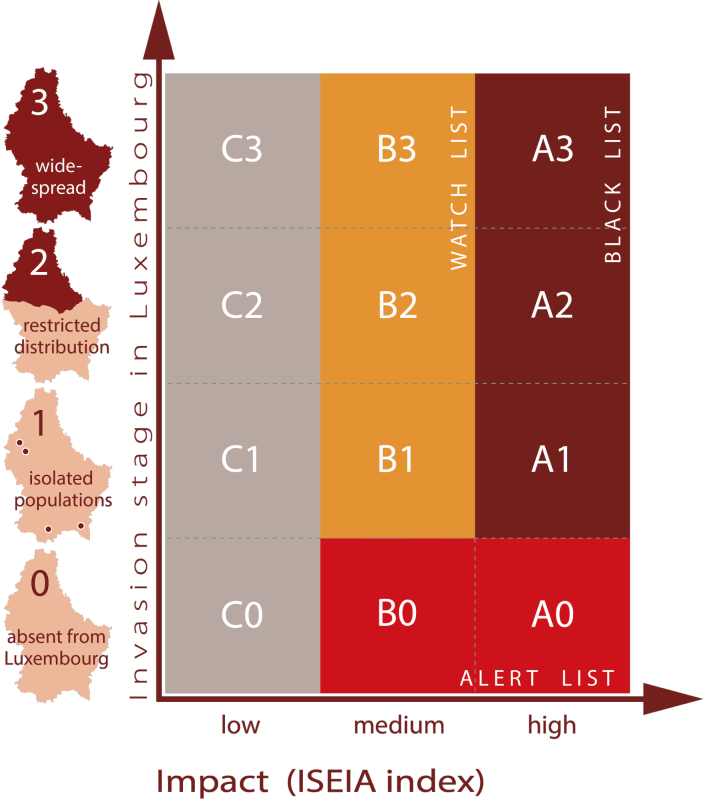
no assessed yet
Harmonia+ protocol
no assessed yet
Worldwide distribution
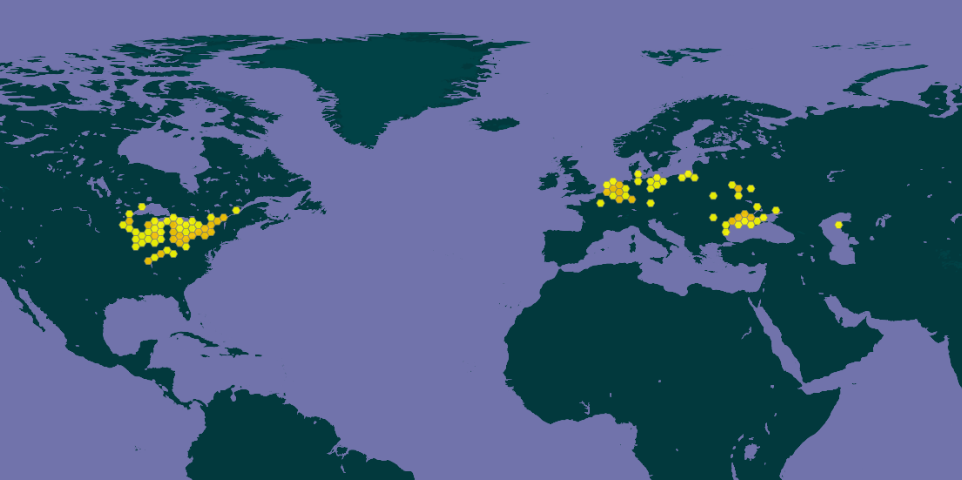
GBIF: https://www.gbif.org/taxon/TC9N#map
Bibliography
- Fofonoff PW, Ruiz GM, Steves B, Simkanin C, & Carlton JT (2018): National Exotic Marine and Estuarine Species Information System. https://invasions.si.edu/nemesis. Access Date: September 24, 2026
- Kanton Aargau, 2026. Neobiota in Gewässern, https://www.ag.ch/de/themen/umwelt-natur/neobiota/neobiota-in-gewaessern?jumpto=Njc1NzcwMC9iZDMxMzc3YS0wMzdjLTQ0NTYtOWEyYS0xODA0MmM0OGNjZjM [Accessed 2026-08-18]
- Müller, R., C. Wolter & T. Peschel, 2018. Neobiota in Berliner Gewässern im Jahr 2018, Wirbellose Tiere, Fische und Wasserpflanzen, Planungsbüro Hydrobiologie Berlin, Im Auftrag der Senatsverwaltung für Umwelt, Verkehr und Klimaschutz, Abteilung Integrativer Umweltschutz, Referat Wasserwirtschaf, pp. 143.
Suggested citation of this webpage
Ries, C. & M. Pfeiffenschneider (Eds.), 2026. Chaetogammarus ischnus (Stebbing, 1899). In: neobiota.lu - Invasive Alien Species in Luxembourg. National Museum of Natural History, Luxembourg. URL: https://neobiota.lu/echinogammarus_ischnus/ [Accessed 2026-10-20].
Page content last updated on 2026-09-24.